Sector: Defense & Aerospace
Basic Details
• Market Cap: ₹513 crores
• Issue Price: ₹110
• Current Price: ₹426
• Listing Date: March 18, 2026
Company Overview
Apsis Aerocom is a Bengaluru-based precision engineering company manufacturing highly complex machined components for the defense, aerospace, and healthcare industries. Unlike conventional engineering, Apsis focuses on low-volume, high-value, mission-critical components where precision, repeatability, and engineering expertise are more important than scale. The company offers end-to-end manufacturing, from engineering interpretation of customer drawings and CAD/CAM programming to machining, inspection, assembly, and final delivery. It is certified under AS9100D and ISO 9001:2015 and claims to have maintained approximately 99.99% manufacturing accuracy over the last three years.
Rather than competing on cost, the company competes on manufacturing know-how. This positions it as a niche supplier within India’s rapidly growing aerospace and defense manufacturing ecosystem.
Products & Customers
Apsis manufactures precision turned, milled and multi-axis machined components for defense, aerospace, and healthcare OEMs. It operates advanced 3-axis, 5-axis and multitasking CNC machines capable of producing geometrically complex parts with tight tolerances.
The company supplies components primarily to defense and aerospace OEMs.
FY26 revenue mix:
-
Defense – 66%
-
Aerospace – 26%
-
Healthcare – 8%
Although customer names are largely confidential due to NDAs, management highlighted that customer additions are increasingly coming through industry referrals rather than cold marketing. During FY26 it added 4 new customers, demonstrating growing industry acceptance.
Financial Performance
FY26 was a decent year.
| Metric | FY25 | FY26 | Growth |
|---|---|---|---|
| Revenue | ₹20.5 Cr | ₹30.6 Cr | +50% |
| EBITDA | ₹10.2 Cr | ₹11.4 Cr | +12% |
| PAT | ₹6.6 Cr | ₹7.5 Cr | +14% |
The business continues to generate unusually high operating margins for a precision manufacturing company.
However, EBITDA margin declined from nearly 50% to 37%, while PAT margin reduced from 32% to 24.5%, largely because of investments in manpower and preparing capacity for future growth rather than deterioration in pricing.
Despite margin moderation, profitability remains decent within some of the listed precision engineering companies.
Growth Drivers
1. Strong order visibility
Current executable order book stands at approximately ₹40.5 crore, exceeding FY26 revenue.
Management further disclosed an opportunity pipeline exceeding ₹100 crore with roughly 30% historical conversion. Importantly, the limiting factor today is capacity rather than demand.
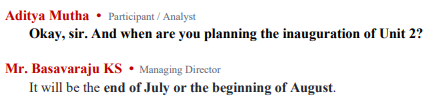
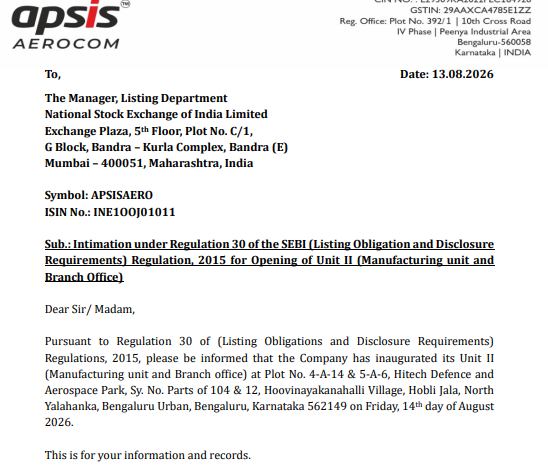
2. Unit II expansion
IPO proceeds are funding a second manufacturing facility inside Bengaluru’s Defense & Aerospace Park.
Highlights:
-
20,000 sq.ft facility
-
Around 1.8 lakh component annual capacity
-
New advanced machines and inspection equipment
-
Focus on aerospace and defense machining
Management expects FY27 utilization to initially remain below 50%, leaving significant room for operating leverage over the following years.
3. Long runway
The company has already received allotment of approximately 40,000 sq.ft of industrial land for a future Unit III, indicating management is planning several years ahead rather than merely expanding for current demand.
Management has articulated an ambitious aspiration of reaching ₹500 crore annual revenue by FY31, although we should treat this as a long-term target rather than guidance.
Competitive Moats
Several aspects differentiate Apsis from a typical CNC jobs.
Engineering capability
Customers provide CAD designs, but manufacturing process planning (CAM), machining strategy and optimization remain Apsis’ intellectual property. The engineering process, from simulation to validated production, creates switching costs.
Sole-source supplier
Management disclosed that approximately 40% of revenue comes from components where Apsis is currently the exclusive supplier, while many remaining products face only one or two domestic competitors.
High entry barriers
Developing complex aerospace components reportedly requires years of manufacturing expertise rather than simply purchasing advanced machines. Management stated that competing suppliers have attempted but failed to qualify several of these components over the past five years.
Customer stickiness
Once qualification is complete, defense & aerospace suppliers tend to enjoy long product life cycles because customers prefer avoiding requalification unless necessary. Combined with quality consistency and delivery performance, this creates recurring business.
Management & Promoter Quality
The promoters come from technical machining backgrounds.
Their experience lies in CNC programming, precision machining, manufacturing engineering and production operations, with over two decades of industry experience.
Encouraging observations:
-
In spite of being such a small company, the management is doing investor calls.
-
Conservative commentary regarding FY27 capacity utilization.
-
Significant investment into R&D (7–10% of revenue) with a dedicated engineering team of 15–20 people.
-
Preference for equity over excessive leverage to preserve profitability.
However, one should recognize that this remains a relatively young listed SME company, so long-term capital allocation and governance track record are still evolving.
Risks & Red Flags
While the business quality appears attractive, one should monitor several risks:
Customer concentration: Although improving, the top customer still contributes 35.6% of revenue, and the top five account for 87%, making customer loss a meaningful risk.
Execution risk: The investment thesis depends heavily on successful commissioning and ramp-up of Unit II.
Aggressive long-term aspiration: Management’s target of ₹500 crore revenue by FY31 implies extraordinary growth from the current ₹30 crore base. While may be achievable in theory given capacity additions, it remains highly ambitious and should not be embedded into valuation assumptions.
Defense dependency: Nearly two-thirds of revenue now comes from defense. Any slowdown (although unlikely) in defense procurement or customer program delays could affect growth.
SME liquidity: As an NSE SME-listed company, trading liquidity remain limited, potentially share price volatility or even loss of capital. Small and microcap stocks carry very high risk due to their smaller size, limited operating history.
Investment Thesis
Apsis Aerocom is emerging as a niche precision engineering company benefiting from structural growth in India’s defense and aerospace manufacturing ecosystem. Unlike conventional engineering companies that compete on machining capacity alone, Apsis appears to compete on manufacturing know-how, complex process engineering and long customer qualification cycles.
The most attractive aspect of the business is that demand currently appears constrained by manufacturing capacity rather than customer demand or the acquisition. If Unit II ramps up successfully and management continues converting its sizeable order pipeline into revenue while maintaining healthy margins, earnings could compound meaningfully over the next several years.
That said, we should temper expectations around management’s ₹500 crore FY31 aspiration and instead monitor measurable milestones such as Unit II utilization, customer diversification, margin sustainability, and order book growth. Successful execution on these metrics would provide stronger evidence that Apsis can evolve from a high-quality SME into a scalable defense & aerospace manufacturing platform.
Disclaimer
Invested, biased. Not a buy or investment recommendation. Not a SEBI registered financial advisor.
The above information is drawn from a combination of sources such as their website, recent investor presentation, and the investor conference call. Used IT tools for the synthesis of notes. Open to correct the post if there are any unintentional errors.
APSIS2025_08062026175813_NSEintimation_Earningscall_Transcript_05062026_signed.pdf
APSIS2025_29052026150034_Investor_presentation_Apsis.pdf
This analysis is for educational purposes only. Always conduct your own research or consult with SEBI registered financial advisors before making any decisions.