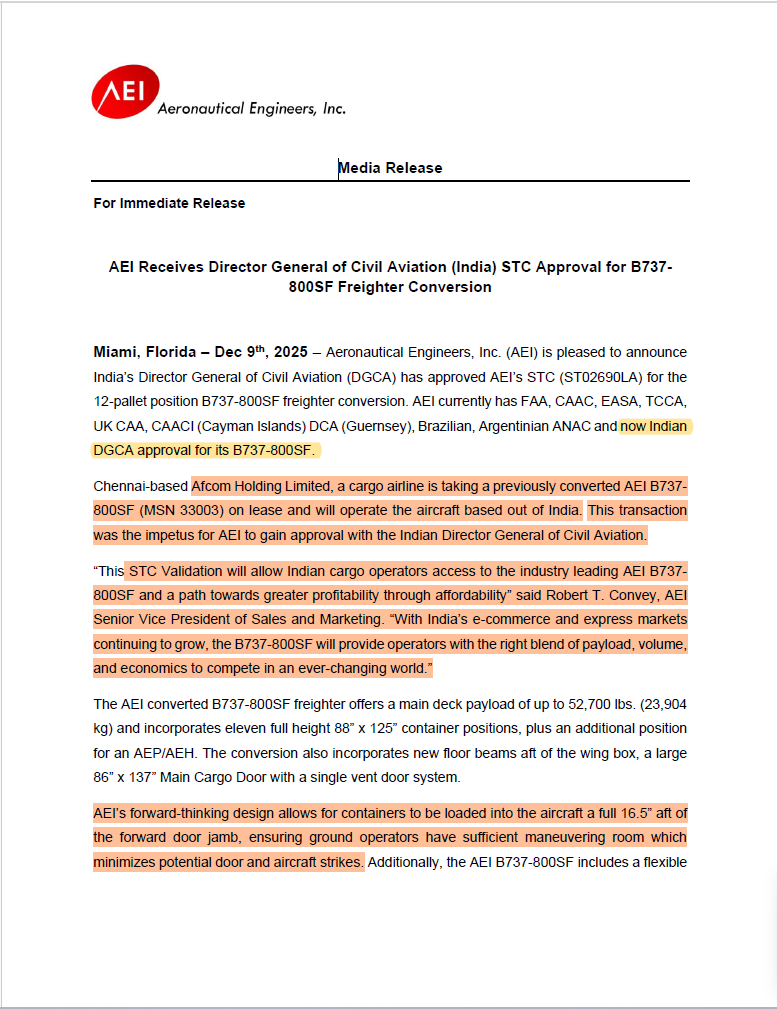
Before we being – I would like to thank @ satishwe & @rajpanda for discussing Afcom Holdings on their personal threads and bringing this company to my attention. Now let’s get started.
Introduction - Afcom Holdings is an air cargo company founded by Captain Deepak Parasuraman in late 2013. A seasoned cargo pilot with over 10,000 flight hours, Capt. Deepak has played a pioneering role in the Indian air cargo sector since the early 2000s. He was among the promoters of Crescent Air Cargo in 2004 and, prior to establishing Afcom, worked on multiple consulting engagements with Lufthansa, Sukhoi and many others. He is also the co-founder of FlySBS, a publicly listed private aircraft charter company.
Afcom, is a pure play freighter airline. I highlighted those two words for a reason. First as the name suggests it is a pureplay freighter. Not a logistics company like Blue Dart, Delhivery or any other end to end logistics partner. Second, it is a no frills airline. It is in the business of leasing planes, hiring a crew and flying from Location A to B. and that’s it, nothing more. So any comparisons to a DHL / Blue Dart or other logistics provider is not a like to like comparison.
The company’s TTM performance signals a decisive breakout from its SME roots. Revenue surged 136% year-over-year (YoY) to ₹390 Crores, while Net Profit expanded by 163% to ₹85 Crores, reflecting a robust Net Profit Margin (NPM) of over 21%. This kind of margin profile is unheard of in the aviation industry and deserves a closer look.
The Airport to Airport business Model – Afcom is not a logistics company. They are not FedEx, or Blue Dart. They do not have a multi-modal infrastructure for end to end logistics solutions. They operate strictly on an Airport-to-Airport basis.
The operational workflow is distinct and is best illuminated through an example -
The Shipper: A factory in Chennai makes an automotive transmission part.
The Freight Forwarder: Companies like DHL Global Forwarding, Kuehne+Nagel, or local players collect the goods.
The GSSA (The Middleman): This is the critical link. Afcom does not maintain a massive sales force. Instead, they use General Sales and Service Agents (GSSAs) to fill capacity.
Air Logistics Group Represents Afcom in Far Eastern countries (Singapore, Vietnam, etc.), Taylor Logistics Represents Afcom in India.
The Airline (Afcom): The GSSA books the space on Afcom’s plane. Afcom flies the plane.
The Destination: A handling agent at the destination airport unloads the pallet, and the freight forwarder takes over for the “last mile.”
The Genius of the GSSA Contract - The most compelling aspect of Afcom’s business model is the risk mitigation embedded in these GSSA contracts. Afcom doesn’t chase cargo directly thereby keeping it’s sales and marketing costs at a minimum. Instead, it partners with General Sales & Service Agents (GSSAs) in India, Hong Kong, Singapore, Japan, Korea and beyond. These agents bring in business from freight forwarders like DHL and Blue Dart — and Afcom just flies it airport-to-airport. From the shipper to the freight forwarder, through GSSAs (General Sales & Service Agents) and handling agents, onto the airline (Afcom), and finally via another freight forwarder to the consignee. Afcom’s business is focused purely on taking cargo sourced from GSSAs and delivering it to handling agents at the destination airport.
Each flight carries a Minimum Guaranteed Return (MGR) of about 50% of capacity from these GSSAs. The GSSA contractually agrees to pay the airline a minimum amount of revenue (50%) for a given flight, regardless of how much cargo the GSSA actually manages to sell and load onto the aircraft. This is at the core of Afcom’s risk transfer of a low load factor to the GSSAs.
Afcom contractually commits 50% of its cargo capacity on all flights to GSSAs (In practice the GSSA’s usually fill the plane to 80% + of capacity) and the remaining capacity (If any) is sold on a spot basis.
The Sky High promises – The management team, led by Captain Deepak, has outlined an aggressive roadmap. They are not content with being a niche player; they want to be a global logistics entity that dominate certain geographies. That being said, Capt. Deepak seems to have a history of biting more than he can chew and the same is reflected in the forward looking guidance he provides. Take a look at his earnings call more than a year ago (H1 FY25) as proof of my above assertion. The guidance provided was overly optimistic and disregarded the fact that a lot of things (such as Govt. approvals, Airworthiness certifications etc.) are not in their control and it’s therefore unwise to guide the market on timelines that are not in one’s control . His future guidance & especially timelines therefore should be viewed as (to put it mildly) - vision-led guidance, not calendar-led guidance 
That being said let’s dig deeper into the guidance provided and how they might achieve it –
FY 26 Revenue goal - ₹1000 – ₹1200 Cr
For Context
FY 25 Revenue = ₹239 Cr.
So how is Afcom going to get there ?
Unit economics (Per Plane) –
In Q1 FY 26 – Revenue = 118.8 Cr.
Total operational aircrafts in Q1 = Two Boeing 737-800.
Therefore total aircraft months in Q1 = 3 months x 2 aircrafts = 6 aircraft months.
Revenue per aircraft per month = 118.8 / 6 = 19.8 cr .
This broadly aligns with management commentary about 18-20 Cr. Of revenue per aircraft on a dry lease (depending on load factor). Although there can be several ways to derive this number with Revenue / aircraft varying between 16 – 20 Cr. Let’s assume the revenue is 18 Cr. per month / aircraft.
Revenue per year per aircraft = 18 x 12 = 216 Cr.
Management hopes to add three additional 737-800s by the end of the FY. Taking the total fleet strength to five. Per DGCA, when a carrier has five or more aircrafts it makes them a scheduled operator which has the advantages of getting fixed slots assigned, 1% less tax on fuel (UDAN scheme), zero landing charges at RCS airports, better and more favorable financing options etc.
Although the fleet strength is expected to rise from two to five, Management commentary seems to suggest that only 4 of the aircrafts will be sweated at the current rate and the 5th is mainly going to be a backup/spare and is expected to make less than 3-4 roundtrip flights / week. Redundancy unfortunately is necessary in the aviation industry.
Back to the guidance – 4 Aircrafts earning 18cr per month = 4 x 18 x 12 = 864Cr + 1 aircraft at 50% capacity utilization = 108 Cr. Total revenue = 864 +108 =972Cr.
In summary the approx. 1000 Cr revenue guidance isn’t unrealistic albeit a year late as this is the theoretical FY 27 revenue not FY 26 like the management guided. But hey! what’s a year between friends 
Growth Aspirations – The management team has articulated a two-phase growth strategy for the company.
Phase 1 (Near Term):
Increase fleet strength from two Boeing 737-800 aircraft to five, each with a cargo capacity of approximately 22 metric tons.
Phase 2 (FY28):
Introduce two wide-body Boeing 777 freighters, with plans to add two additional aircraft subsequently. This phase is aimed at positioning India as a central air-cargo hub connecting the Far East with African markets, which in turn link to Europe and the United States through partner airlines. Each Boeing 777 offers cargo capacity in excess of 100 metric tons and, owing to its long-haul capabilities, is expected to deliver higher margins and superior realizations on a per ton-mile basis.
The addition of wide-body aircraft unlocks access to new geographies at service speeds that are currently unavailable within the industry. This expansion will enable Afcom to commence direct operations from India into Korea and Japan, while critically extending connectivity to West and South Africa. The company’s long-term ambition is to serve the entire trade corridor spanning Japan and Korea through India and onward to South and West Africa. This region is widely regarded as one of the fastest-growing global trade belts, with India uniquely positioned as the natural geographical hub between the Far East and Africa.
The introduction of wide-body aircraft will also significantly enhance the efficiency of Afcom’s existing narrow-body Boeing 737-800 fleet. The 737s, which currently operate high-frequency, short-haul routes across Southeast Asia, will serve as feeder aircraft to the Boeing 777s. These narrow-body operations will consolidate freight within Southeast Asian markets and facilitate inbound and outbound connectivity for the wide-body fleet. This strategy aligns closely with the “China+1” supply-chain diversification trend, with key hubs established in Hanoi and Bangkok. Vietnam, in particular, has emerged as a major global electronics manufacturing center, hosting companies such as Samsung and LG. Afcom has already launched routes to Hanoi to transport high-value electronic components into India for onward transshipment to Western markets.
To conclude this section on growth, all I will say is that I am not brave enough to hazard a guess as to what the full revenue potential following the induction of the Boeing 777 aircrafts will be. To put scale into perspective, five Boeing 737-800 freighters with 22 metric tons of capacity each collectively equate to approximately 110 metric tons—roughly the capacity of a single Boeing 777 freighter at 103 metric tons. I will leave it at that.
Competition & MOAT Analysis - The most common, and laziest, bear case against Afcom is: “Why would I ship my cargo with a small operator like Afcom when Indigo or some other passenger airline flies to the same city 10 times a day and is probably cheaper?”
This argument usually is because of a fundamental misunderstanding of aviation physics, dimensions, and regulation. To understand Afcom’s positioning, we must dissect the limitations of the “Belly Cargo” model used by passenger airlines. Passenger (PAX) aircraft are heavily restricted by the IATA Dangerous Goods Regulations (DGR). The logic is simple: if a lithium battery catches fire in the cargo hold of a passenger plane, 180 people might die. The main moat for freighters vs PAX therefore is twofold.
- The Hazardous Goods MOAT – PAX aircraft have strict limits on the amount / number of hazardous goods it can carry. Hazardous goods are categorized from Class 1 – Class 9. Explosives being a class 1 hazardous good & Li batteries a Class 9. Afcom has a permit to carry all classes (1-9) of hazardous goods.
- The Door dimension MOAT - The cargo door on a standard narrowbody passenger plane is approximately 1.2 meters high by 1.8 meters wide. It is designed to fit a standard LD3 container or loose luggage. A freighter on the other hand has massive 3.4 meters wide by 2.1 meters high doors or bigger. The implication - If a shipper needs to move a server rack that is 1.8 meters tall, or an aircraft engine, or a large automotive mould, it physically will not fit through the door of a passenger plane. It requires the main deck of a freighter & will not fit in the belly of a PAX. This “geometry moat” protects Afcom from the capacity competition of passenger airlines.
A deeper dive into what Afcom actually carries will help elucidate the above point further.
| Cargo Type | Description | Operational Challenge | % Contribution of Afcom’s Cargo |
|---|---|---|---|
| Hazardous Goods | batteries, paint materials, chemicals, and all dangerous goods (Class 1 to 9). | Requires expertise, strict adherence to international safety standards, specialized DGCA approvals, and specially trained staff. | 23% - 25% |
| Over-Dimensional Cargo (ODC) | Consists of machinery, special equipment, aircraft spare parts, and engines. | Requires dedicated freighter space due to size constraints. | 30% - 35% |
| Perishables / Flying Fresh | flowers, food items, confectionery, marine products, fruits and vegetables, and dairy products. | Requires temperature-controlled facilities and specialized handling, as some items (like frozen foods requiring dry ice) are restricted on passenger airlines. | Varies. |
| High-Value Goods | Gold, silver, diamonds, gems and jewellery, precious art and artifacts, and currency. | Transported under stringent security protocols. | Varies. |
| Other General Cargo | machinery, spare parts, electronics, garments, leather goods, IT products. | Varies. |
The Competitor Landscape: A sparse field -
The Indian domestic freighter market despite its size is surprisingly under-penetrated. The key competitors to Afcom are -
Blue Dart Aviation: The incumbent 800-pound gorilla. They operate a fleet of 6-8 Boeing 757-200 freighters.19 However, Blue Dart is an Integrator, majority-owned by DHL. Their business model is “door-to-door” express delivery (documents, small parcels). They are expensive and their network is optimized for courier schedules (night flying for morning delivery). They generally do not compete for the “heavy freight” or “airport-to-airport” spot cargo that Afcom targets.
Indigo CarGo: This is the most credible threat. Indigo has recently inducted Airbus A321P2F (Passenger to Freighter) aircraft.20 The A321P2F has slightly better volume metrics than Afcom’s 737-800BCF. However, Indigo’s freighter network is still largely subservient to its passenger network logic and hub-and-spoke dominance. While formidable, the market is currently demand-constrained, not supply-constrained.
Quikjet: Operates Boeing 737-800BCFs, but they are effectively a captive carrier for
Amazon Prime Air in India.21 They fly dedicated routes for Amazon’s e-commerce network and rarely bid for open market spot cargo.
Pradhaan Air Express A newer entrant operating the A320P2F. They are a direct competitor, but their fleet size is small, and the market is currently starved for capacity.
New Entrant - What stops a new entrant from building capacity you might ask? It usually takes 3-5 years for a new Dry lease (model) competitor to enter the market. This is because of the requisite governmental approvals, import restrictions, airworthiness checks and other regulatory hurdles that one needs to navigate prior to commencing commercial operations. The competitive landscape therefore should remain relatively unchanged for the next few years.
Risks –
-
Betting the farm on the 777s - Filling 23 Metric Tons (MT) on a 737 is relatively easy. Filling 102 MT on just one Boeing 777 requires a sophisticated sales & supply chain network. If a 777 flies empty, the cash burn due to fuel ($40,000/hour) is catastrophic. Moving from a 737 to a 777 is akin to moving from driving a delivery van to captaining a container ship. The operational complexity, maintenance requirements, and capital intensity rise exponentially. If they fail to fill the 100 MT capacity of the 777, the fixed lease costs alone will bleed the balance sheet dry in months. Additionally - the “Japan-India-Africa” route is unproven and speculative. Whilst the introduction of the 777s if all goes well, could launch Afcom into a different orbit, if all doesn’t go well, could bankrupt the company.
-
Route & Customer concentration - At present, Afcom remains highly concentrated across a limited number of routes—such as Chennai–Hanoi and Chennai–Mauritius—and relies on a small set of commercial partners (Air Logistics Group as an example). Any imposition of trade barriers or regulatory constraints on these routes could result in an overnight decline in capacity utilization. Furthermore, the company’s dependence on just two or three GSSA partners to fill aircraft capacity, while simultaneously expanding fleet size based on these relationships, introduces concentration risk. A disruption or termination of business by any key partner could materially impact if not bankrupt Afcom.
-
Oil Risk – While oil prices do matter to any airline, Afcom’s contracts with the GSSA’s explicitly pass on the increase or decrease in oil prices to the customer, so this is not too significant of a rik.
-
Operational Disruptions and Reliability - The company’s operations are vulnerable to factors such as adverse weather conditions, unforeseen technical issues, or labor disruptions (strikes). If for whatever reason Afcom’s plane’s don’t fly, the balance sheet bleed because of lease costs can be severe.
-
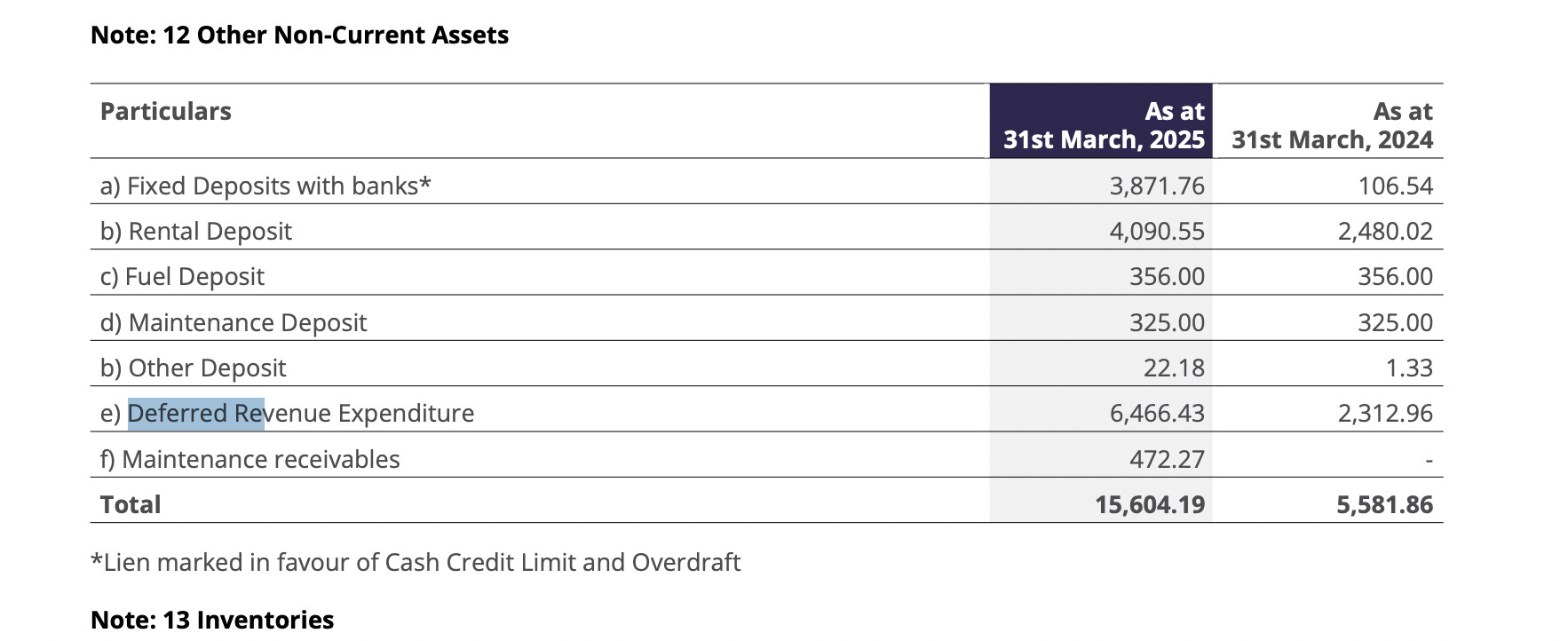
Accounting Integrity (Are they for real!) – This is a pet peeve of mine. I am not referring to the IND AS vs IND GAAP reporting here. According to me that is somewhat important but not too significant (it’s doesn’t make or break the investment thesis, it only alters the perceived PAT by 15%-20%, if that. More on this to follow in subsequent posts.) The main issue is that the Cash tax paid is not lining up squarely with the reported tax expense in the P&L. This is an accounting yellow flag for me & I usually skip companies that have this issue. This makes one question their PBT in the first place. We need clarification from the management on this!!
Final Verdict -
Afcom is a fascinating, high-risk, high-reward type opportunity. It is not for the faint hearted. It is for the investor who understands that in the airline business, you are only one safety incident or unforeseen event away from a financial disaster, but if the skies remain blue, it can transform the fortunes of the company and of those that are invested in it as the opportunity size is massive. Afcom could currently either be trading at 4-5x FY28 earnings or 2,000 crores more than where it should be 
Disclosure – Tracking position, Invested. Less than 0.25% of Pf. Need to gain more conviction to scale this up.
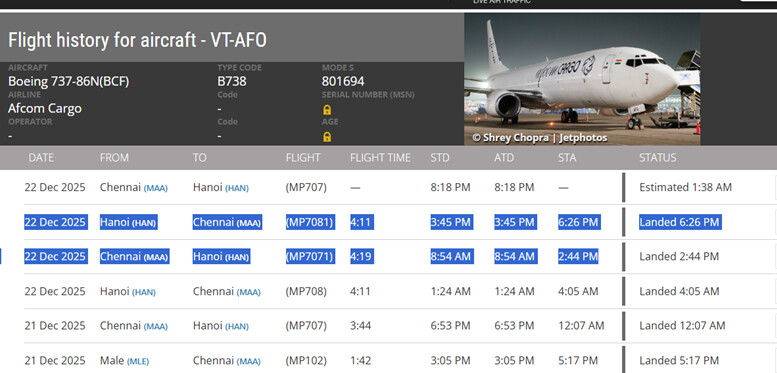
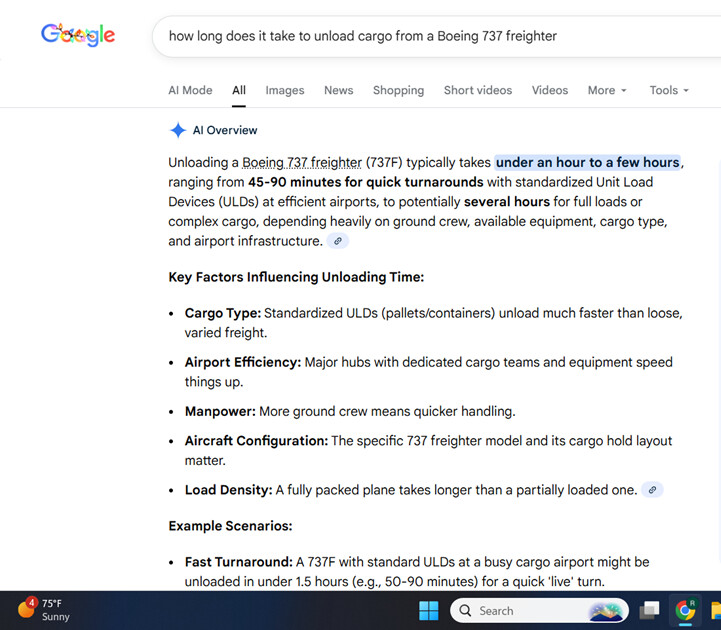
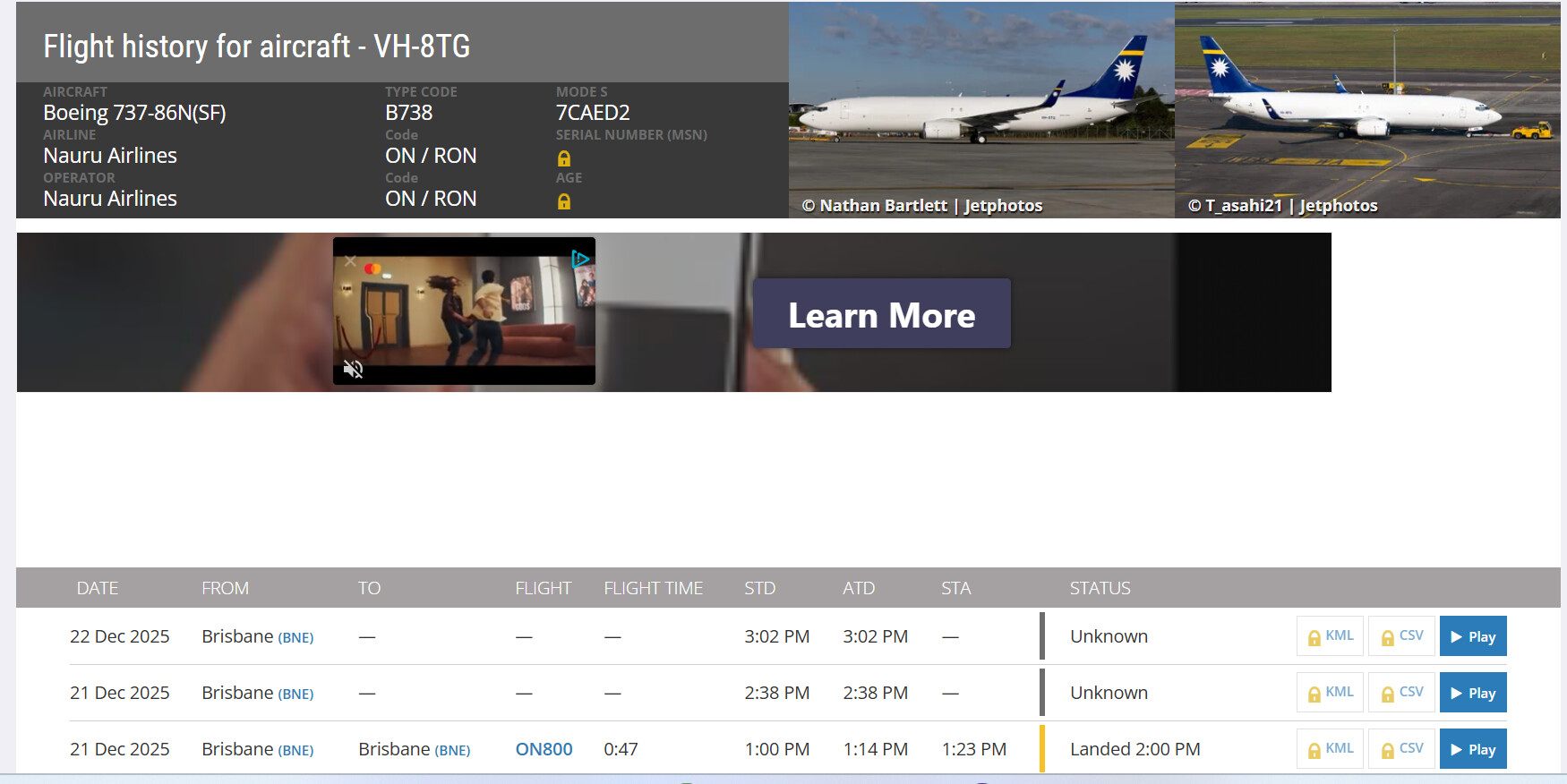
 . Not going to comment, don’t know how /if this is even possible. In the images below, Look at the departure (ATD) and arrival times. VT-AFO arrives at Hanoi at 2:44pm and departs at 3:45 pm? Same with VT-AFN