
I find the current situation in delta to be very interesting. Spent the weekend looking at the company. Sharing my notes below.
Deep discount
The current price does have a lot of discount baked into the company. Few of the posts cover that well. The company is trading at 0.9x book value. Both the casino & the real-estate business is undervalued. Not going to write more on this.
Will the company survive?
The question in the mind of the market is whether the company will survive due to the GST notice overhang. The case is currently in the supreme court.
I was bored on the weekend, so i went through the karnataka high court order of 2023 related to Gameskraft. The below section of the judgement caught my attention:
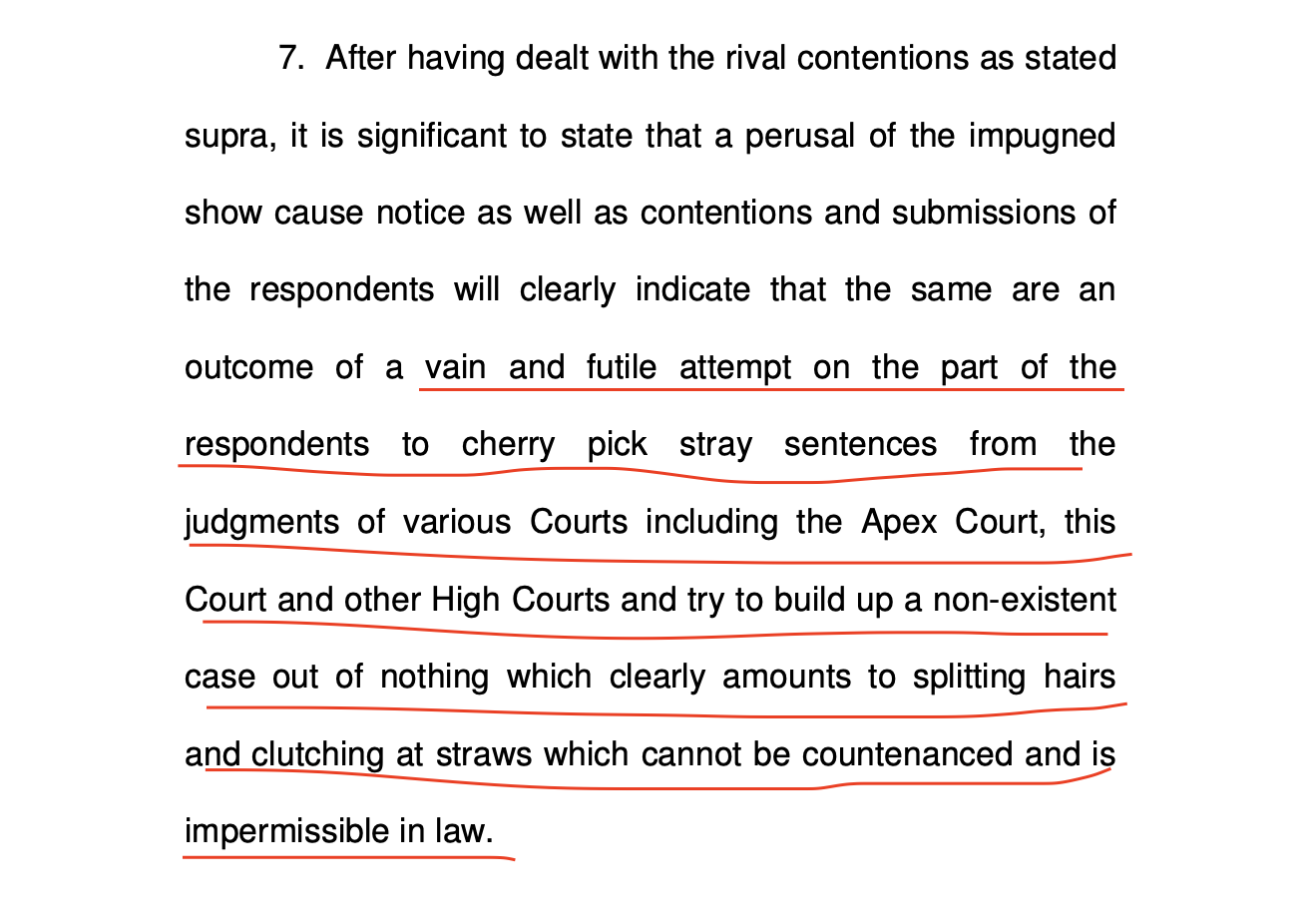
The highlights in red are mine. This is comment by the high court judge on the respondent’s case (the GST tax officials). source: order (see page 320)
The same case is now being heard in the supreme court with high implications for Delta. Now we know that there are many instances of Supreme court overruling high court judgements.
We also know that the case facts can be different for different companies. Gameskraft is primarily a Rummy company. While Delta is primarily an offline casino company. Rummy is a game of skill while casinos have games of both skill and chance.
Even given the above, do we as investors have a certainty or edge in knowing how the case will unfold? The answer in my mind is simply “I don’t know”
Below this line is a purely theoretical thought exercise from my head. Feel free to ignore it
How should we look at this company?
Investing has always been a risky approach. Not all the facts are knowable. A lot of uncertainities exist.
As mentioned by one user above, the act of investing in Delta itself has become a “gamble”. The investment in delta has come to resemble a coin toss. Heads (judgement in favour) we win. Tails (judgement not in favour) we lose significant capital (let’s assume 100% loss).
When we look at it as a coin toss, the key question to my mind are:
- Are the odds favourable?
- If the answer to the above question is yes, then how do we position size our bet?
For simplicity sake, lets assume the answer to the first question is favourable. Then how do we position size?
On Position Sizing
The answer to this can be varied. It depends on the odds (max gain to max loss) and the probability of winning vs losing. It also depends on the risk appetite.
There are multiple approaches an investor can take to position size in this bet:
1. Capital Protection Approach: Remember rule 1 & 2 of Warren Buffet? Rule 1: Never lose capital. Rule 2: Do not forget Rule 1. Or in the words of Mohanish Pabrai “Heads I win, tails i dont lose much”. In this approach, the allocation for an investor would be 0%
2. Regret minimization approach: What is the maximum that i am willing to lose without losing sleep? This could be 0.5%, 1%, 2% of your portfolio. It can also be 0%. This depends on you as an investor and your risk appetite.
3. Return maximisation approach: This approach is what is the maximum amount that i can bet given the odds & probabilities. This is where frameworks such as Kelly criterion come into place.
For the uninitiated, the Kelly Criterion is a formula that helps one decide how much to bet (while maximising returns and minimising risk of ruin). It is primarily used in gambling and in a very few cases in investing.
But given that the returns in Delta’s outcome is dependent on the pen stroke of a judge, can we apply the Kelly Criterion here?
- What is the Odds in this bet?
Assuming the judgement is in favour, and the PB ratio reverts from current 0.9x to 2.0x (The 10 years median PB for Delta is 2.5x). This translates to odds of 2.0/0.9 = 2.2
- What is the Probability of a favourable verdict?
This is unknown. Unless someone is from the legal profession or the judges themselves, it is very difficult to estimate this. But there is an alternate way to look at this. We need to invert or flip the question to “For a 0% portfolio allocation, what is the maximum probability of unfavourable judgement” This gets summarised in the table below:
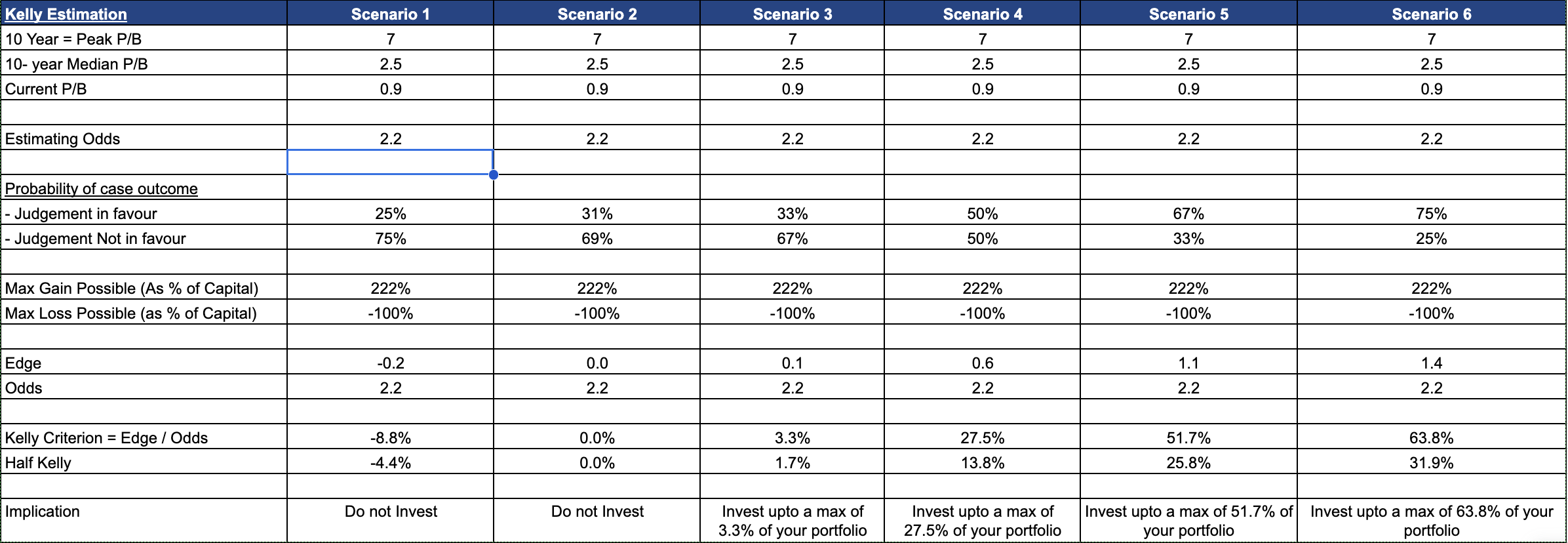
Key takeaway of the above table. (For an odds of 1 : 2.2)
- If you estimate the probability of favourable judgement is <31%, then do not invest
- If you estimate the probability of favourable judgement is 33%, then invest a maximum of 3.3% of your portfolio
- If you estimate the probability of favourable judgement is 50%, then invest a maximum of 27.5% of your portfolio (This chunkiness in allocation can lead to high volatility in Kelly criterion). Not sure if any investor has so much courage!
But the above still does not guarantee that you wont lose money. Its a game of probabilities. And we cannot know it for certain.
Few of the key issues with the Kelly criterion is that it is very difficult to apply in investing because:
- Very difficult to estimate the odds in real life
- Very difficult to estimate the edge in real life
- At times can leader higher volatility in portfolio
The odds & edge that i estimated can be horribly wrong. I will never know for certain. (The only way to know this is to see what the judgement is in thousands of parallel universes).
I would love to hear how other investors in this forum/thread have positioned sized for risk/return in Delta (Assuming they are invested or planning to invest). Looking to learn
PS: I am not a lawyer and have ZERO legal expertise. Nothing in this post construes as legal or investment advice
Also nothing in this rant is an advice to gamble. This is a forum for investing. If the admins feel this post needs to be deleted, please go ahead. The above is more of a theoretical exercise.