
Polymixin B / Colistin is one of the commonly used antibiotics used in hospital for resistant infection. It is often used in combination with other other drugs like Meropenem. Nephrotoxicity and neurotoxicity are the common side effect associated with these medications. Hopefully Venus remedies solve this issue.
Market seems to be excited by initial animal study data itself ( Glenmark pharma deal seems to have changed perception of market for companies doing R&D).
Hopefully Venus remedies completes phase 1 and phase 2( if required by regulator) clinical trial soon to make use of their exclusivity and also helps in treating patients. Phase 3 trail may not be required as its a existing drug and we know the clinical efficacy.
If VRP-034 proven on clinical trails use of polymixin B may increase to some extent from existing levels but may not change materially as indications/resistance patterns remains the same.
Discl: not invested
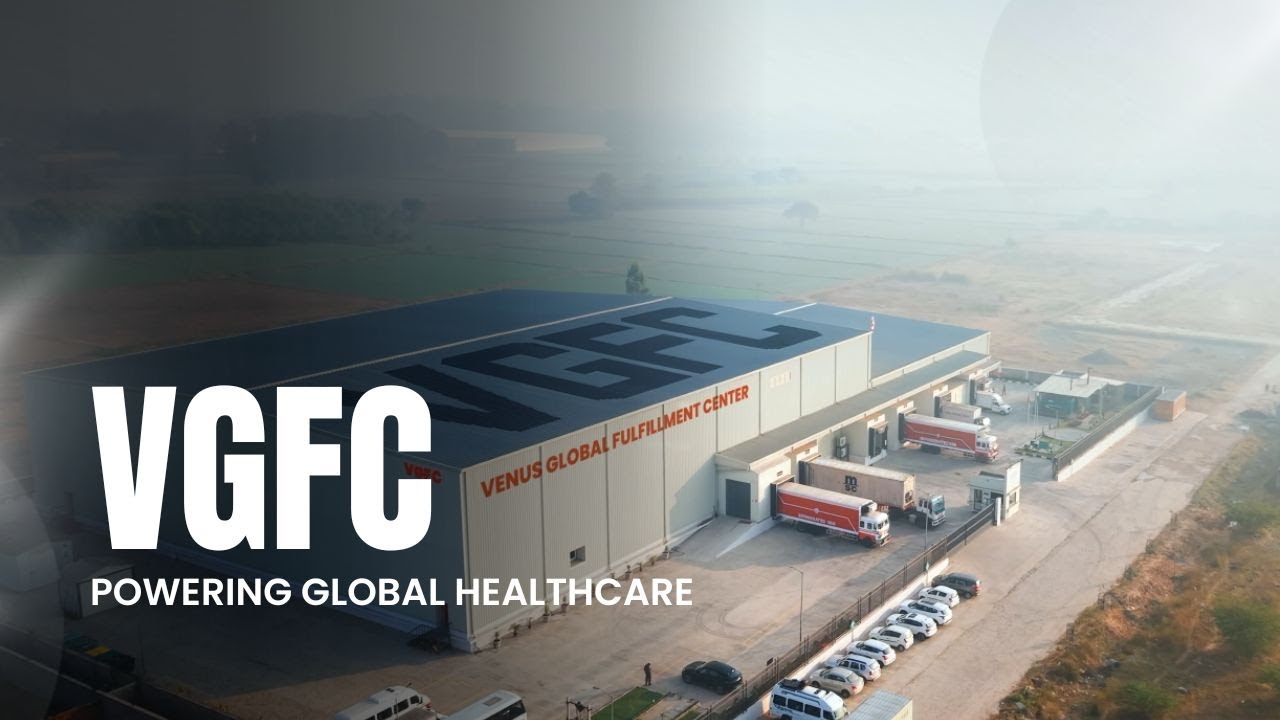
Venus Global Fulfillment Center is one of the most important recent investments by Venus Remedies. it can significantly improve the company’s supply chain efficiency, customer service, and global reach .
Disc:Invested
Is there any Phase 1 trial date announced for the MET-X clinical trial ? I could not find any status for this
The 2025-26 Annual Report for Venus Remedies Limited describes the strongest year in the company’s 37-year history, marked by record-breaking profits, a return to dividend payouts, and significant clinical milestones.
Financial Performance & Resilience
-
Record Profitability: Consolidated Net Profit (PAT) crossed ₹100 Crore for the first time, reaching ₹102.79 Crore—a 127% increase over the previous year.
-
Revenue Growth: Consolidated revenue from operations stood at ₹769.60 Crore, up 17.87%.
-
Debt-Free Status: The company maintained zero debt for the third consecutive year, having successfully transitioned from a period of high debt (₹335 Crore) between FY17 and FY20.
-
Resumption of Dividends: Based on the strong performance, the Board recommended a final dividend of ₹10 per share (100%), the first payout to shareholders in over a decade
Business Segment Highlights
-
International Dominance: Exports grew to ₹590+ Crore, accounting for approximately 77% of total revenue. The company currently serves over 100 countries and holds 1,100+ marketing authorizations.
-
Domestic Growth: Domestic revenue grew by 16%, driven by a 70% contribution from critical care products. The company also successfully entered the Employees’ State Insurance (ESI) segment, supplying 74 ESI hospitals.
-
Manufacturing Excellence: Monthly production output hit a record 1 Crore units without adding new facilities, achieved through productivity improvements and digitalization.
Innovation and R&D (VMRC)
-
Clinical Milestones: The lead anti-infective candidate, VRP-034, received CDSCO approval for Phase 1 clinical studies, with patient dosing beginning in early FY27.
-
USFDA Recognition: Venus holds two USFDA QIDP (Qualified Infectious Disease Product) designations (for VRP-034 and VRP-048), a rare distinction for an Indian pharmaceutical company.
-
Advanced Science: The Venus Medicine Research Centre (VMRC) celebrated its 20th anniversary, achieving proof of concept in CRISPR-based gene-editing delivery and beginning research into exosomes
Intellectual Property Overview (as of March 31, 2026)
The company’s IP assets are a core part of what management calls its “regulatory capital”.
-
Patents: 150+ patents have been granted globally.
-
Trademarks: 125+ registered trademarks.
-
Copyrights: 17+ copyrights.
-
Marketing Authorizations: 1,100+ authorizations worldwide, which act as gateways to international revenue.
Key Patented Technologies
-
Renal Guard Technology (RGT): This is a foundational proprietary platform designed to reduce the kidney damage typically caused by last-resort antibiotics like Polymyxin B. The RGT patent has been filed in 88+ countries and granted in 15.
-
MET-X: A patented metallo-β-lactamase (MBL) inhibitor in-licensed from Infex Therapeutics (UK), which is being paired with meropenem to target highly resistant pathogens.
Future Outlook: Mission 2030
The company unveiled Mission 2030, a charter of ten missions focused on science, manufacturing, and sustainability. A key long-term goal is the development of the Venus Industrial Park (VIP), a greenfield campus designed to scale production to 100 Crore units per year
Discl: Invested.
Adding here for investors tracking the stock:
@phreakv6 has covered most of the story well. Just adding some more data/insights below based on my look at the ARs and the export data:
Export data
I had collected the export data till 2025 and couldn’t collect more as the regulators recently stopped export data. Here are my observations:
- Venus is the largest Indian exporter of Meropenem ex-US. Aurobindo is the largest exporter to US via its subsidiary Eugia.
- Antibiotics formed ~75% of its export value in 2022. By 2025, it had become 62%. Share of oncology increased during this period.
- The top 3 countries of export were Hungary, Saudi Arabia and Mexico. This aligns well with the geography mix they shared in the 2026 AR.
AR notes:
Since the company doesn’t do concalls, AR is the only source of information. Thankfully, the ARs have always been quite detailed dating back to 2013. It gives a good view of the evolution of the company.
- 2013-14
- Venus showcased it’s ambition to be a research based and an innovator company, especially in the antibiotic space.
- They developed Elores over 7 years as an innovative antibiotic product to combat anti-microbial resistance. 2014 AR mentions out-licensing this to Korea and South Africa
- They tied up with Teva and Mylan for cancer and antibiotics.
- However, their ambition for being an innovator turned to be its bane. They used debt to fund long gestation research projects eventually defaulting and going into CDR.
- 2015 - 19
- This was a period of struggle. They eventually sold off Elores to Cipla and used the money to pay down the debt and come out of CDR.
- 2020 - 25
- This was a period of rebuild marked by various strategic pivots.
- They changed product mix by introducing oncology products. It helped realign the revenue between acute and chronic therapies.
- In the international business, they pivoted from spreading themselves too thin across many countries to establishing local presence in few countries and going deeper.
- In the domestic business they focused on the following:
- Hospital supplies: Tender based supplies to Govt. hospitals. Also, developed supply relationships with private hospitals.
- CMO: Contract manufacturing for Cipla, Zydus, Intas, Ajanta Pharma, and Lupin. In 2024, they had 14 active CMO contracts
- Trade generics: They created a basked of trade generic products which they sold entirely online through the Davai app, requiring no MR.
- In 2025, they aimed to focus on higher gross contribution products and move volumes to less price sensitive markets
Financials
Bharani has mostly covered the balance sheet repair. I will just add a note on margins:
- The margin expansion from 10% to 19% in 2026 has almost all come from gross margin expansion. I asked the investor relations about the reasons for margin expansion and in their words, it was “due to product mix, geography mix, positive $/INR and PLI incentives”.
- It appears that their strategy of focusing on higher gross margin products and less price sensitive markets is partially playing out.
IT capabilities
- Venus appears to be forward leaning in terms of IT integration not only in its quality processes and compliance but also it’s supply chain.
- They claim to using the Davai app for order fulfillment for 90% of the field sales and order-to-fulfillment time under 24 hours. I did a scuttlebutt with one of the users of Davai app i.e. a distributor based out of Maharashtra. He supplied Venus’ products to both government and private hospitals. He confirmed that Venus is able to fulfill orders in 24-48 hours. However, the scuttlebutt sample size is 1, so please take it accordingly.
Summary:
- Venus has been on a journey of transformation after the CDR struggles. 2026 appears to be the year when things are falling into place. 2027 will confirm if the pace of transformation continues.
- On the capabilities front, they tick the boxes in terms of scientific capability, antibiotic innovation (Elores earlier and now VRP-034), EU GMP sterile injectables facility, qualified next generation and ambition.
- On the capital allocation front, they still need to prove themselves. It will be interesting to see how they plan and fund the clinical trials of VRP-034. Also, 2026 AR talks about building.a Venus Industrial Park with 100 crore units capacity from the current 10 crore units capacity i.e. 10x. It’s a bold vision but the devil lies in the details like where is the demand coming from, which therapies and which markets. I hope they allocate their capital well.
- On the valuations front, I would not give their domestic business a high multiple unless they scale up the CMO business to become a major share of domestic with 12%+ margins. If that happens, I would value the domestic business like a Windlas Biotech. However, if the horse of their export business keeps galloping at 20%+ growth, there is scope for re-rating. VRP-034 is an optionality that is a few years away.
I will be attending the AGM on Aug 20th. If there are any specific questions for which you would like answers from the management, please send me over DM. I will add it to my list.
Disc: I am invested from 980 levels and therefore, have a lot of margin of safety. Bharani has already highlighted the risks.
The risks are high. While experienced folks might have entered as valuation arbitrage, their capital allocation and growth in F27 over the now TTM base, needs to be proven - not a given by any means.
Please summarise the AGM of Venus remedies when you get time sir.
AGM notes
Business model/Markets
Venus is heavily export-oriented with 75–80% of revenue comes from exports.
Exports:
- The export business is approximately 50% tender / 50% private market.
- Private market generally involves local partners/distributors.
- Tender business involves government/health ministry procurement.
- Historically, the business was more dependent on tenders and tender cycles. Growth in Southeast Asia and CIS has increased private-market exposure.
- Europe is one of the least profitable businesses for Venus. Europe remains strategically useful because it:
- maintains quality credentials
- provides regulatory experience
- helps Venus qualify for other markets
Domestic:
- 50% contribution from prescription business for branded generics and research products.
- remaining 50% comes from generics, split into:
- distribution directly in the private market and
- institutional business that happens through tender cycles and direct supplies to various central and state institutions and ESI networks.
- The CMO business is <5% of total company revenue and is utilized selectively when spare capacity exists.
Current capacity and capacity addition
There were a lot of questions from investors on how they could achieve 1 crore per month output from a 10 crore annual capacity. Also, there were questions on how they plan to support growth without adding new capacities. The management’s response was along the following lines:
- 10 crore annual capacity is the “designed” capacity assuming 1 shift of operations. They will be able to increase throughput by additional shift utilization, better scheduling, de-bottlenecking, larger batch sizes etc.
- Next four to five years of growth can be easily achieved based on just optimization from existing facilities
- There are currently eight manufacturing facilities, divided between anti-infective, oncology and general injectables (ampoules, pre-filled-syringes). While oncology and anti-infective are operating at high utilization, the other facilities are under utilized. A lot of product mix will now also deliberately focus on non-oncology and non-anti-infective portfolio expansions.
Capex
- The current capex (shown in CWIP) is aimed at “Venusian Chambers”, the company’s headquarters and R&D centre. It is expected to be completed around Q4 FY27 / January 2027. The new facility will:
- consolidate support functions and create a new R&D centre
- free space at Baddi, Panchkula
- allow additional manufacturing capacity at those existing sites
- The next major capex will be Venus Industrial Park. This is a greenfield expansion planned as a staged 10–15 year project with a vision to scale the capacity 10x. The first manufacturing unit is slated for operation around 2030, with a focus on dedicated penicillin manufacturing.
R&D Pipeline
-
VRP 034: Received regulatory approval for its Phase 1 clinical study and initiated subject dosing. The study primarily evaluates the reduction of nephrotoxicity/renal injury. Trial readouts are expected by Q4 FY27 or Q1 FY28, with potential licensing partnerships planned for regulated markets like the US.
-
VRP 048 (MetX): Nearing completion of pre-clinical development. Clinical Trial Application (CTA) submission is planned for Q1 FY28, with targeted commercial launch around 2031. Venus holds exclusive licensing rights for India for the meropenem + MetX combination.
Growth & Margin Guidance
- Sustainable annual revenue growth is targeted at 12–15%. Anything above that will be a bonus.
- Guiding for sustainable gross margins around ~50% (Last 3 quarters gross margin stood at 53–54%)
Overall impression
- The Q&A was entirely handled by the next-gen, Saransh and Akshansh.They were very forthcoming with the answers to investor queries. They individually answered 2-3 questions of each investor rather than clubbing them towards the end. The answers to remaining questions were also promptly sent over email.
- VRP-034 readout mid-next year would be a key milestone. The management is at least thinking about out-licensing and therefore, de-risking themselves from funding the clinical trials entirely from their cash flows.
- The thing that didn’t excite the investors much is the moderate growth guidance of 12%-15%, especially since they have already grown 30% YoY in Q1. Many investors questioned the management on the guidance but they kept saying that this was a “sustainable” growth rate.
Disclaimer: The above are notes from the audio recording and there could be transcribing errors. Happy to be corrected.
Disclosure: I reduced my allocation after the AGM, to adjust for the growth.
Hello Sir
As we can see the argument of Mr. Phreakv in his post was that Venus looks cheap in valuation as compared to its peers but as per your last post where in AGM call management said the Growth guidance will be 12-15% do you still believe that this business is cheap. Please advice
Review their Capitalization policy, especially as it relates to R&D expenses, including how they are capitalized and written off, and over what period.
I endorse views expressed by @Phreakv6 . I don’t want to analyse more . Suffice to say that you must be able to differentiate between management’s projection whether it is pragmatic or lofty. This is about management quality. So 12-15 % revenue growth which is sustainable is ok with me, coming from Venus management. I am sure we will see about 20% growth at the year end. And let us not forget that Pharma R&D is a long term game. There is a big feather in their cap that almost 70% is export. Is it not a certificate on their quality? May be recent drop in the share price is inducing these doubts but those with conviction will notice that. And remember that the stock has galloped more than 50% in a short time. And yes, it is customary for R&D expenses to be written off.
Anyone has a clue why is the stock price falling continously? Is it purely because the stock ran up pretty fast befor the decline and hence profit booking? Or some other reason. Thanks!
Disc: Invested
I think there is a subsidiary drag on the results while parent company’s standalone operations performed strongly, the company’s consolidated net profit (₹25.65 crore) fell short of its standalone net profit (₹28.96 crore). This is due to net losses of ₹5.84 crore of its German subsidiary. There is also increase in operational expenses due to rise in depreciation and amortization expenses, which jumped to ₹9.27 crore from ₹5.92 crore quarter on quarter. Experienced members can throw light on this.
Thanks for your response. I also see the decline started from start of October month, and well before the Q2 results, hence was curious.