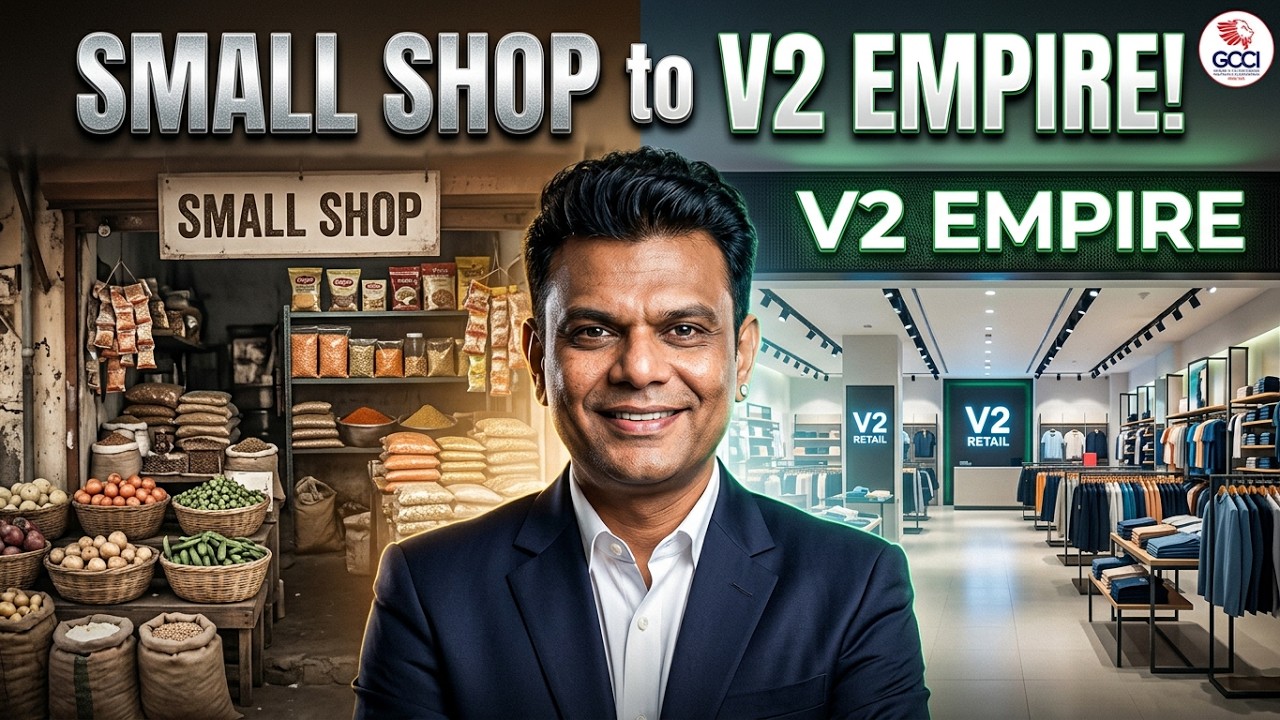
V2 Retail and the Architecture of Affordable Aspiration
The visible story is store growth. The deeper one is whether each new location becomes part of local routine, customer trust, and repeat demand.
Opening Line
The best neighborhood businesses do not win by being extraordinary.
They win by becoming the choice people stop rethinking.
That is one of the most underrated forms of economic power: becoming a low-friction decision.
Think of the pharmacy at the corner you walk into when you do not want to compare five options. The restaurant on a highway you choose because you know the stop will not waste your time. The petrol pump you pull into not because it is beautiful, but because you trust it enough not to second-guess the decision.
None of these businesses needs to feel magical. They only need to feel safe, familiar, and reliable enough to repeat.
Once a business crosses that line, the economics change.
It no longer has to win every customer from zero. It begins the day with borrowed trust. And borrowed trust, repeated often enough, turns a network of locations into something far more powerful than presence.
It turns it into habit.
The companies that achieve this often look plain at first. Then, one day, they stop behaving like stores and start behaving like infrastructure.
That is where this story begins.
The Bridge
That is what makes certain retail businesses more powerful than they first appear.
They do not win by being premium, nor by being unforgettable every time. They win by becoming reliable enough to repeat.
In India, that matters enormously because the consumer story is no longer one-dimensional.
The same market is becoming more aspirational and still deeply value-conscious. More digital and still heavily offline. More brand-aware and still careful about price.
It is not one India moving in a straight line.
It is many Indias moving at once.
That is exactly the kind of market where low-friction trust becomes powerful.
This is where V2 Retail enters the picture.
On the surface, it looks like a fast-growing value-fashion chain. But the more interesting possibility is that it is trying to become something harder to build and easier to underestimate:
a distributed, low-friction retail answer for households that want to stay current without making the purchase feel risky, chaotic, or financially foolish.
That possibility — more than the store count, more than the quarterly growth, more than the category label — is what makes the business worth dissecting.
What V2 Really Sells
V2 does not merely sell shirts, kurtas, jeans, kidswear, or family apparel.
It sells a simpler answer to a very human question:
“How do I look better without making the budget uncomfortable?”
That question matters because clothing is rarely just utility. A customer is not only buying fabric. She is buying presentation, confidence, comfort, family approval, occasion-readiness, and the quiet satisfaction of feeling current without feeling financially careless.
This is where value fashion becomes more interesting than the phrase suggests.
The Indian consumer is becoming more aspirational, but not less value-conscious. Aspiration has increased, but budget discipline has not disappeared. The customer wants better design, better freshness, better store experience, and better trust — but she still wants the price to feel sensible.
That tension is the opportunity.
A local market may offer low prices. But it often comes with friction: bargaining, inconsistent quality, unclear pricing, poor trial experience, crowding, limited trust, and the constant doubt of whether the purchase was actually worth it.
Organized value fashion reduces that doubt.
For a middle-income household, especially a woman shopping for herself, her children, or a family occasion, the store is not only a place to buy clothes. It is a place where small decisions become easier. The price is visible. The assortment is arranged. The product feels current. The family can shop together. The purchase feels less risky.
That is the real product.
Fashion here is not pure utility. It is deeply linked to occasions, festivals, weddings, birthdays, school events, work, social outings, and family functions. These are moments where appearance matters — but overspending still hurts.
So the customer is not asking for luxury.
She is asking for a safer upgrade.
A better-looking kurta for a festival. A fresh shirt for a family function. Affordable kidswear that does not feel poor. Casualwear that looks current enough for photos, outings, and everyday confidence.
That is why V2’s proposition is not simply “cheap clothes.”
Cheap can still feel risky. Cheap can feel chaotic. Cheap can feel like compromise.
V2 is trying to offer something more valuable:
affordable aspiration with lower decision friction.
If the company gets this right, the store becomes more than a discount outlet. It becomes a repeatable answer for households that want to look better, stay current, and still feel financially sensible.
V2 does not sell luxury.
It sells affordable confidence.
Why Offline Still Matters
The easy argument is that fashion will move online.
The better argument is that fashion discovery may move online, but fashion trust still often gets built offline.
For V2’s customer, the store does something a screen cannot fully replace:
it makes the decision feel safer.
That is why offline is not merely a channel here.
It is a trust interface.
A well-run value-fashion store lets the customer touch, compare, try, decide, and buy in one visit.
That matters because V2 is not only competing for attention.
It is competing for confidence.
And in value fashion, confidence is often built closest to the rack, the trial room, the price tag, and the billing counter.
That is why V2’s store network should not be seen as old-world baggage.
It is the operating surface of the business.
How the V2 Machine Works
The customer sees a store. The investor has to see the machine behind it.
V2 is not trying to build a luxury brand. It is trying to build a repeatable retail machine that can deliver a visible upgrade at a manageable price, store after store.
The demand side is straightforward. V2 serves middle-income families who need clothes not once a year, but again and again — for daily wear, school functions, festivals, weddings, travel, and the steady stream of ordinary social moments that still require people to look presentable.
This is not occasional aspiration.
It is repeat demand with budget discipline attached.
Competition exists, of course. Zudio, V-Mart, Vishal Mega Mart, Baazar Style, Style Union, Yousta, Intune, Cantabil, Azorte and others are all trying to serve some version of the same need.
Clothing is not a winner-takes-all category. Different customers want different fits, fabrics, colours, styles, and price points, which is why multiple players can coexist and still grow large.
So the real question is not whether rivals exist.
They do.
The prize is not owning the category.
It is owning a repeatable corner of it.
This is where the operating model matters more than the market label. In a diverse market, winning retail is not about serving everyone. It is about aligning merchandise, pricing, store experience, network, and replenishment around a chosen customer.
That is what V2 is trying to build — a lane based on price clarity, family comfort, freshness, and merchandise control , and then keep that lane productive as the network expands.
That also means V2 is not creating the need from zero. The need already exists in local markets, bazaars, and family wardrobes. The opportunity is to convert that demand into a more organized, repeatable habit.
Its real fight is not only for footfall.
It is for trust.
In the bazaar, every purchase carries a small investigation cost. The customer has to judge the fabric, the fit, the fairness of the quote, and whether the garment will still feel worth it after a few washes. Organized retail reduces that mental tax. In that sense, V2 is not just selling fashion. It is offering a quality floor in a market where uncertainty is otherwise part of the purchase.
Retail often looks like a product business.
In reality, it is often a hesitation business.
But that is only half the story. V2 is not built just to prevent disappointment. It is built to make aspiration affordable. The product has to clear a quality floor, yes — but it also has to look like it belongs in a more expensive box. That is what makes value fashion work. The customer is not just buying out of necessity. She is buying into a better version of how she wants to look.
The victory is not that the product is cheap.
The victory is that it does not look like the compromise was cheap.
The store itself is part of the model. In value fashion, the store is not merely where inventory sits. It is where hesitation gets resolved. The display, the assortment, the pricing clarity, the family comfort, the ease of browsing — all of this helps turn intent into purchase. If the store feels confusing, stale, or stressful, the model weakens. If it feels current, accessible, and easy to shop, the model strengthens.
Then comes merchandise control.
This is where private labels matter.
A retailer that only sells other people’s brands remains closer to a shopkeeper. A retailer with strong private labels gains more control over design, sourcing, price points, assortment, replenishment, and correction.
Yes, that helps margins. But the deeper advantage is control — and speed is the visible result of that control.
In a category where customers often care less about the logo and more about whether the product looks current, fits well, and feels worth the price , private label changes the game.
It gives V2 a better chance of reacting to what is actually selling rather than waiting on someone else’s product cycle.
In a category driven by freshness, private label is not just a margin lever.
It is a response-time lever.
Freshness is the operating core.
Fashion is one of the few retail categories where old stock is not just unsold stock; it is fading relevance. If the rack feels stale, the store feels stale. If the store feels stale, the customer stops returning. So the machine works only if V2 can keep enough newness on the floor, avoid dead inventory, and move merchandise before relevance slips away.
In this business, old stock is yesterday’s fashion and tomorrow’s markdown.
That is the model at its best.
And that is why the real test is not only whether V2 buys well.
It is how quickly it recognises a mistake, marks it down, clears the floor, and recycles the cash.
A machine that cannot correct quickly eventually starts carrying its own errors.
That is where data starts to matter.
A growing network does more than add revenue. It produces signals: what is selling, where it is selling, in which size, at what price point, and in what local context. But collecting data is not the edge. The real skill is turning those signals into better buying, sharper allocation, faster replenishment, and earlier correction when something is not working.
In value fashion, data is useful only if it reaches the rack fast enough.
There is also a people layer to this machine. Retail is a people-heavy business, and V2 is no exception. A store still needs managers, floor staff, cashiers, stock handlers, and support teams to keep the format running. But once that base is in place, higher sales do not always require proportionately higher manpower. Better merchandising, stronger footfall, higher conversion, and smoother replenishment can make the same store and broadly similar teams carry more throughput. That is where operating leverage starts to appear.
A better store does not need twice the staff to sell twice the product.
In that sense, employees are not just a cost line. In value fashion, they are part of the conversion system.
The expansion strategy matters for the same reason.
V2 is not trying to scatter stores everywhere at once. The logic is to deepen presence in existing states and clusters first, especially in markets where organized value fashion still has room to convert local demand, and only then widen into newer territories. A single store creates presence. A cluster creates familiarity, tighter distribution, and better local learning.
This is one of those businesses that is easy to describe and hard to execute.
Because everything has to work together: the location, the cluster, the assortment, the freshness, the price architecture, the inventory discipline, the local data, the store team, and the repeat behavior of the customer.
When those pieces align, V2 can do something very valuable:
convert unorganized shopping into organized habit, while offering a better-looking product than the bazaar and a safer price than premium retail.
That is the machine.
But retail machines are not judged by description alone. They are judged by store productivity. In V2’s case, that means watching the hard operating numbers — same-store sales growth, sales per square foot, footfall, average bill value, average selling price, and total sales.
That is where the machine stops being described and starts being measured.
What V2 Has Already Built
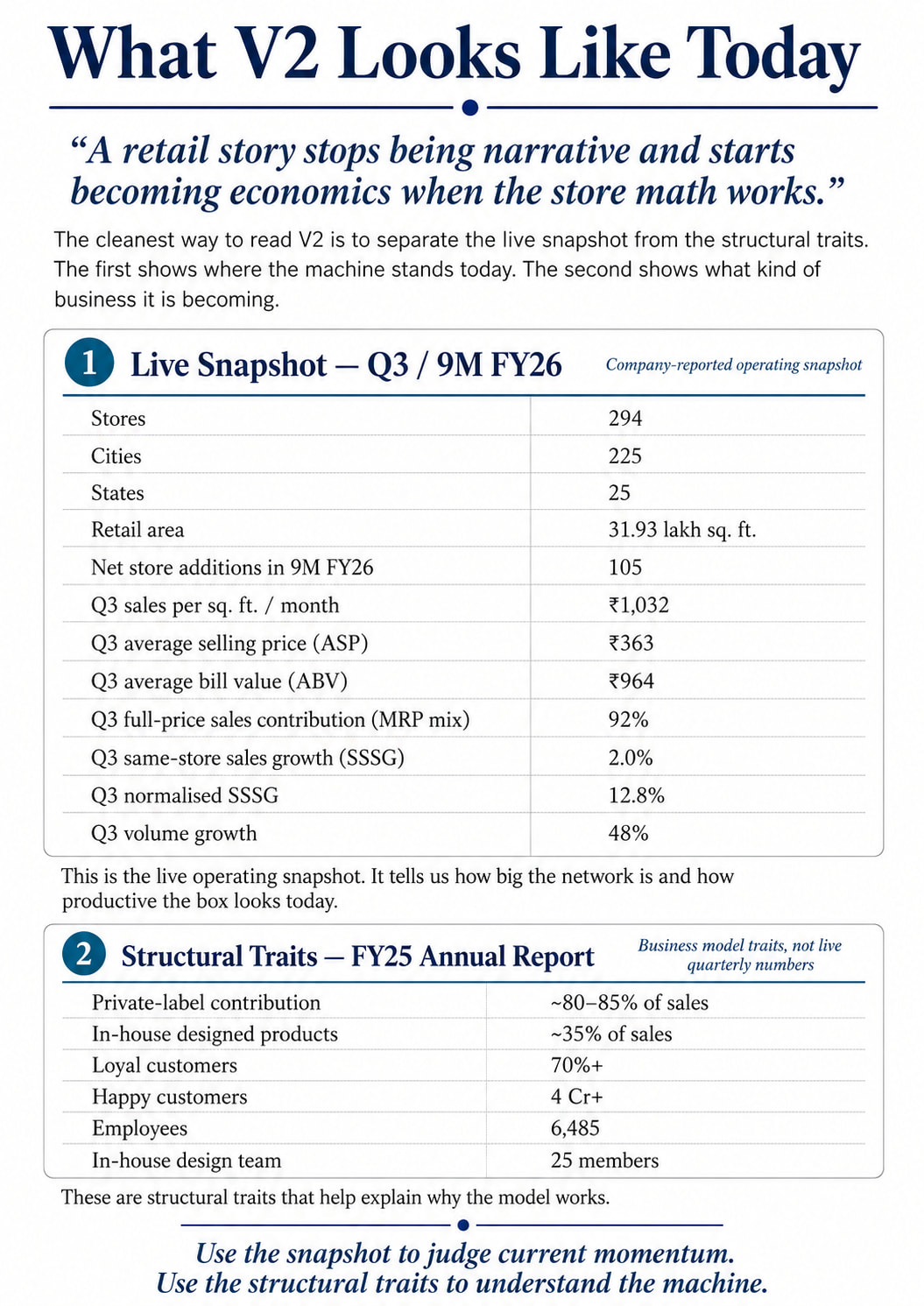
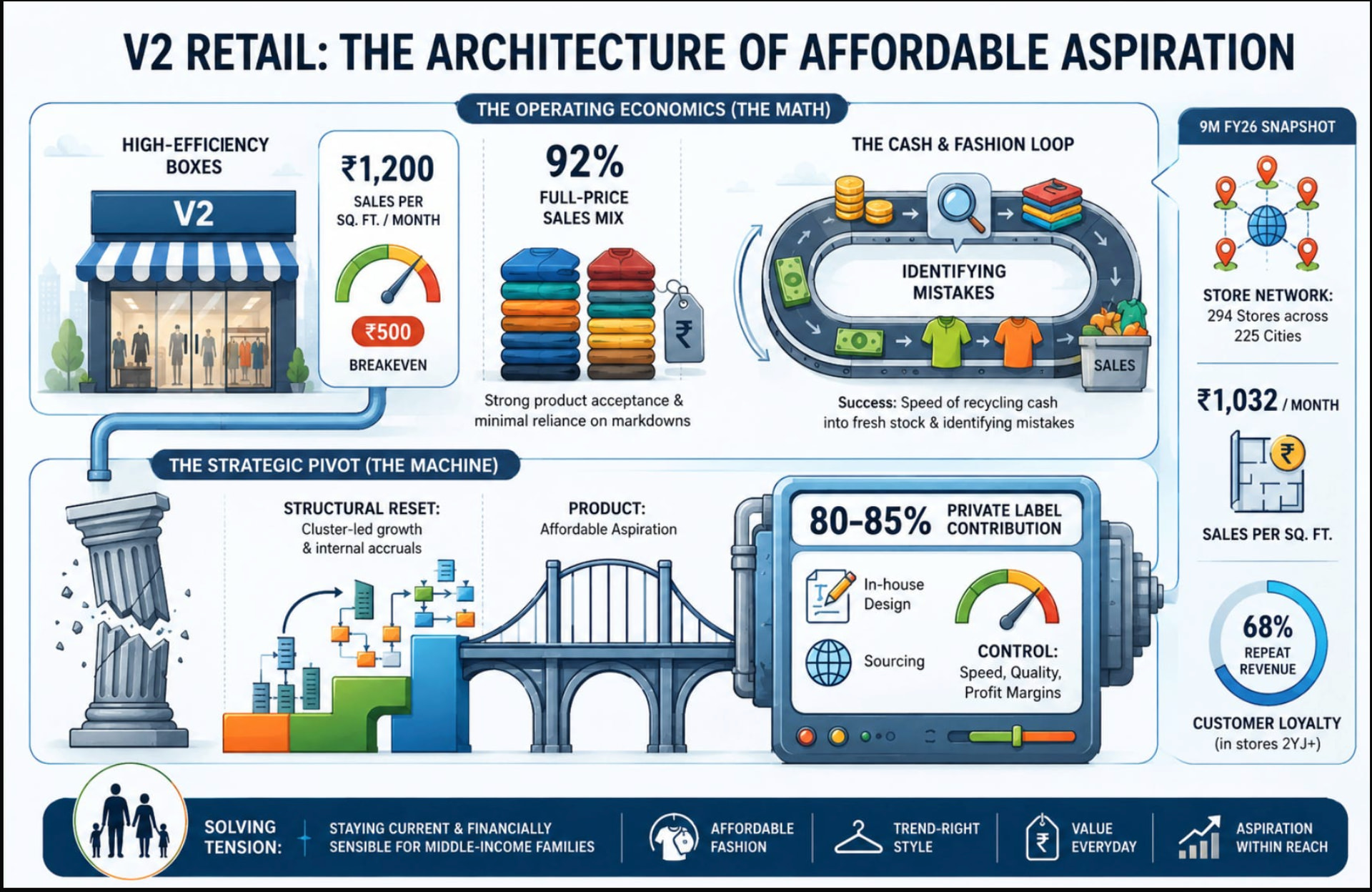
Before going deeper into the economics, it helps to see the business as it stands today.
The snapshot above carries the factual load. What matters here is what those facts imply.
V2 is no longer a small or scattered value-retail experiment. By 9M FY26, the company was operating 294 stores across 225+ cities and 25 states , with a retail footprint of about 31.93 lakh sq. ft. That is no longer proof-of-concept scale. It is large enough to begin testing repeatability.
And these are not tiny boxes. A typical new V2 store is about 10,000–11,000 sq. ft. , which tells you the company is not building a light-touch presence. It is building a meaningful family-shopping format with enough room to carry breadth in assortment and turn the store into a real destination, not just a narrow apparel outlet.
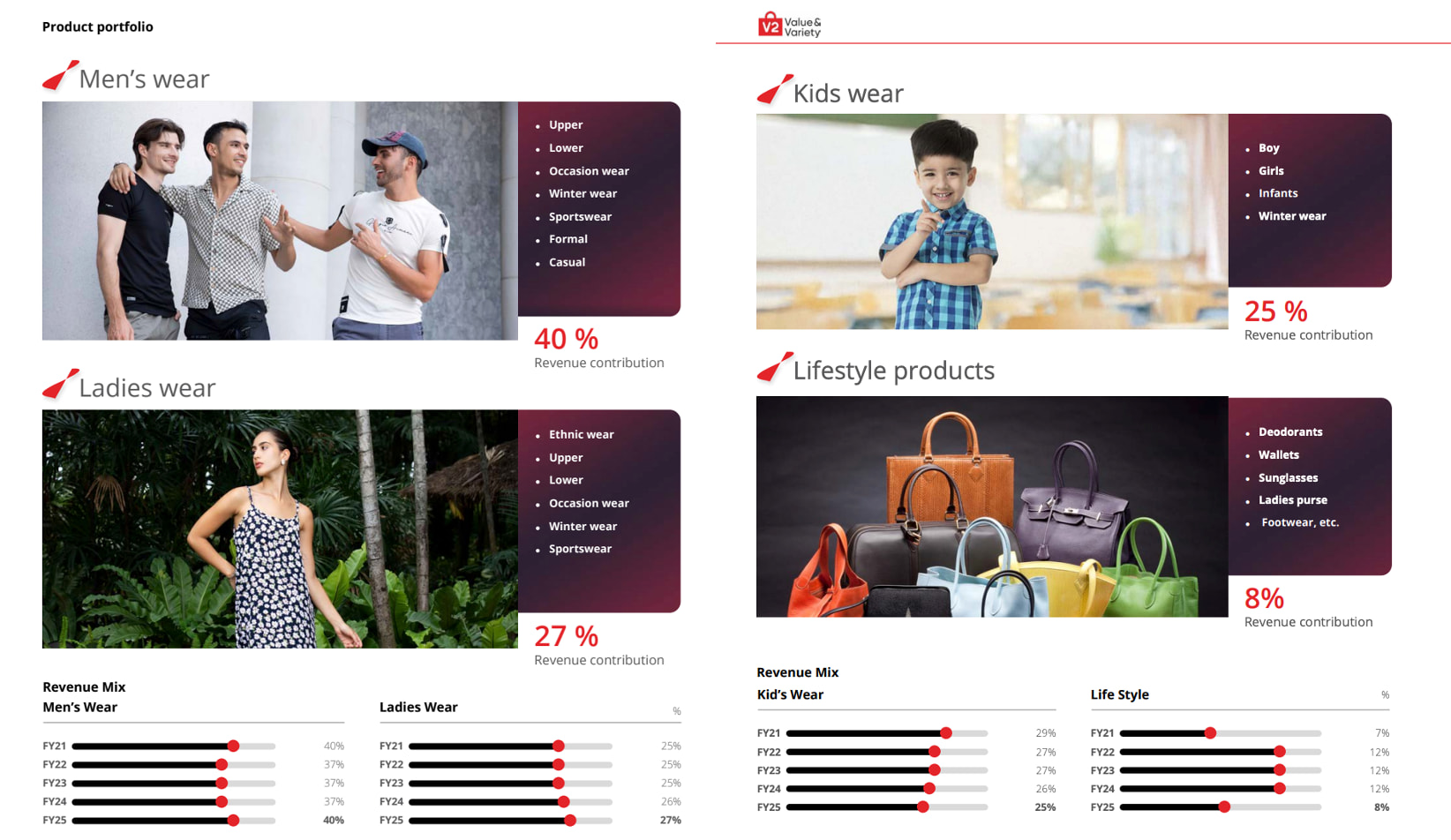
The format is also broader than a single-category fashion bet. In FY25, the product mix was 40% men’s wear, 27% ladies wear, 25% kids wear, and 8% lifestyle . That makes V2 closer to a family wardrobe platform than a single-line chain. It matters because family traffic usually deepens the basket, widens occasions, and improves repeat relevance.
Just as important, the business is becoming more controlled. The annual report and presentations frame V2’s operating advantage through an in-house design team, agile supply chain, warehousing and logistics, and a private-label-led architecture that gives the company more control over design, quality, replenishment, and value pricing. This is not just store addition. It is merchandise control.
That is really the shift to notice. V2 is no longer trying to prove that one value-fashion store can work. It is trying to prove that the format can travel — across cities, across clusters, and across a much wider operating base without losing its character. That is a very different stage of business. The question is no longer whether the concept exists. The question is whether the concept repeats.
And the way management wants to scale says a lot about how it thinks. This is not a scattershot rollout. V2 is deliberately using a cluster-led expansion strategy : roughly 60–70% of new stores are going into strong existing geographies , while the remaining 30–40% go into promising new markets. That matters because clusters do more than improve brand familiarity. They improve local learning, assortment accuracy, replenishment flexibility, inventory rebalancing, and execution control. In other words, V2 is not just adding stores. It is trying to make the network smarter as it grows.
There is a customer-cohort angle to this too. In stores older than two years, repeat customers now contribute about 68% of revenue , and purchase frequency has improved to roughly once every 4.25 months . That matters because it suggests V2 is not building loyalty through a formal rewards program or discount gimmick. It is building it through the product itself — assortment, price-value, fit, and the confidence that the visit will feel worth repeating.
The customer economics are also moving in the right direction. In Q3 FY26, average selling price rose to about ₹363 and average bill value to about ₹964 . That matters because it suggests the business is not only attracting traffic. It is also improving the quality of the basket. The customer appears willing to buy slightly better merchandise and leave with a stronger bill, which is usually a sign that the format is becoming more relevant, not merely more visible.
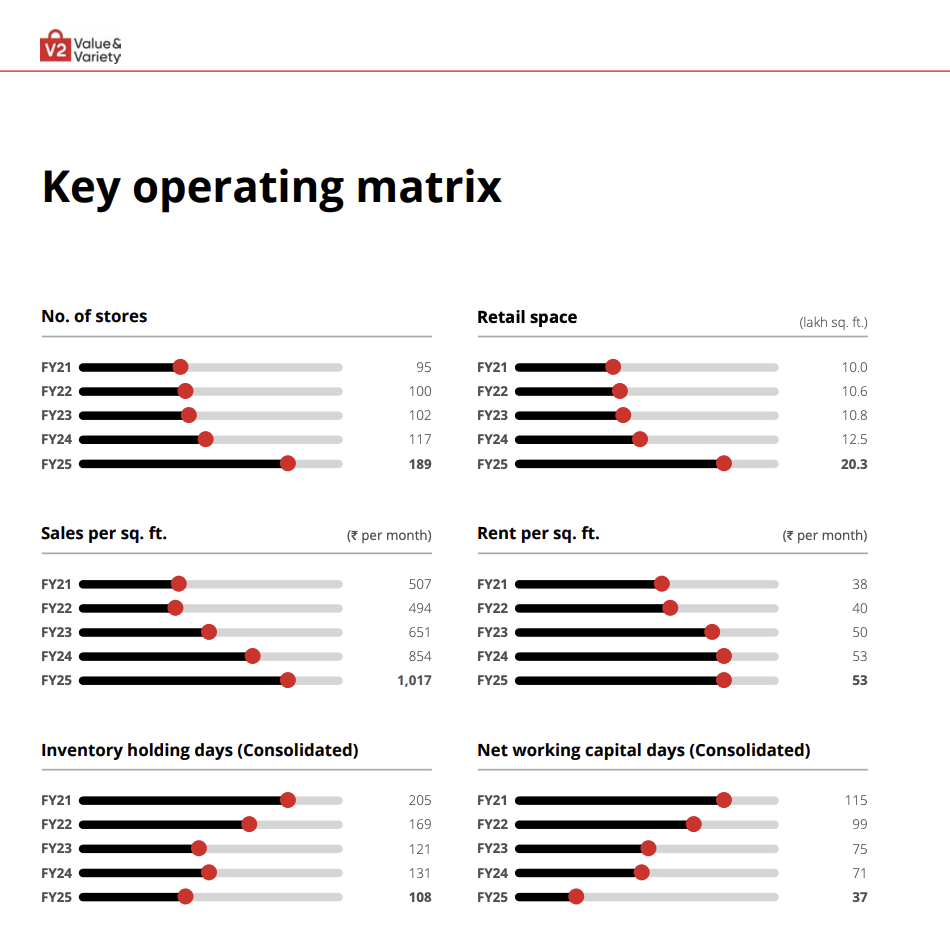
And the inventory cycle is improving too. In FY25, the company reported inventory turnover of 4.25x , up from 3.83x a year earlier. That matters because it suggests the platform is not just getting bigger. It is getting tighter. Inventory is being moved with better discipline, capital is being tied up for less time, and growth is beginning to look more like a system than a sprawl.
That is why this section matters. What V2 has already built is not just a larger retail footprint. It is the early shape of a repeatable value-fashion platform: meaningful store boxes, clustered where it is strong, supported by family-led category breadth, reinforced by customer return behaviour, and sharpened by improving basket quality and inventory turns.
What you see today is not just a growing chain of stores. You see a value-fashion platform with scale, family traffic, increasing merchandise control, and early signs that the machine is starting to repeat itself.
Who Built V2 — and How the Business Got Here
V2 Retail is not a first attempt.
For an investor, that is one of the most important sentences in this entire thesis.
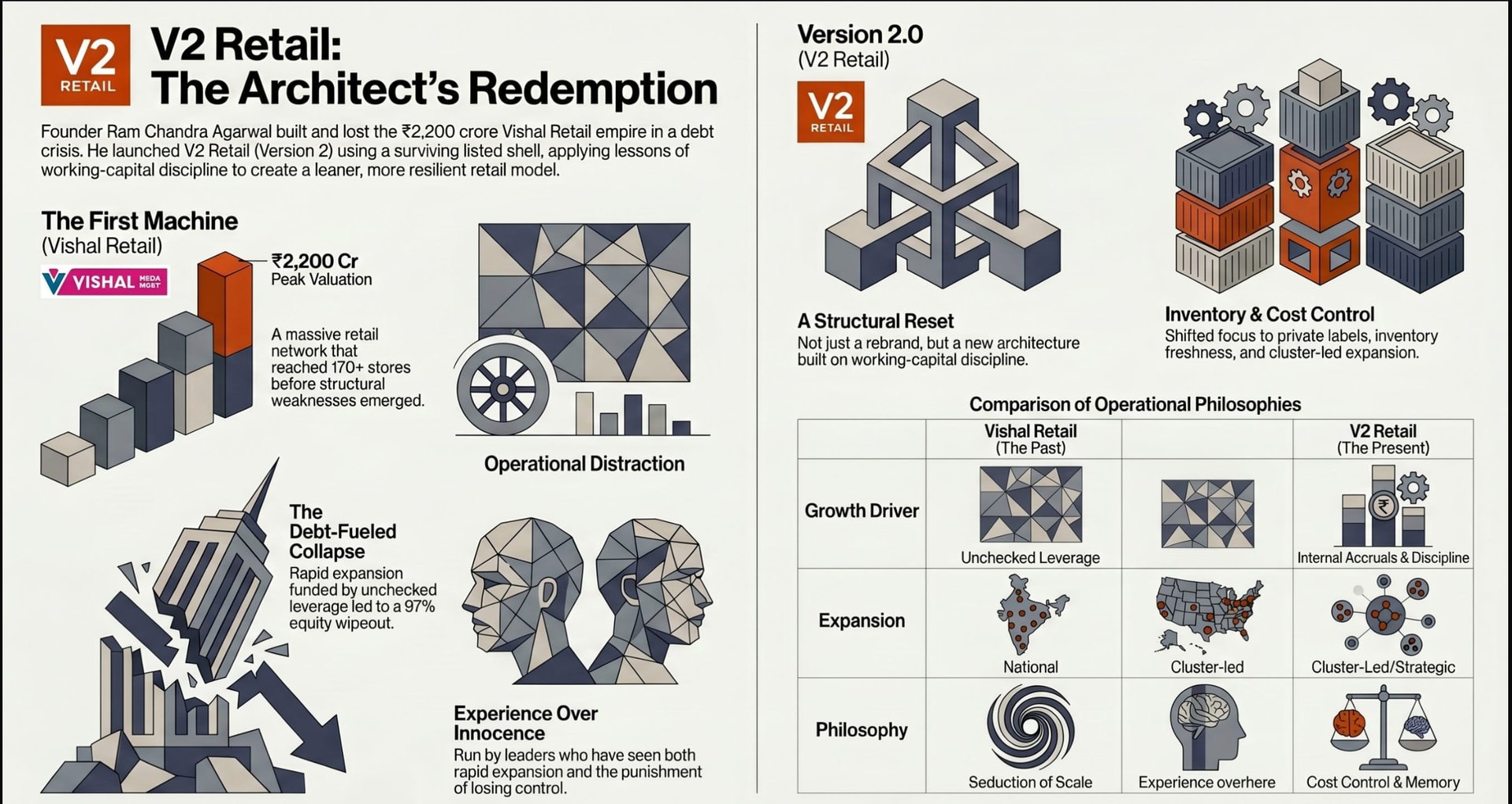
The business was built by Ram Chandra Agarwal , one of the original architects of value retailing in India. But to understand the machine, you first have to understand the temperament of the builder.
Agarwal’s story does not begin in a corporate boardroom. It begins with a photocopy machine in Kolkata. Struck by polio at the age of four , and permanently reliant on crutches, his instinct was never to seek safety. He moved from that photocopy machine to selling soft drinks, and eventually opened a small garment shop in Kolkata’s Lal Bazaar . He then spent years on the shop floor, studying something no spreadsheet can teach properly: the psychology, the wallet, and the aspiration of the Indian middle class.
He didn’t learn retail from a spreadsheet. He learned it from the street.
The First Machine: The Seduction of Scale
By 2001, he moved to Delhi and launched Vishal Retail . The concept was brilliant. The scale was intoxicating. The company went public in 2007, became a household name, and by the time the story reached its peak, Vishal was operating over 170 stores across the country under Vishal Megamart, Vishal Retail and Vishal Fashion Mart. Three years before the collapse, the business had reportedly commanded a market valuation of about ₹2,200 crore .
That is the part people forget.
He had already built scale before the crisis broke the machine.
This was not an overnight success story. It was a serious retail network, built by a founder who had already shown he could dream big and execute at scale.
But scale can hide weakness when the cycle is kind.
The mistakes were the classic mistakes of a first empire builder.
Unchecked leverage.
Rapid store expansion was funded with too much debt.
Operational distraction.
Capital and attention drifted into doing too much inside the chain instead of keeping the machine tighter and lighter.
Management deficit.
The business scaled faster than its operating bandwidth. The founder’s ambition outran the institution around him.
When the cycle was kind, leverage amplified the rise.
When the cycle turned, it accelerated the fall.
Vishal Mega Mart Sells Out to private Equity
Then came the real shock.
As the cycle worsened, Vishal entered debt restructuring on about ₹730 crore of debt . By 2011, after the debt spiral and distress sale, the retail and wholesale businesses were sold to TPG Capital and the Shriram Group for just ₹70 crore — roughly 3% of peak value .
That was not a setback.
That was a total equity wipeout.
But this is where the story gets more interesting.
Agarwal did not vanish with that sale. He sold the Vishal brand and the operating businesses, but the listed company remained. That same entity was later renamed V2 Retail Limited .
That distinction matters.
Because V2 is not a completely unrelated fresh start.
It is the same listed shell, rebuilt after the old operating machine was sold away.
Version 2.0: The Architecture of Memory
Most promoters do not survive a collapse of that magnitude with ambition intact. They retreat.
Agarwal did not.
He started again with roughly ₹10–15 crore left. And when asked how he handled the psychological blow, he quoted the Bhagavad Gita : stay detached emotionally, but work with passion.
That line matters.
Because V2 is not just a new company.
It is a new architecture built by someone who already knows what overexpansion costs.
He named the business V2 Retail — literally, Version 2 .
But this was not merely a rebranding.
It was a structural reset.
Today’s V2 reads like a retailer shaped by memory and scar tissue. The language is less about empire and more about private labels, inventory freshness, working-capital discipline, cluster-led expansion, and cost control .
There is a people lesson inside this rebuild too. Retail is a human-heavy business . Stores do not run on strategy decks; they run on hiring, training, supervision, task discipline, and customer handling.
In a 200-store-plus retail chain, culture is simply the system by which the same standards travel.
There is also a generational layer to this rebuild. Alongside Ram Chandra Agarwal , the operating structure now includes Akash Agarwal , who serves as CEO and whole-time director. That gives the business an interesting mix: founder memory on one side, and a newer operating layer on the other.
So this section should not be read as founder mythology.
It is more useful than that.
It tells you that V2 is being run by people who have already seen both sides of retail:
the seduction of fast expansion,
and the punishment of losing financial control.
The first brand was sold because leverage met a crisis.
The second brand is being built as if that lesson still matters.
That is not proof of success.
But it is a much better starting point than innocence.
The Economics of a V2 Box
The table above carries the hard load. What matters here is what those numbers mean.
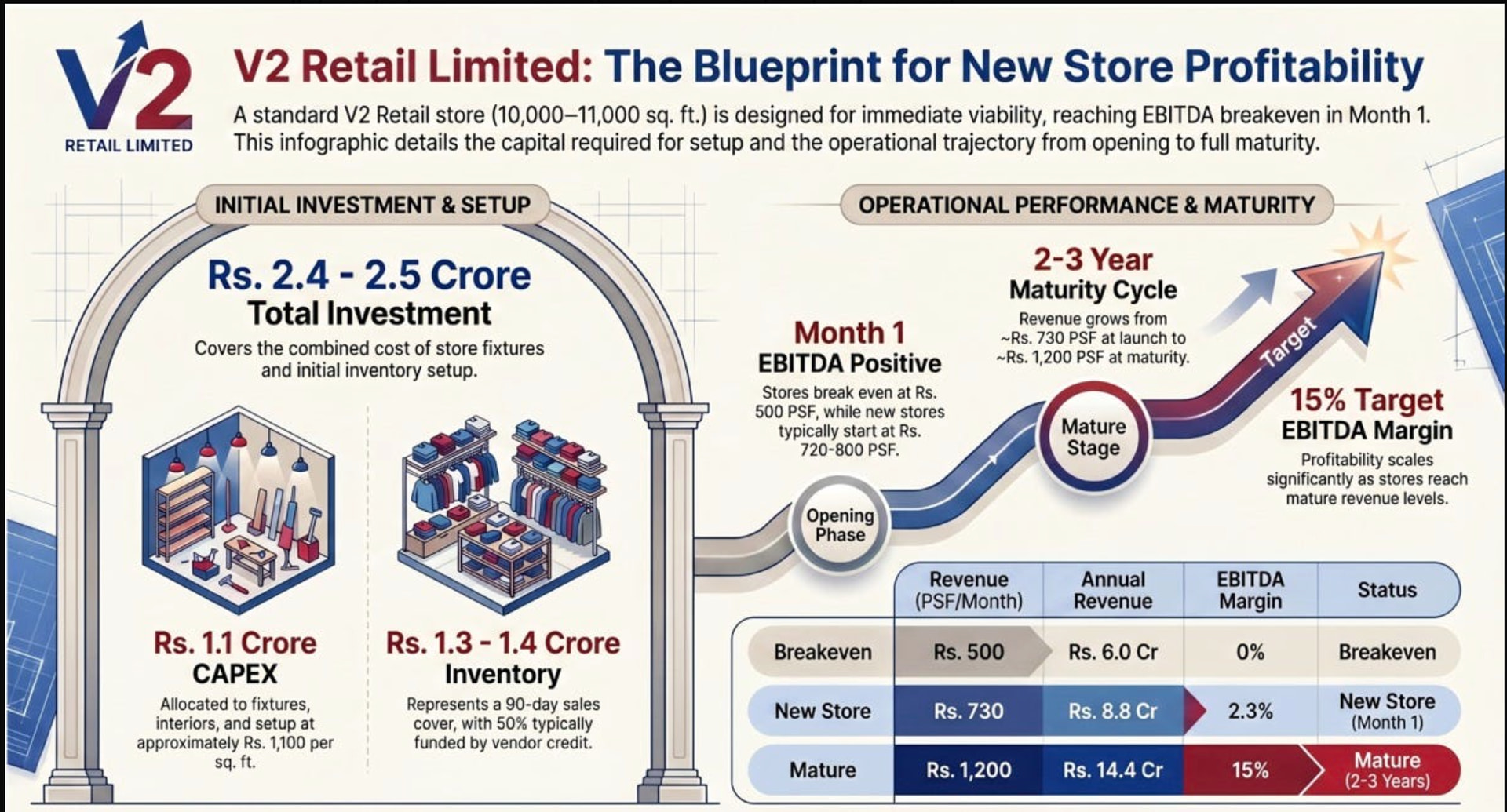
A typical V2 store is not a light experiment. It is a real retail box with real capital behind it. Management’s own framework suggests a new store is usually 10,000–11,000 sq. ft. , needs about ₹1.1 crore of capex , ₹1.3–1.4 crore of opening inventory , and therefore roughly ₹2.4–2.5 crore of total initial investment.
Before the first customer walks in, the capital is already at work.
That is why store economics matter so much.
A weak store is not just a weak store.
It is capital sitting in a room, waiting to earn its right to exist.
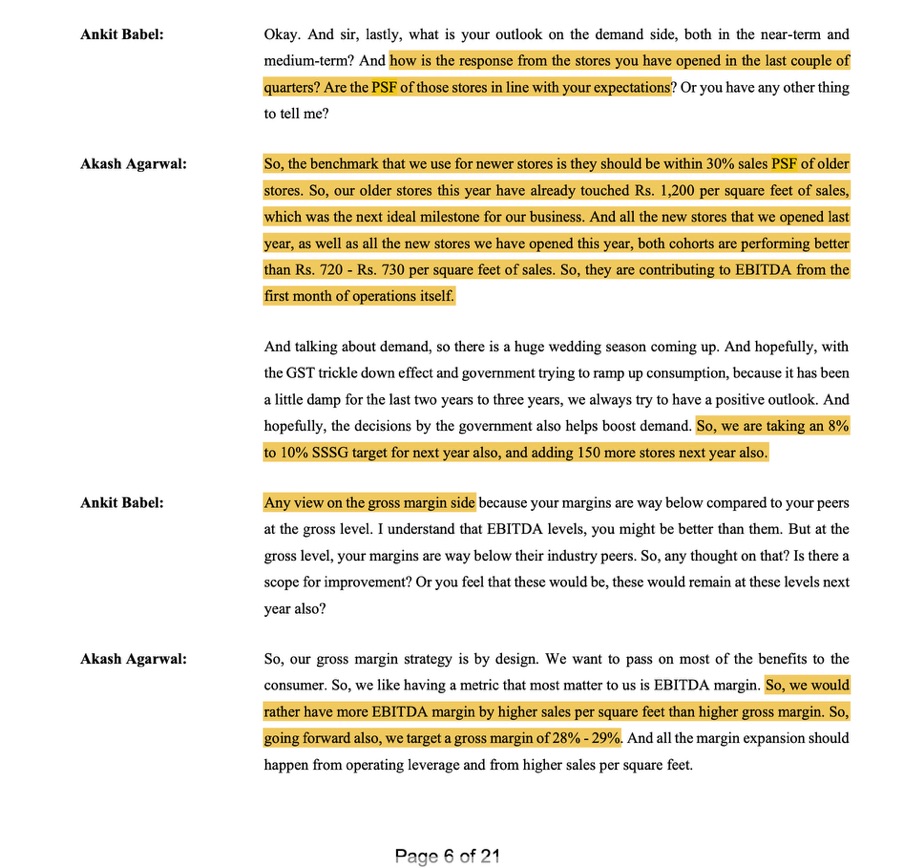
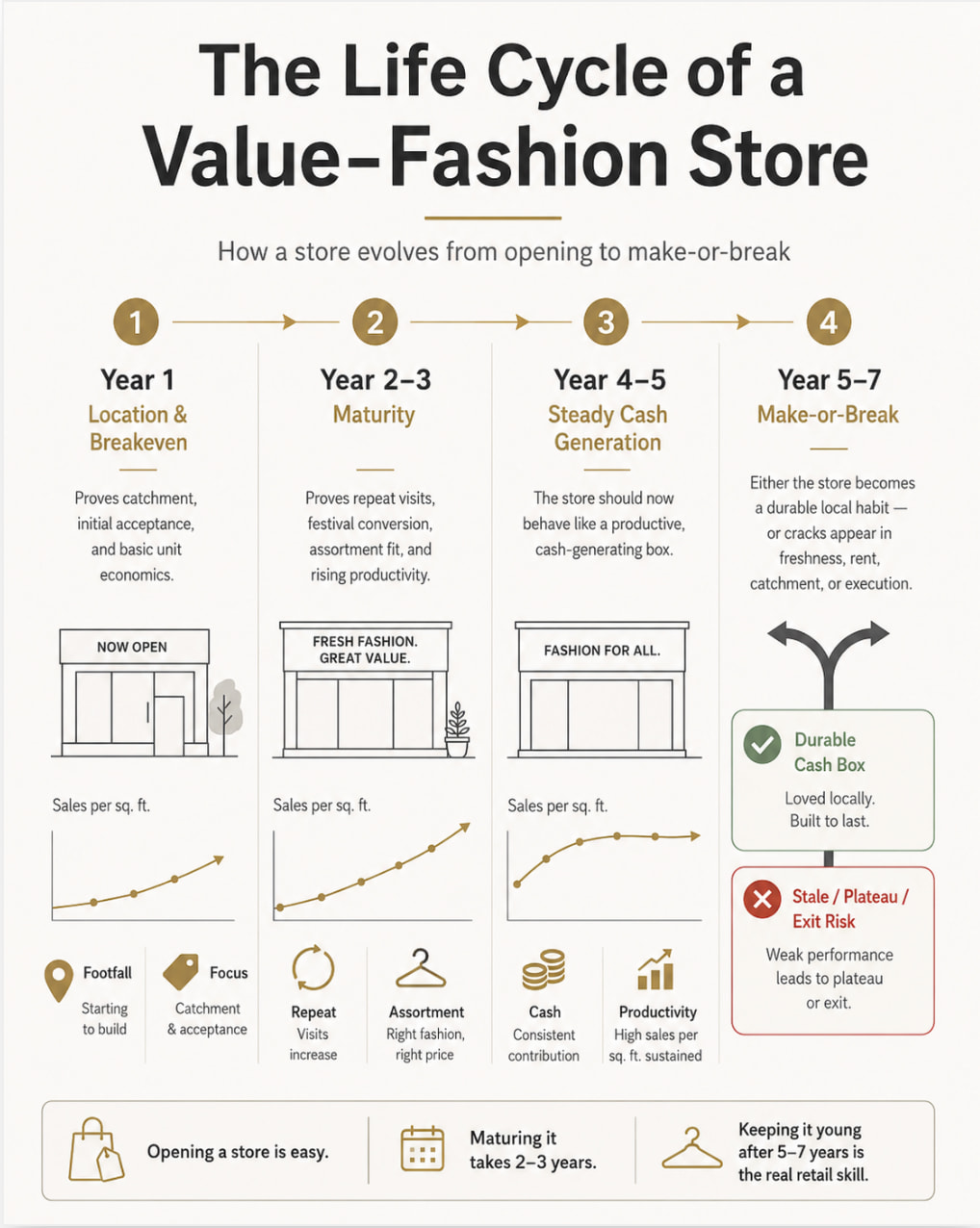
The key point is not that new stores start below mature stores. That is normal. The key point is whether they mature well.
New stores begin at roughly ₹720–800 PSF , while mature stores do about ₹1,200 PSF . Breakeven is around ₹500 PSF . So the real question is not whether a store survives.
It is whether it climbs.
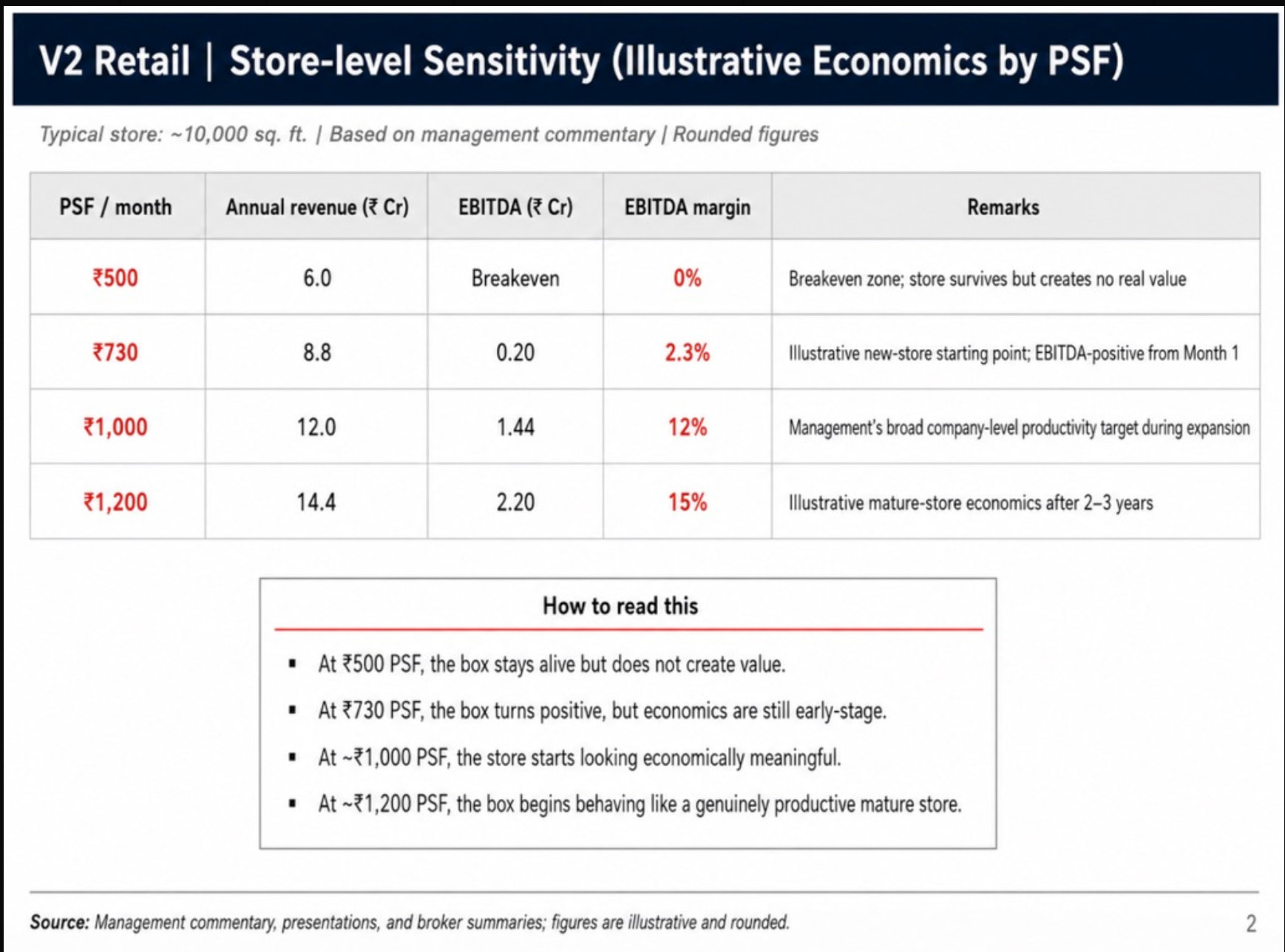
That is why the sensitivity table matters so much.
At ₹500 PSF , the box is alive, but not attractive.
At ₹730 , it is positive, but still early.
At ₹1,000 , the economics begin to look meaningful.
At ₹1,200 , the store starts behaving like a genuinely productive asset.
That is the real store-level ladder.
And that is where retail shifts from narrative to economics.
A store opening is an event.
A store climbing this ladder is value creation.
The rest of the metrics matter for the same reason. PSF tells you whether the box is productive. ASP and ABV tell you whether the basket is improving. MRP mix tells you whether growth is being preserved with pricing discipline. And inventory turns tell you whether capital is circulating fast enough or getting trapped in stock.
Read together, the numbers say something simple:
a good V2 store is not just one that sells.
It is one that sells enough , fresh enough , full-price enough , and fast enough to justify the capital behind it.
That is the real economic test.
Because in retail, store count can make growth look bigger.
Store productivity is what makes growth valuable.
What Can Make This Machine Stronger — and What Can Break It
A retail machine does not become stronger because it opens more stores.
It becomes stronger when each new store proves that the model is repeatable.
For V2, the investor question is simple:
Is the company getting better while getting bigger?
That answer will not come only from revenue growth. Revenue can grow because more square feet are added. The real proof has to come from productivity, freshness, timing, data discipline, and cash conversion.
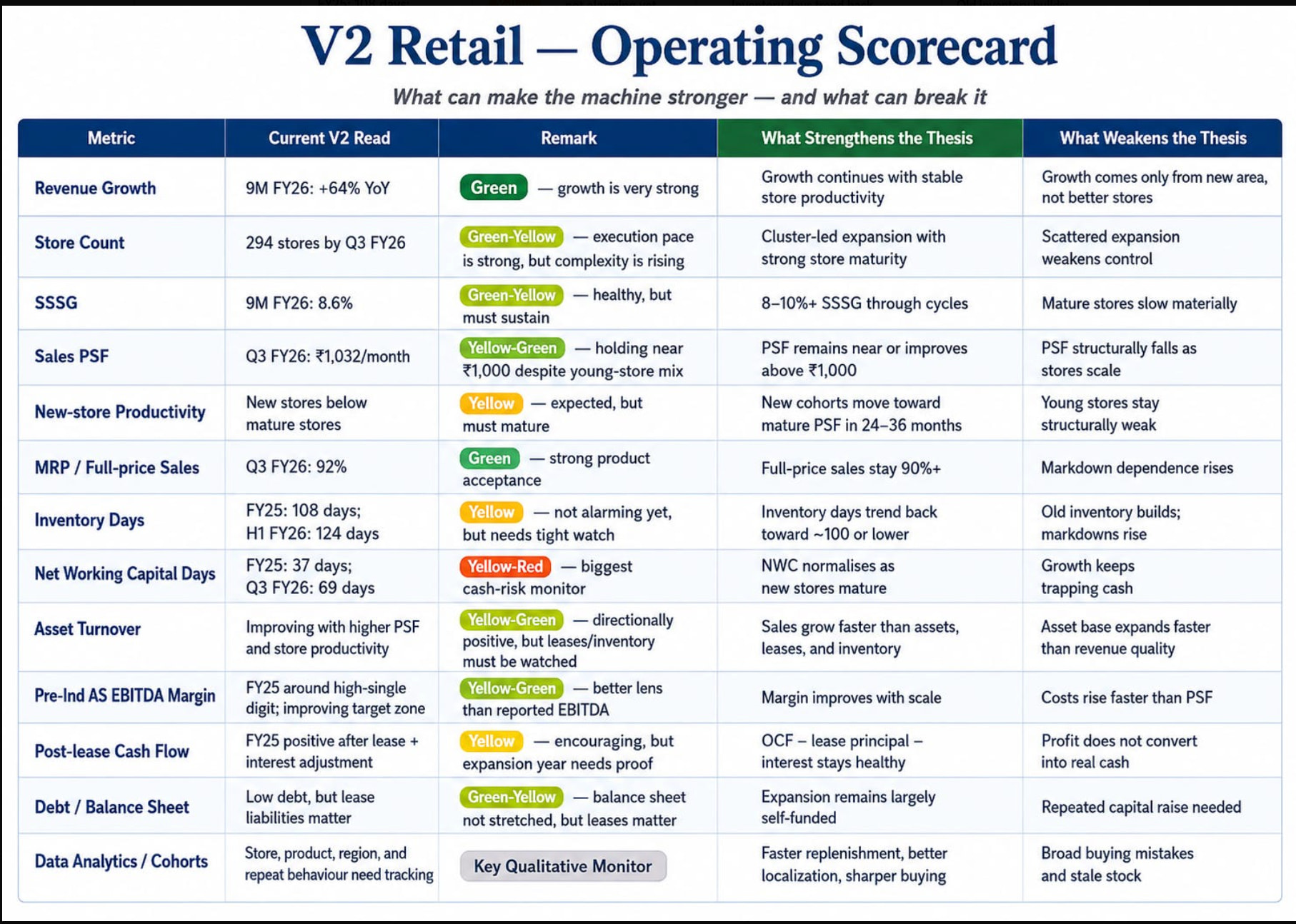
The Operating Scorecard: Is V2 Getting Better While Getting Bigger?
V2’s numbers show strong execution so far: revenue is growing fast, full-price sales remain high, PSF is still around the ₹1,000/month zone, and the store base has scaled sharply.
But the stress points are also visible.
Inventory days and working-capital days have moved up during expansion. That is why the next test is not just growth. It is whether growth stays fresh, productive, and cash-disciplined.
This is where fashion risk becomes central.
V2 is not DMart. Grocery has longer shelf life and more predictable repeat demand. Apparel does not. Fashion has a clock.
And in India, that clock is not only seasonal. It is also festival-led and occasion-led — Diwali, Eid, Dussehra, weddings, birthdays, and family functions. If the right product reaches late, the sale is often lost, not postponed.
That is why supply chain is not a back-end function for V2.
It is the operating spine.
The company has to read demand early, move inventory on time, replenish winners quickly, and cut mistakes before they become stale stock.
This is also where data analytics and cohort tracking matter:
what sold → where it sold → who bought it → how fast it moved → what should be repeated, reduced, or killed
That is the correction loop.
So the test is simple:
Growth is not proof. Fresh inventory, full-price selling, repeatable store productivity, on-time merchandise, and cash conversion are proof.
If these variables improve while the store base expands, the machine is getting stronger.
If they weaken, the rollout number will not protect the thesis.
Competitive landscape
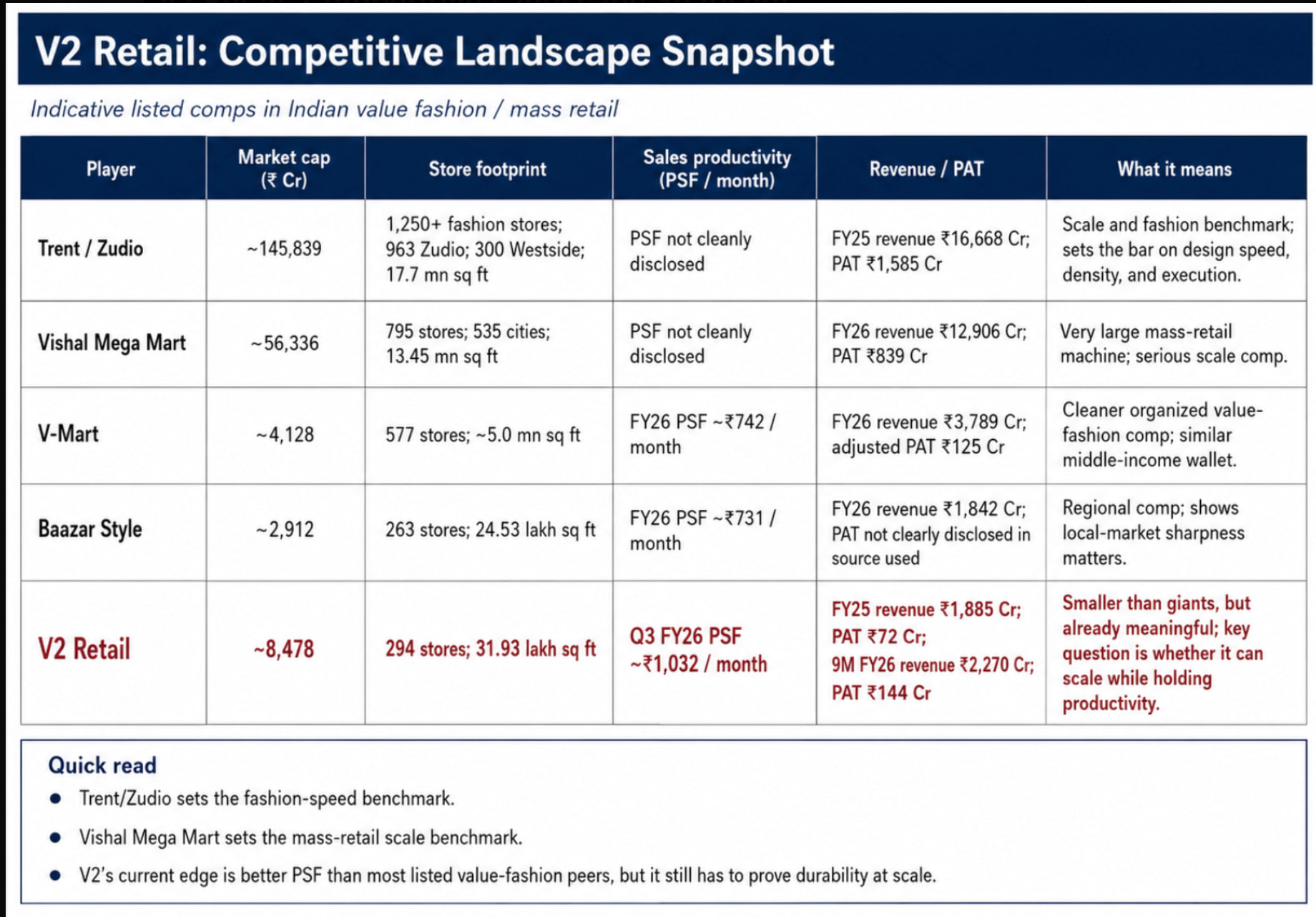
The table above makes one thing obvious: V2 is not playing in a soft category.
This is not a market where being “good” is enough.
This is a market where one player has already set the benchmark on fashion-speed and scale, another has built a massive mass-retail machine, a third is a cleaner listed value-retail comp, and regional players still know their customer well enough to stay dangerous.
That is the field.
So the real question is not whether V2 belongs in the conversation.
It does.
The real question is what kind of position it can earn inside a market that already has serious operators with serious advantages.
Trent/Zudio has fashion velocity.
Vishal Mega Mart has mass scale.
V-Mart has category adjacency and a similar wallet.
Baazar Style has regional instinct.
V2’s pitch is different: it is trying to become a serious Tier II/III/IV value-fashion machine with better-than-expected box productivity, stronger private-label control, and a growing footprint in markets where organized fashion retail still has room to deepen.
So I am keeping this as a snapshot and saving the deeper teardown for a separate piece — one where I will properly compare Zudio, V-Mart, Vishal Mega Mart, Baazar Style, Max, Westside, Pantaloons, Yousta, Azorte and others across format, pricing architecture, store economics, inventory turns, private-label models, regional strengths, and what each retailer is really optimizing for .
That second article will be the full competitive map. This section is only the marker on the wall.
Valuation: Pricing the High-Velocity Machine
A scaling retailer like V2 cannot be valued through one headline multiple.
If you look only at P/E, you are looking in the rear-view mirror while the machine is still accelerating.
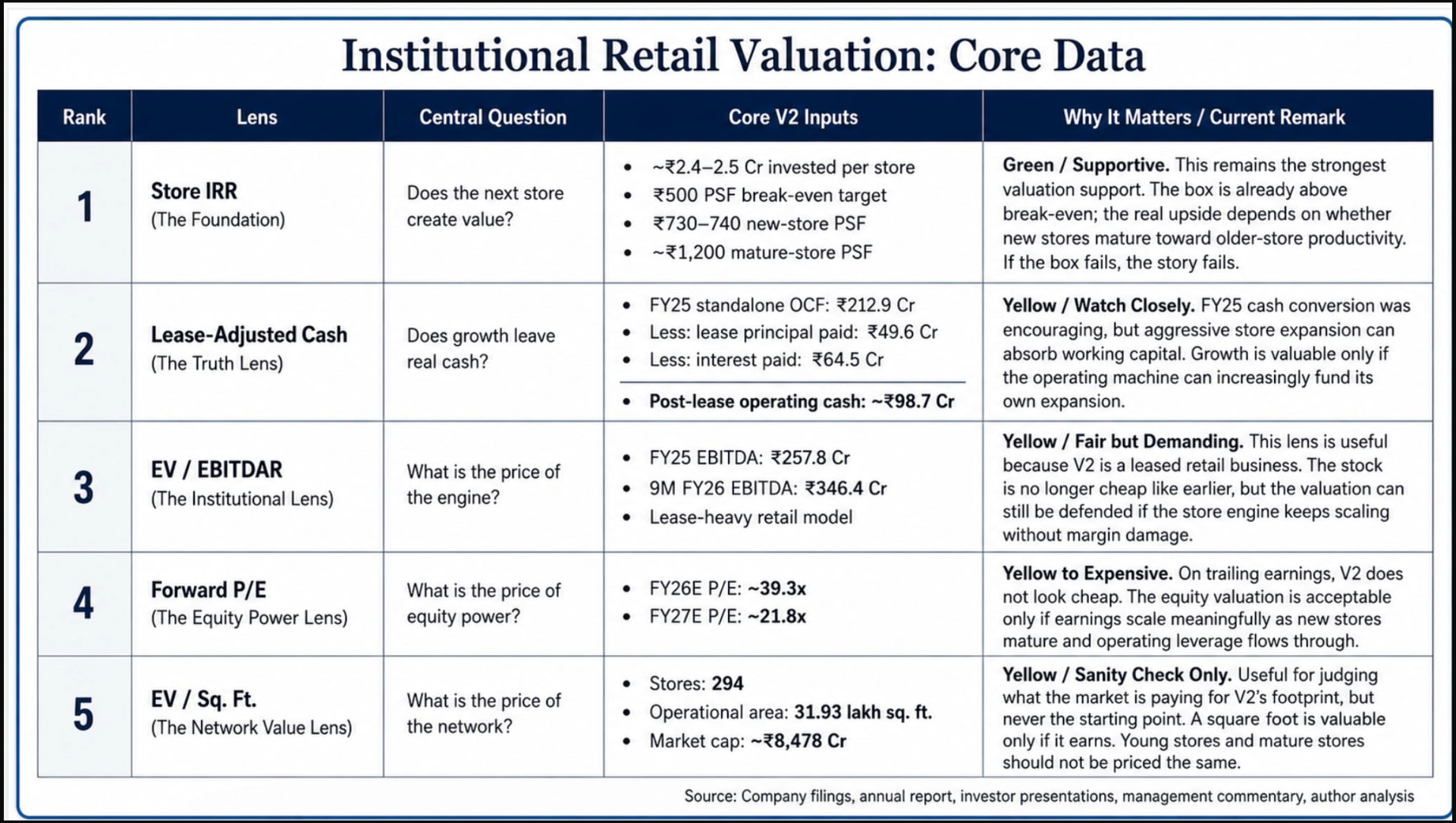
A more careful way to value V2 is to move in this order:
the box → the cash → the engine → the equity → the network
The Valuation Stack
A few things are easy to miss here.
First, growth is not value by itself. In retail, value is created only when new space earns well on capital. That is why store IRR comes first. The real question is not whether V2 can open more stores. It is whether the next store can become a good box.
Second, leased-retail cash flow needs a cleaner lens. Operating cash flow already adds back depreciation. Lease principal sits below OCF. So the practical shortcut is:
Operating Cash Flow – Lease Principal – Interest Paid
Do not subtract depreciation again. If anything, the missing adjustment is maintenance capex.
Third, EV / sq. ft. is useful only after productivity is understood. A square foot is not valuable because it exists. It is valuable because it earns. A mature store and a younger store should not be treated as the same asset just because both occupy floor space.
So the practical takeaway is simple:
Start with the box.
Check whether growth leaves cash.
Then price the engine.
Then price the equity.
Only then look at the network.
That sequence keeps the investor closer to the economics of the business, and farther from the comfort of a single flattering multiple.
Valuation View: Underwrite the Next 1–2 Years
For me, V2 is not a simple cheap-or-expensive call.
It is an execution-underwriting bet with a potentially longer runway .
The market is already giving V2 credit for growth. The stock is no longer priced like a broken or ignored retailer. It is being priced for store expansion, operating leverage, and earnings growth.
So the question is not whether V2 looks optically cheap on trailing earnings.
It does not.
The better question is:
Can V2 keep converting new square feet into profitable, mature, cash-generating stores?
That is why I would not anchor the thesis to one-year P/E.
I would anchor it to store-box economics .
The next 1–2 years are the underwriting window. This is where I need to see whether the store engine is behaving as expected: new stores remain productive, full-price sales stay strong, inventory stays fresh, working capital does not slip out of control, and growth starts leaving better post-lease cash.
If that proof comes through, V2 can move from a rollout story to a repeatability story .
That is where the holding period can extend to 3–5 years or more .
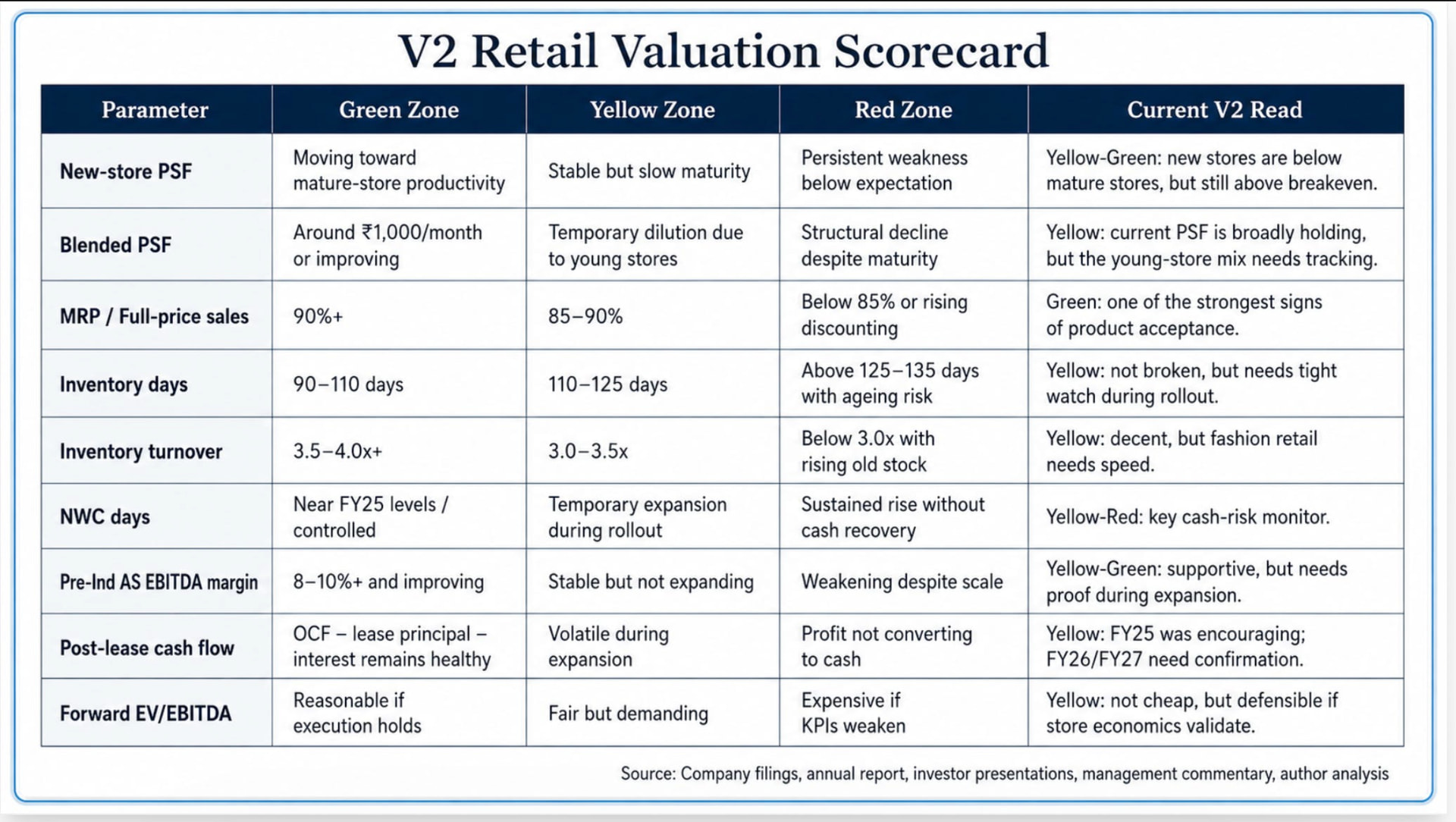
Valuation Scorecard
The important point is this:
V2’s valuation is not protected by obvious cheapness. It is protected by execution.
So my stance is not:
“V2 is cheap.”
My stance is:
Underwrite the next 1–2 years. Own for 3–5 years or longer only if the box keeps validating.
That is the discipline.
Because in retail, longevity is earned store by store.
If V2 keeps improving while getting bigger, the holding period should expand with the evidence.
Risk / Anti-Thesis: What Can Break the Thesis
No retail thesis is complete until you ask the harder question:
What if expansion works — but the box economics do not mature the way the market expects?
That is the real risk in V2.
At this stage, survival is not the question. V2 has already reached scale. The question now is whether the next leg of growth makes the business better , not just bigger .
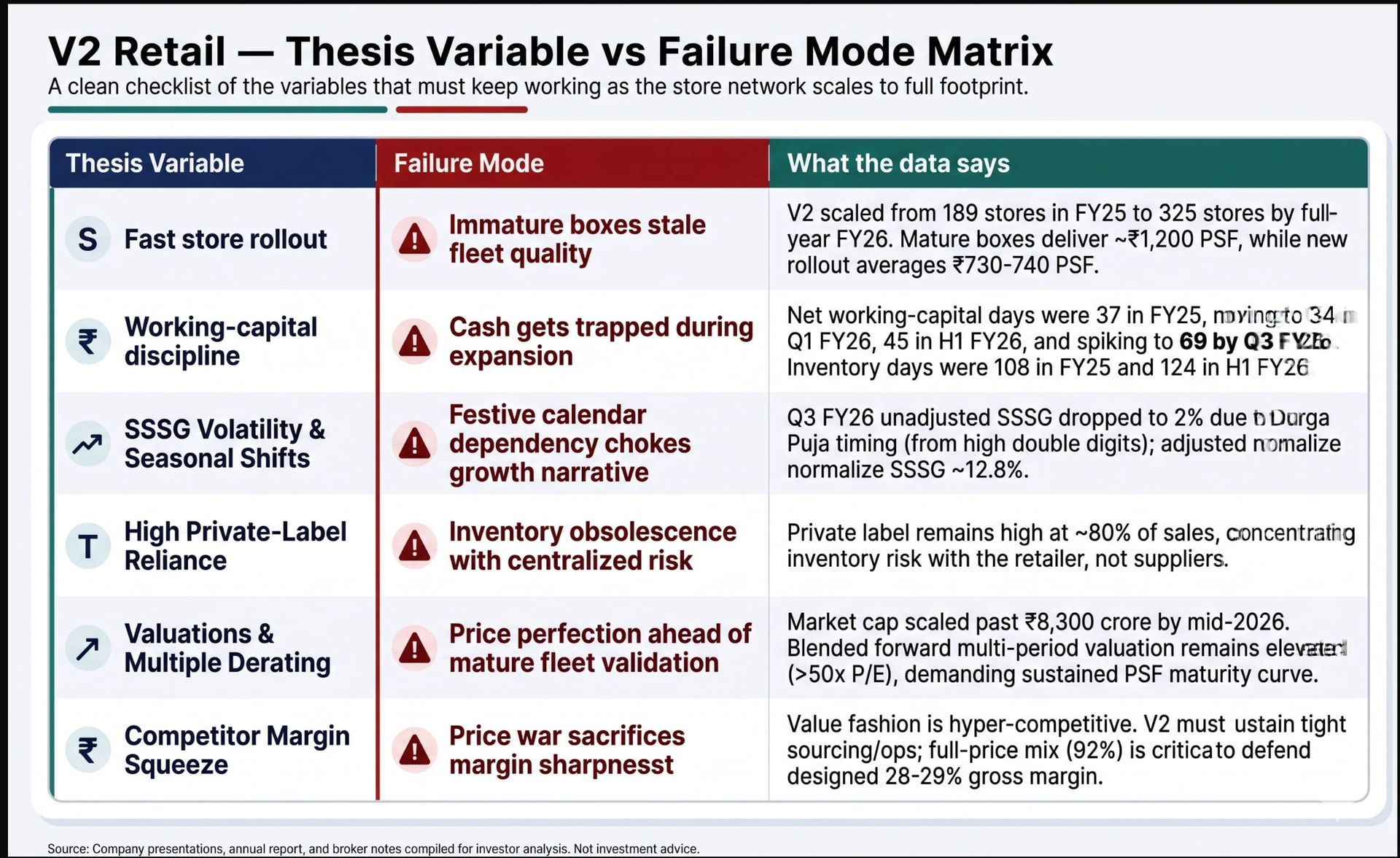
The matrix above is the real checklist.
It says the same thing in a harder way: every strength in the story has a failure mode. Fast rollout can dilute fleet quality. Working-capital efficiency can weaken under expansion. Better scale economics can get masked by immature boxes. Private label can improve control, but it also internalizes more of the merchandise mistake. And a high-growth narrative can punish even small execution misses once valuation starts assuming maturity before the stores have actually matured.
So the anti-thesis is not that V2 is broken.
It is that the business may keep growing in footprint while the economics stop improving at the same speed.
That is how retail stories disappoint.
Not through collapse first — but through slower maturity, weaker cash conversion, softer productivity, and valuation that runs ahead of proof .
That is what needs to be watched here.
The real watchpoints
- Are newer stores climbing out of the ₹730–740 PSF zone fast enough?
- Is blended PSF recovering after rollout, or slowly resetting lower?
- Are working-capital days normalizing, or staying heavy?
That is the real bear case.
Not fraud.
Not irrelevance.
Not immediate breakage.
Just a far more common retail outcome:
a business that scales faster in area than in maturity.
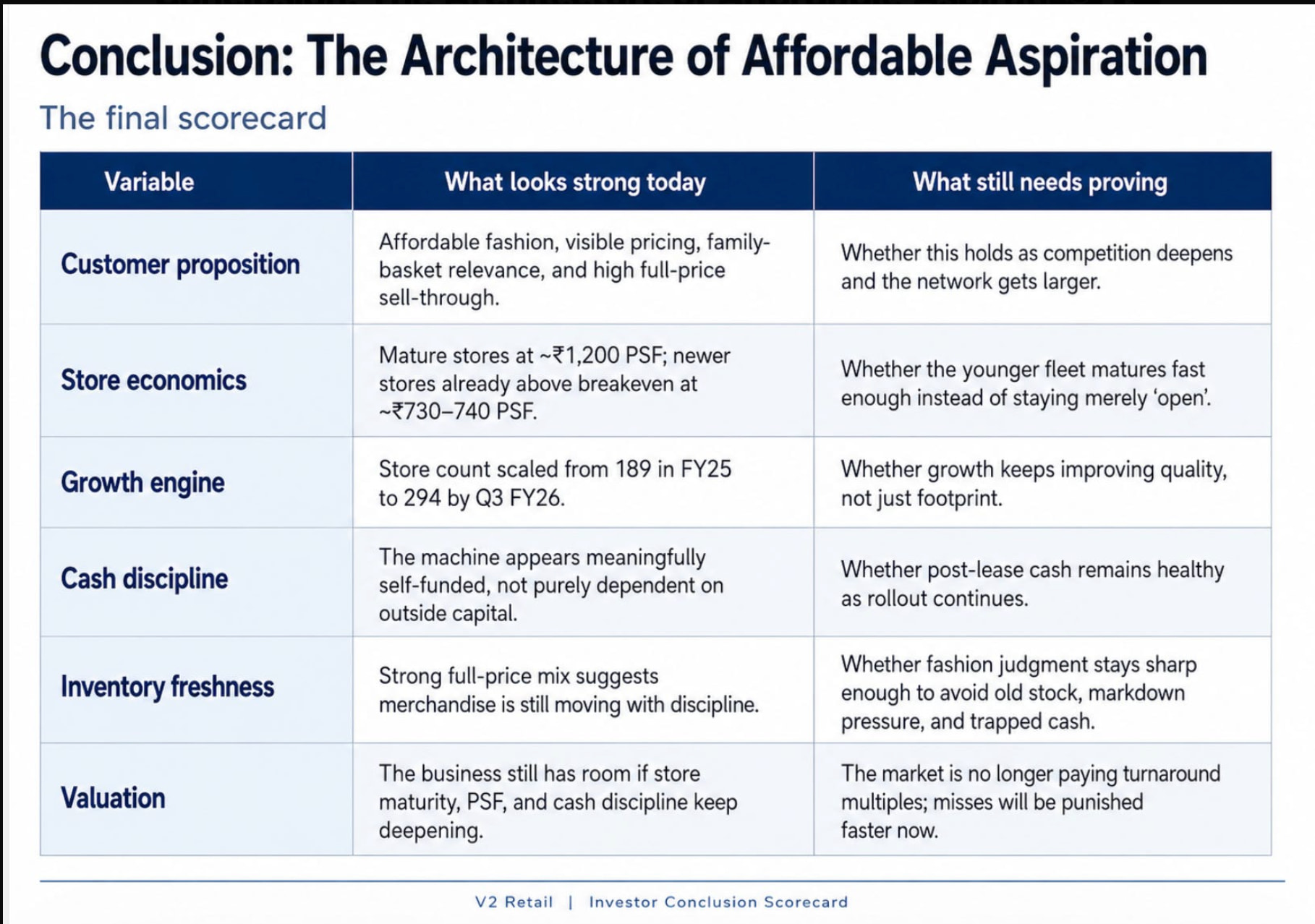
Conclusion: The Architecture of Affordable Aspiration
V2 is not interesting because it sells cheap clothes.
It is interesting because it may be building something much harder: a repeatable retail machine for customers who want to look better, shop with less friction, and stay within the budget.
That is the real story.
Not luxury.
Not brand mythology.
Not slogan-driven aspiration.
Just a sharper question:
Can organized value fashion become a trusted habit for the Indian middle-income family?
V2’s answer is operational, not poetic:
fresh enough merchandise, trusted enough quality, low enough prices, and disciplined enough execution to make the customer come back.
That is what the shopper sees.
What the investor should see is the harder layer beneath it:
That is the entire game.
Because retail does not become great when it gets bigger.
It becomes great when it gets better while getting bigger.
And that is the standard V2 now has to clear.
The easy part of the story may already be behind it. The market has noticed the turnaround. The stock has rerated. From here, the question is no longer whether V2 exists.
The question is whether the machine can keep compounding without losing shape.
That is where real retail stories separate.
Some chains expand and look important.
A few expand and become durable.
Very few expand and become inevitable.
V2 is not inevitable yet.
It is still on trial.
Because fashion retail carries a sharper risk than staple retail. A weak assortment does not merely slow sales. It creates old inventory, forces discounts, blocks shelf space, traps cash, and weakens the very freshness that brings the customer back.
So the thesis is not just store expansion.
It is taste at scale.
If the box keeps working, the cash keeps holding, the product remains fresh, and the younger fleet matures into the older fleet, this story can still travel much farther.
If not, retail will do what it always does:
it will punish weak economics long after the rollout looked impressive.
V2 is no longer a hidden story.
Now it has to become a proven one.
 Investment Status & Thesis
Thesis Written On: May 20, 2026
Current Stance: Meaningful but controlled position, biased by holding.
Disclosure: I am currently invested in V2 Retail with an allocation of approximately 2–3% of my total equity portfolio.
For me, V2 is a dual bet on scale leverage and fashion velocity . The company has shown enough proof to deserve real capital, but not enough proof to be treated as inevitable. In retail, the difference between a compounder and a value trap often comes down to the quality of the next 100 stores opened.
The Decision Ledger
I may increase my position if: Newer stores move toward ~₹1,100–1,200 PSF , blended PSF stays around ~₹1,000+ , inventory days stay near or below the ~100–110 day zone, and full-price / MRP sales remain above 90% .
I may hold my position if: Blended PSF stays broadly in the ~₹900–1,000 zone, inventory days remain manageable in the ~110–125 day band, and full-price sales stay in the ~80–90% range without visible markdown stress.
I may reduce my position if: Revenue grows but blended PSF slips below ~₹900 , inventory days move above ~125–135 , or full-price sales fall below ~80% , suggesting rising markdown dependence and weaker freshness.
I may exit the thesis if: newer stores stay stuck near the ~₹730–740 PSF zone, blended PSF weakens structurally, inventory keeps aging, and markdown pressure becomes the main driver of sell-through rather than true demand.
In value fashion, PSF tells you whether the box is selling, inventory days tell you whether stock is moving, and full-price sales tell you whether the customer still wants it without being bribed.
Formal Disclaimer
I am not a SEBI-registered research analyst or investment advisor . Nothing in this post is investment advice, a recommendation, or a solicitation to buy or sell securities. This is my personal research and interpretation based on publicly available information, company filings, investor presentations, and management commentary.
Retail is a high-execution, high-risk business. Please do your own due diligence and consult a qualified advisor before making any investment decision.
Your capital. Your responsibility.