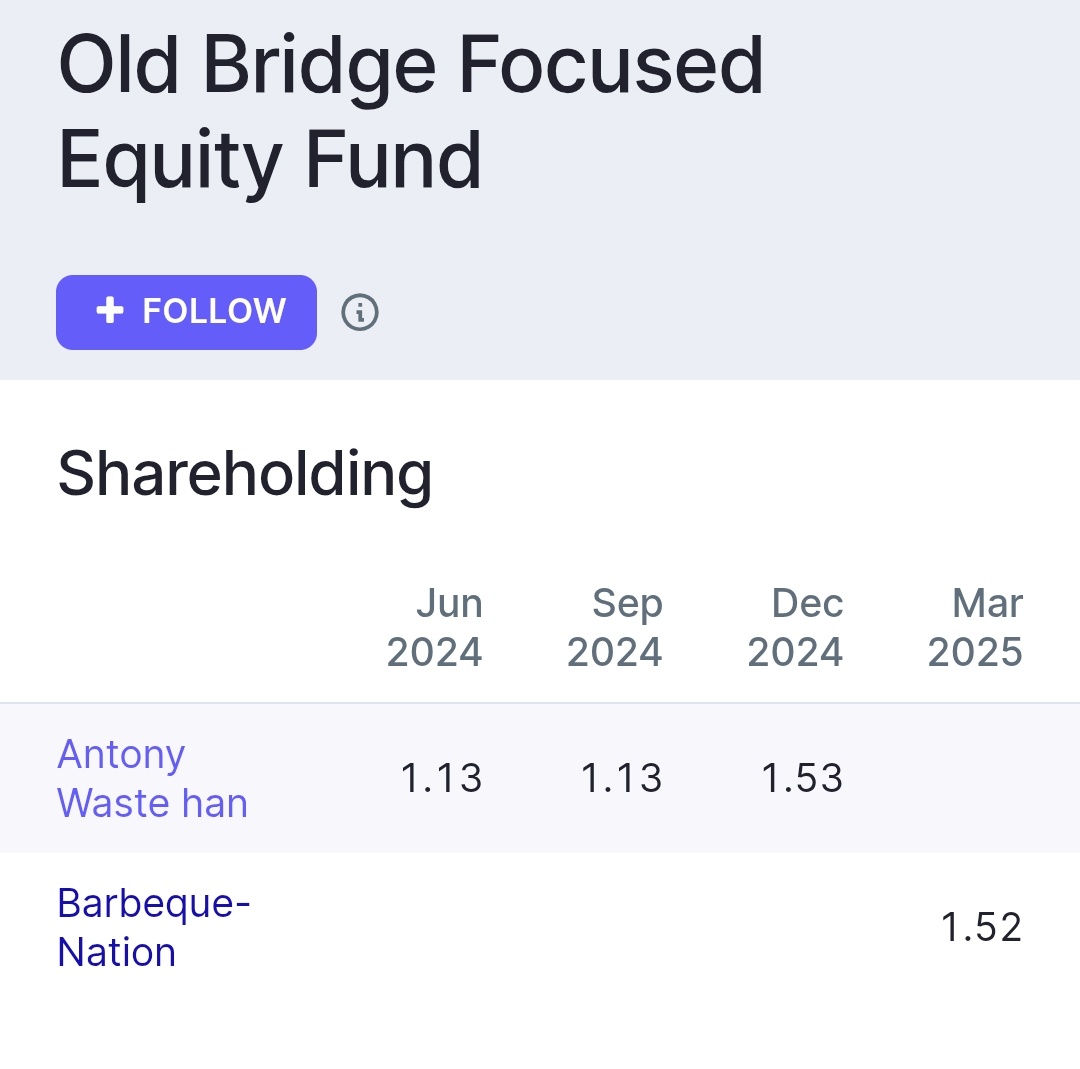
United food brands ( Barbeque nation ) Ltd

This is a very peculiar data point. It’s strange why this behavior is more prevalent in South? Any insights? Is it because of the type of food they prefer? Is BN (Barbeque Nation) providing any customized, south specific delicacies to southern market, any localization?

Also is this a general trend for all speciality dining in Southern states or only BN?

True. But BN already has the concept of Barbeque in box which you can order home. I myself have ordered it 5 times.

But I think the bigger issue is competition. Almost anyone can replicate the BN model. They are not providing anything unique.

1 Like

I got the doubt that, South must be their problem bcoz, I see lot of people around me who were once interested in going to Barbeque are not showing the same interest any more after going there 2-3 times.
So is the reason I asked the mgmt in the concall, South specific questions. They agreed that indeed south is the issue. But when the next participant asked the questions in detail about the South issue, mgmt refused to comment on regional specific questions any futher.

My personal feeling and feedback from few of my friends here in south is,
1.They have already experienced it a couple of times already, now they want to taste something different. There are many other alternative options, Not only in Barbeque format but in various other formats as well.
2. Corporate companies (software mostly) were offering dinners to their employees at Barbeque frequently before, now they are not offering as much.
3. Ordering any item online is way cheaper and easier than handling the Traffic, parking issues etc.
4. Overall people are not so enthusiastic to get the same experience repeatedly.

4 Likes

Agreed. There is a pick up in their Delivery based business and I think it will grow further. But when it comes to Ordering, as you said, there are enough of options to choose from, One doesn’t need to go with Barbeque alone.
Barbeque Nation is a good experience. But they had it already a couple of times and so not so interested in repeating it again. Especially as there are other new alternatives. (People may want change :wink: )

There seems to be an in general slowdown in consumption. Most of the QSRs are driving towards value growth. Barbeque Nation doesn’t position itself as a QSR, but something like a fine dining experience. However, there is less of demand on spending on discretionary items / experiences in general due to inflationary pressures. They could try to increase their traffic by giving more discounts. I rarely see any discount offerings for BBQ Nation whenever I feel like going there. (Majority of the times I skip going due to lack of discounts / higher prices.)

1 Like

Time for Barbeque Nation to get more creative and then step up the marketing.

If they keep repeating the same things, they will remain stale, and lose out to competitors easily. Customer stickiness / repeat rate seems inherently low in such type of business, they NEED to do some tinkering to the existing model.

Disc: Recently took a position as a Brand Play and staring at losses after the crash

4 Likes

I used to be frequent customer too until last couple of times I experienced a degradation of quality specially in the main course section. Nothing tasted good and the experience was forgettable. Recently, we went to Absolute Barbeques and were blown away by the their spread and food quality. Its cheaper too.

For the prices they are charging the management needs to up the ante, start improving main course quality and offering better deals and offers.

3 Likes

No one wants to have a buffet every time you dine out. There was a time I liked buffet but now I simply dislike them as you tend to over eat and ultimately not enjoy anything. Having just couple items of your own choice with no options to spoil it, is what I like more now.

When it comes to drinks, BN does not seem to be the choice of place either for most…maybe because of chosen ambience.

Also many times in a family of say 6 people 3 may not want to hog in a buffet and hence may feel not getting value for money.
I think they need to revisit their core strategy of buffet vs Ala carte and maybe have best of both worlds as they have sufficient space and resources.

Well above are personal thoughts and preferences and carry no value in investing and neither a company would change business model based on our wish list…probably just thoughts on trying to analyse what’s not working for the company currently….I maybe wrong in my assessments.

1 Like

Does wait time and dining time also contributing to people not going to Bbq restaurants?

1 Like

The starting post of this thread (Barbeque Nation | Value Seeker) is very well written and gives pretty good context on BBQ.

Personally, I have been to Barbeque Nation, and I was impressed with the experience and I thought this chain can expand across India. What do you call it? Authority bias / recency bias etc etc , I dont know, But some huge bias towards BBQ :slight_smile:

However, when it got listed, I had no interest in looking at the company as valuations were not in my favor . But recently, when the stock got hammered (Feb 2025), I started looking at the company again.

The first apprehension that I had now, is despite taking the restaurant count to 225, why the company still posting losses? Are there many new stores openings, expenses of which (Initial setup cost/ depreciation etc) are front loaded, but revenues back ended? I found its not the case, 80% of the restaurants are in mature category.

Agree that they do generate 70 to 100 Cr cash, and deploy it in new restaurants, and the business funds growth on its own. But saying that depreciation in P&L is not real cost, is not correct , and that you should ignore it, I do not agree to. They are not profitable (for now), even after having 200 restaurant chain.

Looking further, I realized that Same store sales growth (SSSG) for the company is declining since last two years, which is industry wide phenomena, not company specific issue. Currently company does 6 Cr revenue per store , with 200 restaurants , it comes to 1200 Cr annual revenue.

The operating leverage is huge in this business, if sales per outlet can reach 7 Cr, 50% of additional revenues will flow through bottom-line (PAT), which means for 200 outlet, additional 1 Cr sales per outlet, can lead to 200 Cr additional revenue, which may translate to 100 Cr PAT. This is assuming no expansion in terms of new outlets. (These are my numbers, you dont need to agree with me. You can have your own numbers, we can all play the role of investment banker)

Now with above background, and at today’s market cap of 1200 Cr, are valuations reasonable? Well, it depends on your view about BBQ being relevant and able to command its authority in competitive Casual dining space and its ability to grow. This is a qualitative opinion and will vary for each investor.

We also need to also think what can go wrong?

  1. Casual dining restaurant (CDR) is mortality and fast changing industry, will BBQ be able to keep itself relevant overtime and grow?

Promoters - I do not have positive view about promoters, about which I have written previously in this post (Barbeque nation Ltd - #22 by Amit2saxena), but presence of Jubliant Foodworks as minority investor holding 10% stake gives some comfort., that minority investors will not be taken for a ride.

Disclosure - Not inivested

13 Likes

How many times would someone eat at Barbeque Nation Ltd per week/month? if we look into successful restaurant chains, would we find that its their ability to get a customer to eat at their restaurants more than once per week or month? Is there a moat?

For comparision look at food chains like Chipotle Mexican Grill.. Customers should be able to eat often without feeling guilty about the price or nutritional value to scale?

9 Likes

That’s like worrying about if people will start skipping meals. I doubt this trend of Semaglutide drugs will have any impact on fine dining restaurants. Junk foods like chips, sweets, namkeen, sugary drinks like Colas will be more impacted.

Disclaimer: have a position, could be biased

4 Likes

Kenneth Andrade doubling down

Disc: invested

1 Like

PF weightage is 1.2% only, not even medium sized bet in their PF.

3 Likes

Interesting interview of the CEO of Chilli’s. I guess key is repeat customers like for any other business and increasing the frequency of their visits.

2 Likes

Though the stock appears cheap now ~ 0.75x sales, I dont see a path to profitability yet and all parameters that are used for a dining business appear bad - If someone is invested in this i would really like to understand their thesis

2 Likes

ICRA’s Credit Rating outlook revised to Negative from Stable

Disc: Have a 1% position. Trapped like most :laughing:

2 Likes

Here is a summary of the concerns and the management’s responses in Q2FY26 result concall:

  1. Concerns Regarding India Business Margins and Strategy
Concern Raised by Investor/Analyst Management Response
Significant Decline in India Business Margins: Margins, even at gross levels, saw a significant decline despite quarterly revenue of 5.6 crores. Analysts were confused about the strategy of compromising margins for growth when growth was still not forthcoming. Gross margins were down by approximately 2 percentage points. This was attributed to two main factors: High food cost (almost 1 percentage point impact) due to a month-long Kaugali Food Festival, which has since been removed (1 percentage point was recovered in gross margin in October); and Value-driven campaigns (like Sizzling 7 and Big Buffets) that were implemented to promote group offers and drive transaction growth. Management stated they are investing in margins and marketing to bring back traffic during a challenging industry period. The overall guidance for consolidated gross margin is to stabilise between 67% and 68% going forward.
Decline in Restaurant Operating Margin (ROM): Comparing Q2FY26 to Q3FY25 showed a significant drop in ROM. Management clarified that comparing Q2 (seasonally one of the worst quarters) with Q3 (seasonally the best quarter) is incorrect. The approximately 4 percentage point drop compared to Q2 last year resulted from lower gross margins, a 1.2% increase in marketing spend, and the ramp-up of new stores. Improvement in ROM is expected in Q3FY26.
Structural Shift Requiring Additional Value: The recovery to flattish SSSG required investments and offers. Analysts questioned if this suggests a structural need for consumers to receive additional value to return to stores, and if further investments are needed to reach mid-single-digit SSSG. Management maintained that the focus is on building transaction growth. Sacrificing some gross margin is acceptable because the format has very high operating leverage, meaning the positive impact of higher SSSG due to better throughput will be greater than the gross margin sacrifice. The current momentum makes the management “extremely happy”.
Concerns on Prior Value Strategy: An analyst recalled a previous attempt 18 to 24 months ago to use lower pricing for revenue pull-through, which was unsuccessful as transactions fell once discounts were removed. Management distinguished the current strategy: the previous attempt was a “blanket” price reduction. The current approach is targeted, focusing on larger group offers which aligns with the brand philosophy of group dining. This limited approach ensures a minimum throughput on the discount while delivering larger volumes, aiding overall operating leverage.
  1. Concerns Regarding SSSG Performance and Business Model Viability
Concern Raised by Investor/Analyst Management Response
Persistent Negative SSSG: SSSG has been negative for almost three years (12 quarters), with Q2 EBITDA hardly breaking even (3.3 crores). Analysts questioned the strategy of continuously opening new restaurants when the existing SSSG is negative. Management countered that the negative SSSG is broadly in line with industry trends. The trend has been only plus/minus 2%, which does not imply the business is failing. Management is happy with the positive momentum over the last four months (July to October 2025, SSSG was 0.3% positive, driven by transaction growth).
SSSG Outlook: Analysts asked if the company should see low single-digit SSSG growth, given the low base from Q3 last year. The entire Q2 was at minus two SSSG, but the four-month period (July to October 2025) was in positive territory. October specifically delivered mid-single-digit SSSG (consolidated SSSG was up 6-7%; India business SSSG was up 5%+). Management stated the momentum is continuing and the focus remains on building transaction growth.
Base Model Not Working: Given the poor performance over several years, analysts questioned if the base model is broken and suggested the company should fix the model before continuing to scale. Management strongly disagreed that the model is broken. The model is working fine even in a subdued performance. The overall portfolio (India business) generates approximately 60 lakh rupees of operating EBITDA on an annual basis, with an average payback period of almost four years, even during one of the “worst time period[s]”. Furthermore, the same brand/offering in international markets, which has been running for nine years, is delivering 20% to 25% annual operating margin. The core concept (all-you-can-eat buffet) is valuable to consumers and is “absolutely not” structurally broken.
  1. Concerns Regarding Debt and Financial Outlook
Concern Raised by Investor/Analyst Management Response
Increased Debt due to Capex: The planned full-year capex of 125 crores, compared to lower cash flow generation (60–80 crores), will lead to a significant debt increase. Management confirmed that debt increased in the first half. However, H2 is generally a stronger quarter for the business. Based on the assumption of achieving around 8% corporate-level EBITDA margin pre-IndAS for H2 (the stronger period), the gap between cash flow generation and capex should not exceed 50 odd crores for the next six months. Later clarification noted that net debt (which was around 90 crores) is expected to increase by only about 15 odd crores over current levels by year-end.
Outside Limit on Debt: If demand remains soft, what is the maximum debt limit the company would allow before slowing down store openings?. Management stated it is difficult to give an absolute offside limit but does not foresee the debt exceeding 100 crores in the current scenario. If margins do not materialize as expected, they may decide to slow down, but they prefer a long-term view when building a stronger business.
  1. Concerns Regarding Competitive Environment
Concern Raised by Investor/Analyst Management Response
Competitive Intensity: Analysts asked if the company has seen an increase in competitive intensity, or if the worst of the scenario is over. Management confirmed that they have not seen any increase in competitive intensity from competition within the same all-you-can-eat buffet category restaurants. The focus is on maintaining momentum, and while Q2 was difficult, the team is cautiously optimistic about building the business and driving transactions.

The management believes that its current strategy of investing temporarily in gross margins and marketing (maintained at 3% of sales) to stimulate transaction growth (which stood at approximately 4% for the four-month period in the dine-in business) is yielding positive momentum. They view the current margin softness as a “short term investment”.

8 Likes

In fact. this is the last in the list (% allocation)

Mgmt is “hopeful” of recovery in the market on its own. Whether it will happen or the society at large is moving away from walking in to restaurants, especially for “all you can eat buffet” towards ordering food online is the real concern.
Mgmt is bold enough to continue with expansion by opening new restaurants. If it works, they can become strong leaders but if it doesn’t, it will have heavy impact on the balance sheet as they are increasing debt levels too.
Not a comfortable situation for a long term investor in the company to be peaceful.

3 Likes