
Found this interview to be very interesting
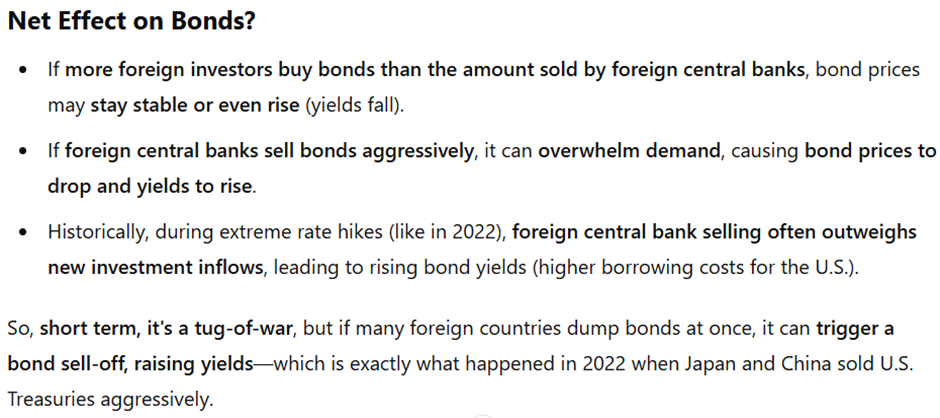
- If you raise interest rates that would attract investments in the US making the currency too strong now, countries who have borrowed in USD, or import or Peg their currency would want to sell US bonds and raise dollars and buy their own currency to maintain exchange rates. This would lead to bond sell off raising yields and hurting the US.
-
If you cut interest rates that would accelerate inflation and higher inflation leads to demand for higher interest rates in bonds hence that would again lead to selling of bonds. (if Inflation rises and I get a fixed interest rate the value of that decreases) . Hence have to get the dollar down
-
Once the 10yrs yield hits 5% or 5.25% that’s when a reset would require and all assets would fall (higher discount rate reduces valuation)
-
Foreigners are short $13 trillion in U.S. dollar-denominated debt in the euro-dollar market (total debt people own to the US. Many global borrowers have taken on debt in U.S. dollars because of lower interest rates compared to their local currencies) if dollar strengthens this debt becomes expensive
-
Foreigners own 8.5$ trillion of US debt (bonds) if dollar keeps strengthening I will have to sell this and maintain my currency or repay my debt this leads to bond price further falling
-
Foreigners own 57$ trillion of US asset gross and 22$ trillion of net asset
-
There is a theory the reason US dollar is strong is because their economy is doing very well, consumption, employment, investments but US economy can not do good if the stocks are falling (why this might fall already explained if yield cross 5%) so kind of interlinked
-
If dollar keeps stranghtening there might be tipping point of foreigners selling treasury bonds which will rise yield which will make borrowing for US fed more expensive especially them having 7-8$ trillion of bonds maturing this year and this is when they have about 7% of fiscal deficit
-
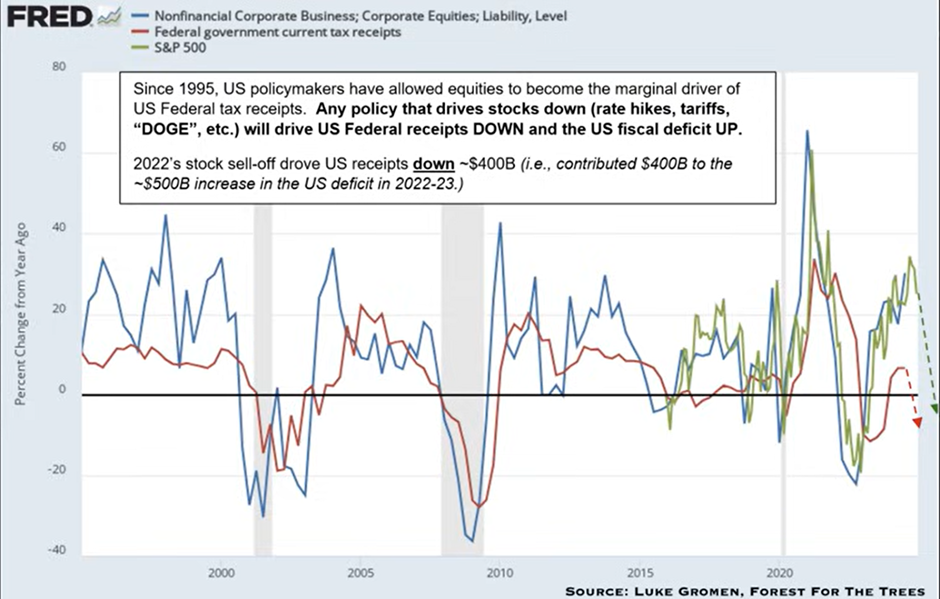
Personal Consumption Expenditures (PCE) make up two-thirds of the U.S. economy and this is doing better than the rest of the world. This means consumer spending is the biggest driver of U.S. economic growth. Now 100% of the growth in PCE is form net capital gains taxable IRA withdrawals, so 10% of california budget is coming from stock market gain form 4 companies
-
Now if we continue with the above thesis and US stock falling ⅔ of US economy fueled by stock gains take a big loss
-
US cannot afford a recission, historically recession has spiked defecit by 6-12% so that would take the deficit to 13-20%, world war 2 levels at this same time if foreigners sell 8$ trillion of bonds that would take the deficit to 20-30% (I hope now we can connect that why they want to cut ⅓ of the US spending) (I think once the sell of starts this can lead to dollar depreciating as people pull out money back to their own country this is my guess)
-
5% of the taxpayers pay 62% of the individual income taxes 31% of the total government income is also a function of the capital gains they have earned form top 4 US companies so stock gains funding US budget
-
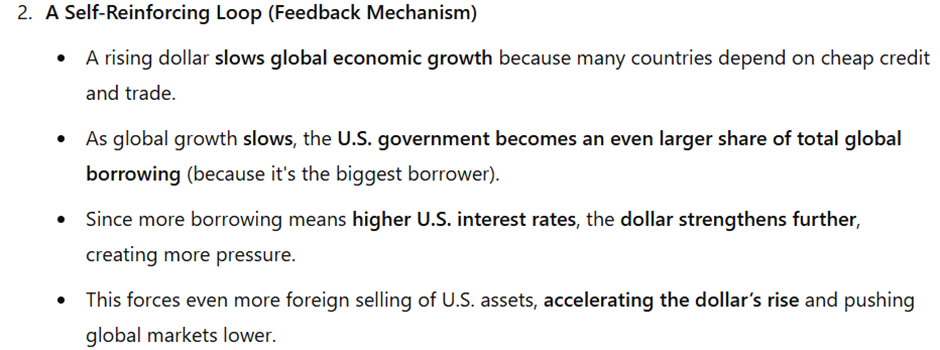
U.S. buys foreign goods → Foreigners get dollars → They invest in U.S. assets → U.S. asset prices rise → More global demand for U.S. assets. Foreign entities have borrowed $13 trillion in dollar-denominated debt because it was cheaper than borrowing in their local currency. A stronger dollar means it now costs more in local currency to repay that debt so they sell treasury to raise cash quickly
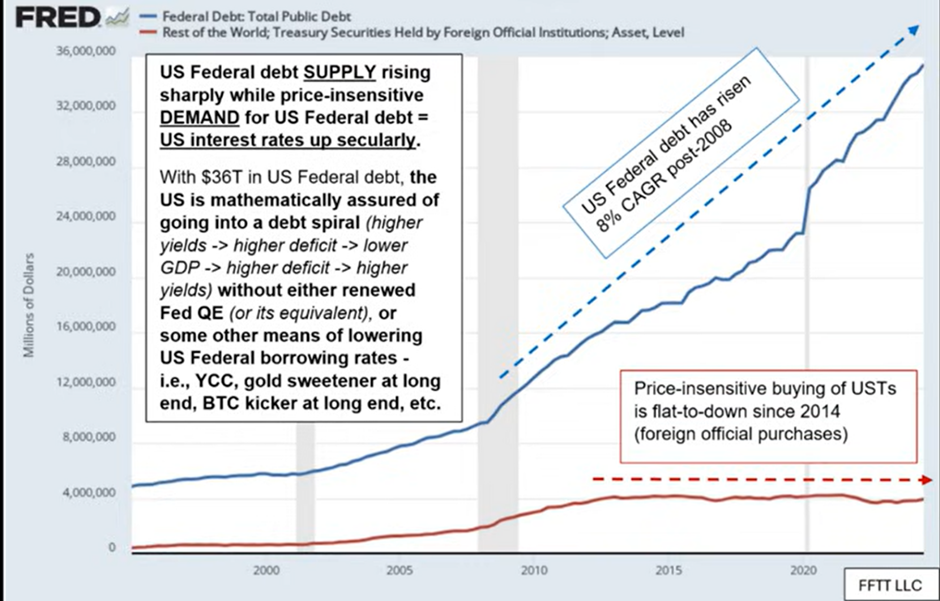
- Price insensitive buyers (these are the buyers who buy regardless of interest rates for political reason to maintain relationship like Japan, China) the foreign official accounts have not bought an incremental treasury bond on net over the last 10 yrs
-
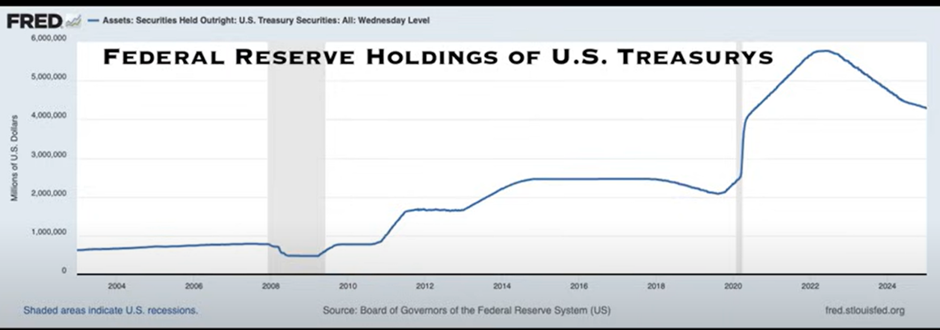
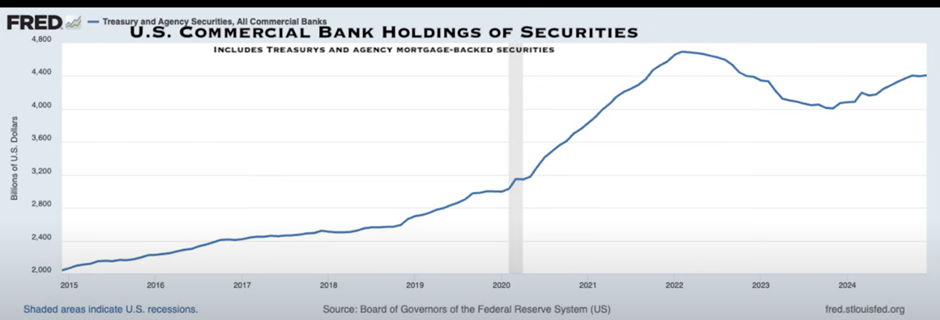
Federal reserves and US commercial banks are among the biggest holder of US debt
-
The Trump administration has been a critic of issuing a lot of treasury bill which Janet Yellen (78th United States secretary of the treasury) and Mnuchin (77th secretary) has also done. Janet Yellen issued more short-term debt (Treasury bills) instead of long-term debt (Treasury bonds). Ideally, locking in long term rates are good but Yellen issued more short-term debt even though rates were higher at short end. 2 possibilities
a. Market could not absorb it without bond market crashing and yield rising uncontrollably (this would happen when they sell bonds)
b. The unlikely scenario that Yellen simply made a bad decision
-
The conclusion is there is not much demand for the long-term debt as seen in the graphs above as well. Now if the US has to issue extra-long term bonds of 50yrs to allies (like Japan, Europe, etc.) In exchange for military protection and trade benefits this strategy might require a much higher price of gold as part of a broader financial reset, hinting at potential moves toward a gold-backed or partially gold-backed financial system. HENCE A POSSIBILITY OF GOLD REVALUATION AS WELL
-
If we recollect this U.S. buys foreign goods → Foreigners get dollars → They invest in U.S. assets → U.S. asset prices rise → More global demand for U.S. assets now placing tariff would disturb this free flow
-
34$ trillion of US debt if yield rises too much borrowing would become expensive. The Fed would print unlimited money to buy Treasuries and cap yields at a set level (like 5.25%). front-end (short-term rates) might be kept lower (e.g., 2.5%) to stimulate lending. Fed’s balance sheet could explode to $40T, $50T, or even $100T as it absorbs massive debt. Investors might flee the dollar and move into gold, Bitcoin, real assets. This would lead to a currency crisis, forcing a financial reset (possibly a shift toward a commodity-backed system).
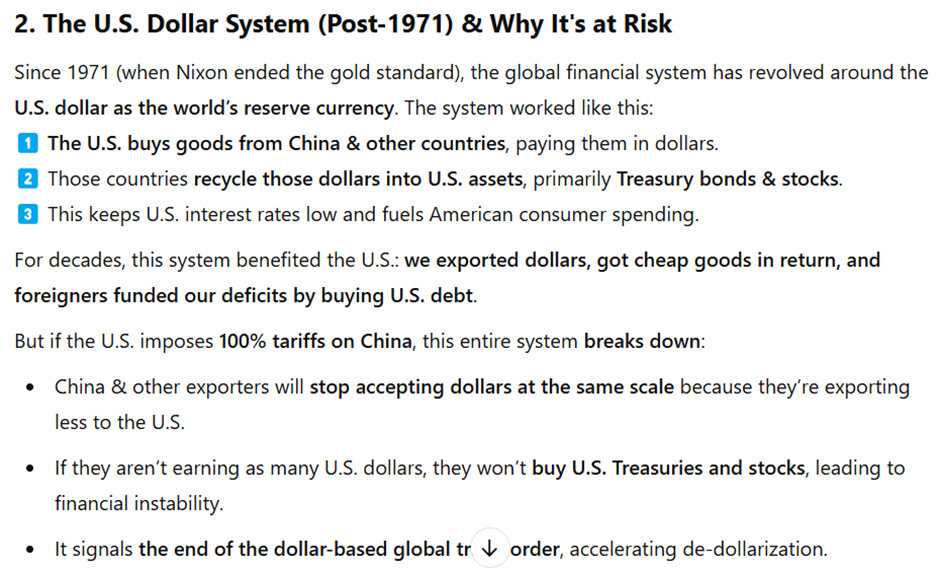
US would manufacturer and loose the reserve status this might lead to devaluation of dollar in longer term like 1$ to 30-40 rs to make their exports competitive