
What is the worst case scenario for Sammaan capital on this case? Will any of the current management team get caught in the cross hairs? How much of the blame will fall on the erstwhile promoter and how much on the current management? The clarification letter issued by the company seems to be aimed at distancing itself from the erstwhile promoter. More importantly, have they fixed their problems. Does their learning from past business make their current business better?
I like all about IHC deal (even price is OK) except they want to keep current management (Mr. Banga) in place. if you want to really gauge assets quality, review has to be done by someone else than team who builds it (though i do not think there is any major write-off pending) but other guy who is free from expectation value fairly and write-off or whatever action is needed as he can always tell “this is not my doing”. Only common link between - 2019 IHFCL and 2025 Samman capital is current management so if IHC want they can certainly take some action - this is me thinking loud.
Invested and biased.
1 Like
Management is simultaneously running down the legacy book, revising its product mix, expanding into non-mortgage lending, and rebuilding operational architecture.
Growth plans are large, a scale-up in disbursements, expansion of the branch footprint, and a push to improve ROA through a lower cost of funds post-transaction. But almost all future guidance has been kept fluid until IHC’s regulatory clearance and integration. The single largest challenge is executing a complex transformation while stabilizing a business that is still carrying legacy issues and undergoing an ownership transition.
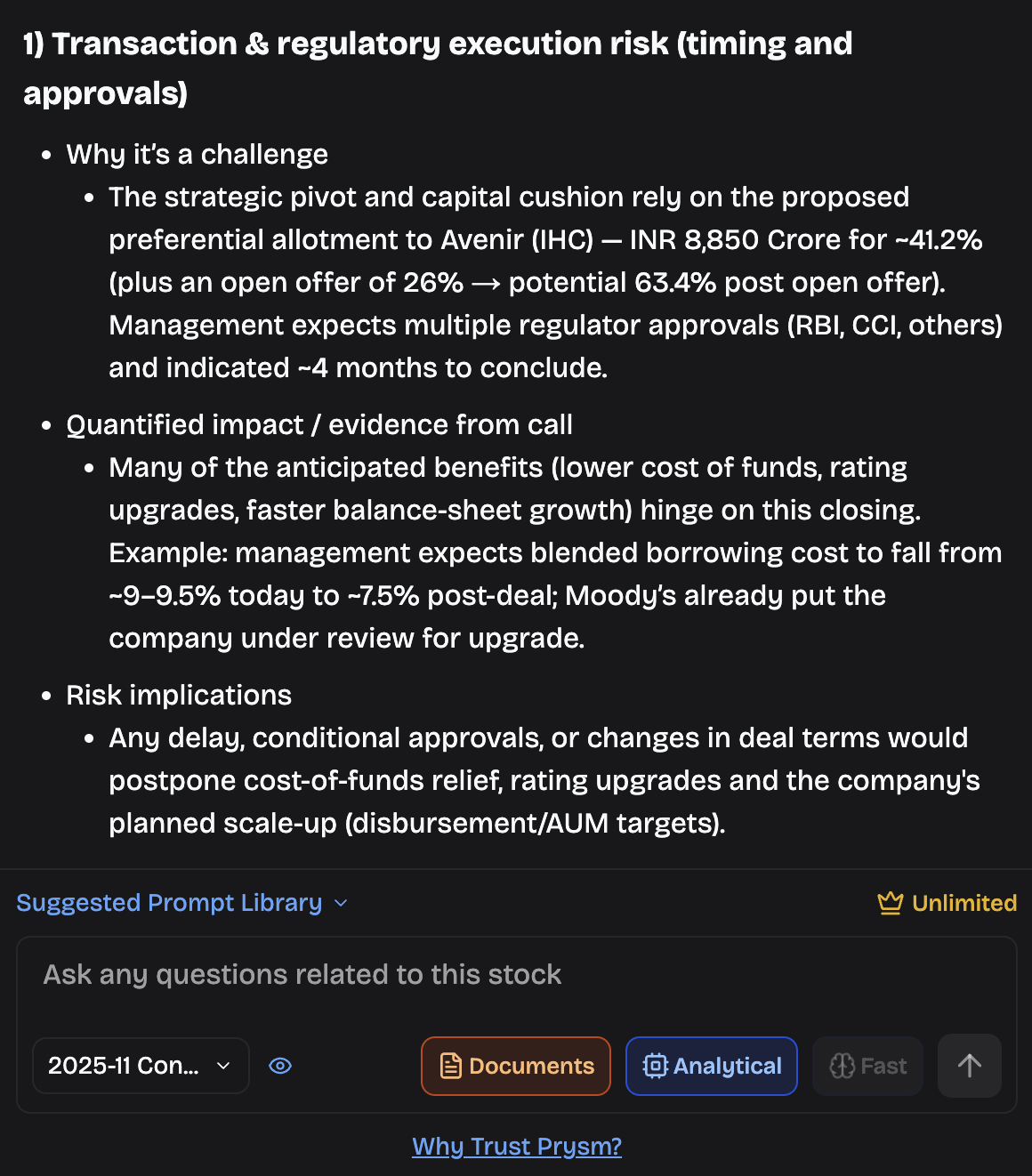
While the ongoing ownership transition adds complexity, it’s important to note that management has already guided for growth beginning Q3 onward, independent of IHC’s integration. The disbursement trajectory, branch rollout, and improvement in asset quality are part of the existing plan and not contingent solely on the new promoter.
In fact, several key metrics shared in recent quarters—AUM mix shift toward growth assets, improving credit costs, and early signs of ROA expansion—were communicated before the IHC-related announcements. This shows the internal engine is already being rebuilt and aligned for scale.
The IHC development has created a layer of market hype, but the operational groundwork for the next phase was laid much earlier. Even without the IHC factor, the business was positioned to accelerate from Q3. The transition will certainly help structurally, but it isn’t the only driver; the core business is already moving in the right direction.
3 Likes
I’d recommend you to not believe in management commentary, for reference do read FY 22 transcripts where Mr Banga targets 1,00,000 Cr of AUM by 2025.
We have to discount whatever the management is saying.
However, considering IHC’s history of acquisitions, over the past 10 years their portco’s have seen a major uptick in both efficiency and scale.
Regarding the lawsuit, considering that we have already created a ~ Rs 8,300 Cr buffer under imputed provisions for the legacy book:
- The maximum liability (Assuming all fault lies with the company, not Sameer Gehlaut, which is unlikely but possible as the worst case scenario) as per the PIL could reach ~Rs 6,000-7,000 Cr (Assuming the PIL is completely accurate in tracing transactions and these transactions which have been initiated 10 years ago and completely repaid will have to be completely paid off by the company, seems unlikely but possible).
- If there is no liability or lesser liability and assuming the legacy book runs down, by FY 28 we can see this massive imputed provision book used as cash for generating income.
- While I do believe IHC would have done their Due Diligence, any serious developments can dilute existing shareholders further if IHC gets more leverage.
Hi all, thank you for your analysis. I am considering taking a position in SCL. However, one question that baffles me and I am not able to get past is the fact that the change in their accounting estimate SCL implemented in 2025 for the securitization of loans, i.e. for the loans they sell to other institution. SCL has changed from a market based estimated of repayment tenure to contractual based. In a nutshell, what they are assuming is that the loan will be only repaid based on the contractual life which is let’s say 20 years vs the market based estimate which is 7 years (as borrowers usually prepay there loan, so it is more realistic), thereby SCL is assuming that interest payments will continue to be received for the next 20 years and booking them all together now, while in reality borrowers will only pay the interest for 7-10 years as this is the actual time period under which the loans are usually repaid. They have book this as “Net gain on derecognition of financial instruments under amortised cost category” of ₹660 crore allowed them to show their Q2 results from loss making into a ₹400 crore profit out of thin air. This is a pure case of window dressing. Could anyone please explain if I am missing something here?
Why would somebody invest in a company with a management trying to fool the investors? It’s seems changing the name to Sammaan Capital was just for the sake of it.
9 Likes
You are absolutely right. The accounting is atrocious.
why institutional investors like IHC did not consider this? or are they part of this or something retailers not knowing?
1 Like
Have any of you tried to access the latest FIR by Economic Offences Wing?
In the PR, company mentions that EOW has filed FIR and Sameer Gehlaut is the target, but it is a bit ambiguous on whether Sammaan Capital has been mentioned in the FIR or not.
On the FIR website, No.175 seems to be hidden.
PS: As per law, FIR can be hidden only if it has been categorised sensitive by the ACP/DCP.
1 Like
Just an observation - With all its trouble, ups and down, all the restructuring, all the changing in business model, somehow this company is able to report quarterly profit of exactly 300 crores plus or minus 30 crores in 13 out of last 14 quarters.
If RBI did not made that rule to take a hit in AIF portfolio, then sammaan might made 14 out of 14 quarters.
5 Likes
Amidst the volatility and uncertainty in overall environment a small step forward towards fruitful IHC- Samman deal. But still long way for SEBI and Legal overhang to clear !!
1a94ed4a-8b62-4f8a-8205-01f34b80baa4.pdf (365.9 KB)
1 Like
The preferential allotment and warrants issue is completed. Sammaan Capital has received an initial tranche of INR 5,652 crores (USD ~600 million) towards the allotment of equity shares and warrants, with an additional INR 3,198 crores (USD ~338 million)to be received within a period of 18 months upon conversion of the warrants into fully paid equity shares.
Aspiring for top 3 position by AUM by FY29 (looks like an almost impossible target, unless they acquire assets) while achieving best in class RoA and RoE.
Targeting significant expansion of product portfolio with entry into MSME, personal and gold loan category.
Glimpse of new growth strategy

2 Likes
Sammaan Capital: When Trust Starts Lowering the Rate
Why IHC’s entry could improve funding access, lower borrowing costs, and change the future earnings power of Sammaan Capital
The Lens for This Thesis
In this article, I want to study Sammaan Capital through a simple lens: trust lowers the rate.
In lending, confidence is not just a narrative variable. It shapes the terms on which money arrives. If trust improves, funding access can widen. If funding access widens, borrowing costs can fall. And when the cost of money falls, the economics of the business can begin to change faster than the market expects.
That is the lens through which I am looking at Sammaan Capital today.
1. Opening: Changing the Soil, Not Just Watering the Plant
When a plant starts looking weak, most people notice the leaves first.
A few greener patches can create hope.
A few yellow ones can create doubt.
But neither tells you the whole story.
A weak plant does not revive just because you pour more water on it.
If the soil has turned bad, water alone will not save it. In fact, sometimes more water only delays the realization that the roots are struggling.
To truly bring the plant back, you have to change the soil itself.
That is Sammaan Capital.
For years, the market looked at it like a stressed plant: alive, but not fully trusted. People kept asking whether growth would return, whether profits would recover, whether the branches would look greener again. But those were surface-level questions.
The deeper issue was the soil — the underlying conditions in which the business was trying to survive: trust, funding access, cost of capital, and the market’s willingness to underwrite a more stable future.
That is what makes this moment interesting.
This is not a post-mortem on a successful turnaround. This is a live hypothesis written before the numbers fully reflect it.
The first leg is done: credibility capital has entered the cap table.
The second leg is what matters: can that credibility reduce funding cost, restore market confidence, reopen growth, and lift normalized profitability over the next few quarters?
That is where the investment case either compounds or collapses.
And that is precisely why I want to write this now.
Not after a few cleaner quarters, when the story will read better in hindsight.
Not after the numbers have already done the convincing.
But at the stage where the control transaction has happened and the operating turnaround is still a hypothesis.
This is still a probabilistic bet.
The ownership change is real.
The business outcome is not.
That is why IHC’s entry matters.
The visible part is easy enough to see: capital has come in, control has shifted, and the headline has changed. The less visible question is the more important one: does stronger sponsorship begin to change the conditions beneath the business?
Because in lenders, confidence does not stay trapped in perception. It can travel into funding access, borrowing cost, spreads, growth, profitability, and eventually valuation.
That is the live question here.
Not whether Sammaan looks healthier immediately.
But whether the soil beneath the business has begun to improve enough for healthy growth to become possible again.
If yes, the numbers will tell that story in time.
If not, this will remain just another transaction that looked bigger in announcement than in operating consequence.
That is the bet.
And that is why it is worth documenting now.
2. What Exactly Has Changed?
At the transaction level, the change is already meaningful.
Through its affiliate Avenir Investment RSC Ltd, IHC agreed to acquire a controlling stake in Sammaan Capital. The core transaction involves a total proposed investment of about ₹8,850 crore, structured through a preferential allotment of equity shares and warrants, which together amount to a 41.2% stake on a fully diluted basis.


That 41.2% is the core economic transaction. It is the part tied to fresh capital, promoter change, and board control.
By the end of March 2026, however, the deal had already moved beyond proposal into actual ownership. Avenir had already come to hold about 28.41% in Sammaan. That matters because it tells us the change is no longer just on paper. A meaningful stake is already in place; the rest of the path to 41.2% depends on the warrant leg playing out over time.
Alongside this, the transaction also triggers a mandatory open offer for an additional 26.0% of the company at ₹139 per share. But that number needs to be read carefully. It does not mean IHC’s effective ownership is automatically headed to 63%–64%. That higher number is only a maximum possible outcome, and it depends on how many shareholders actually tender into the offer.
This is where the economics matter more than the formal structure.
At ₹139 per share, the open offer looks more like a regulatory requirement that follows a change in control than the central economic leg of the deal. So for practical purposes, the more relevant ownership numbers are the ones tied to the main transaction: about 28.41% already in place by end-March 2026, rising toward 41.2% on a fully diluted basis as the warrants convert.
In other words, the important part of the transaction is already clear:
- a new sponsor has entered
- a meaningful stake is already in place
- fresh capital has been committed
- promoter control is changing
- board control is shifting
What remains uncertain is not whether the transaction matters.
What remains uncertain is whether this change in ownership and control will translate into lower funding costs, stronger market confidence, and a real operating turnaround over the next few quarters.
That is the part the numbers still have to prove.
3. Who Is IHC, and Why Does It Matter Here?
IHC, or International Holding Company, is not a niche financial investor. It is one of Abu Dhabi’s largest listed groups, with reported assets under management of over AED 870 billion — roughly ₹22 lakh crore. It operates across sectors such as energy, healthcare, real estate, food, agriculture, mining, and infrastructure.
That scale matters in Sammaan’s case because this is not a passive cheque. Through Avenir, its investment vehicle, IHC is putting in meaningful capital and taking meaningful control.
Its visible India investing record, at least from publicly reported deals, already shows a willingness to write very large cheques:
- 2022 — Adani Group green portfolio: about $2 billion invested across Adani Green Energy, Adani Transmission, and Adani Enterprises
- 2023 — Adani Enterprises FPO: about AED 1.4 billion invested, roughly $381 million
- 2025–26 — Sammaan Capital: about ₹8,850 crore committed through Avenir, tied to a 41.2% fully diluted stake, with actual ownership already around 28.41%–28.5% by end-March 2026
- 2025 — Haldiram’s financing round: IHC joined the round, though the exact cheque size and stake were not publicly disclosed in the reports I have seen
In Sammaan’s case, IHC matters less as a headline name and more as a source of scale, credibility, and financial firepower.
4. The First Real Test: Can Funding Costs Fall by 175–200 bps?
When this transaction was first discussed publicly, management made the key claim clear: if things go as expected, Sammaan’s cost of funding could fall by roughly 175–200 basis points over time.
That is why this variable sits at the center of the thesis.
Sammaan Capital Management guiding lower cost of funding after IHC deal
A promoter change, by itself, is not the investment case. The real question is whether stronger sponsorship changes how the business is funded.
If that happens, the impact can be meaningful. Lower borrowing costs can improve spreads, support growth on better terms, and lift normalized profitability. That is the chain that matters.
One of the earliest external validations to watch here is the credit rating trajectory. In a lender, ratings do not just influence perception; they can directly affect the ease and price at which liabilities are raised. So if this thesis is working, one should expect not only commentary about lower funding costs, but also a gradual improvement in how rating agencies and lenders assess the business.
So this is the first thing I will be tracking closely over the next few quarters: does Sammaan actually start borrowing more cheaply than before, and does external confidence improve along with it?
Because that is where the story moves from transaction to evidence.
If funding costs begin to fall in a visible way, the transaction starts to matter economically, not just symbolically. If they do not, then the market should be careful about assuming that capital infusion alone is enough to create a turnaround.
That is the first real bridge between IHC’s arrival and Sammaan’s future earnings power.
5. Cheaper Money Alone Is Not Enough
Even if Sammaan’s cost of funding starts falling, that alone will not complete the turnaround.
A lender does not improve just because borrowing gets cheaper. It improves when the underlying book also becomes cleaner, more scalable, and easier to fund. So the second part of this thesis is not only about cheaper liabilities. It is also about what kind of business those liabilities are supporting.
A few numbers matter here:
- Total proposed IHC capital: ₹8,850 crore
- Capital already received: ₹5,652 crore
- Additional capital possible via warrants: ₹3,198 crore
- Consolidated AUM: ₹64,200 crore — the company’s total loan book at the group level
- Growth AUM: ₹44,038 crore — the part of the loan book the company wants to scale going forward
- Legacy book: ₹20,162 crore — the older book that is still economically real, but likely to run down over time and carries weaker forward economics, including lower margins and a lower-quality profile than the growth book
Taken together, these numbers show why the story cannot be reduced to funding cost alone.
On a loan book of ₹64,200 crore, an eventual ₹8,850 crore capital infusion is large enough to matter. It can ease liability pressure, support fresh credit growth, and give the company room to reshape the balance sheet. But fresh capital does not automatically create a better lender. What matters is whether that capital helps the company grow the better book faster than the older book continues to run down.
So the second thing I will be tracking over the next few quarters is simple: is Sammaan becoming only a better-funded lender, or also a cleaner and better-structured lender underneath?
If funding costs improve and the business mix improves with them, the turnaround starts looking structural. If not, the story may look better in optics than in substance.
6. What I Will Be Tracking From Here
If this thesis is right, the proof will not arrive in one dramatic moment. It should begin to show up gradually, across a few linked variables.
So these are the things I will be tracking over the next few quarters:
- Cost of funds: does Sammaan actually start borrowing more cheaply than before?
- Credit rating and liability access: do rating agencies, lenders, and debt markets begin to view the business with greater confidence?
- Business mix: does the growth book keep becoming a larger share of the total, while the legacy book continues to shrink as a drag on the story?
- Profitability quality: do margins and profits improve because the machine is getting healthier, not just because of temporary effects?
- Execution under the new promoter: does the change in control start showing up in sharper capital allocation, cleaner structure, stronger operating confidence, and possibly leadership upgrades where needed?
A later update, two or three quarters from now, should not just revisit the stock price or the headline. It should revisit these same variables and ask a much simpler question: did the thesis begin to work where it actually mattered?
Closing Thought
The transaction has changed the starting point.
The next few quarters will tell us whether it changes the business.
If funding costs fall, if the better book keeps becoming a larger part of the story, and if the new promoter turns credibility into operating proof, then Sammaan will start looking less like a repaired balance sheet and more like a repaired franchise.
That is what I will be watching.
Because the real opportunity is not in noticing a turnaround after it becomes obvious.
It is in recognizing, early, when the conditions for one may be starting to form.
Disclosure
Invested with Allocation: 2%
Thesis Written On: April 20, 2026
Current View: Biased due to holding.
Strategy & Risk: This is a liability-side repair and operating reset bet. The thesis rests on whether IHC’s entry can improve funding access, lower cost of funds, and support a cleaner, more scalable lending book. The key risk is not whether capital has arrived — it has. The real risk is whether that capital changes the economics of the business over the next few quarters.
Positioning: At 2%, this is a meaningful but still measured position. The size reflects conviction in the setup, while acknowledging that the operating turnaround still needs to be proven in the numbers.
When I will be adding more: I will be looking for operating proof, not just narrative comfort. That means visible improvement in borrowing cost, stronger confidence from lenders and rating agencies, continued shift toward the growth book, and cleaner profitability. If those variables begin moving in the right direction, the thesis strengthens. If they do not, the transaction may remain important in form but weaker in consequence.
Formal Disclaimer
I am not a SEBI-registered research analyst or investment advisor. Nothing in this post constitutes investment advice, a recommendation, or a solicitation to buy or sell securities.
This is a personal investing note written to document a live thesis at a particular point in time. Please conduct your own due diligence before making any investment decisions.
Your capital, your responsibility.
12 Likes
Thank you for the detailed take on Sammaan Capital. Would it be right to say that the groundwork done by the management probably encouraged the investor IHC to invest in the company to continue its turnaround. Hoping for Gagan Banga and the management team to continue steering the company to profitability. Also, I think with IHC, the keyman risk with Gagan Banga has reduced considerably. Also with the new buyback rules vis-a-vis open market purchase, can we expect the management to do buybacks via open market route when it becomes legal again to increase their ownership should the CMP of the share continue to stay low? This should benefit the minority shareholders as well. Definitely looks like the risk in this company is a lot lower now than in the past.
Good write up. I have 1.5% position and was planning to add more when CoB goes down.
It was brought up in this thread before but main risk for me was how management recognized the revenue when they sell loans to other institutions. They are recognizing as if each loan will be paid until the last year and there is no risk of pre-payment. Management justified the move saying that there is no standard way of calculation so they are going by the contract, but thats absurd and definitely not a common practice. When the pre payment happens, I am not sure how much of loss they have to book and how meaningful it would be.
I would be very happy if IHC takes over or atleast instill some governance structure around these schemes.
3 Likes
Sammaan Capital targets 200 basis-point margin gain in 18 months after IHC entry, says Gagan Banga
2 Likes


how do we see this 7K cr loss? can somebody explain it, whether to treat this negatively or positively
In my view, this was expected. IHC must have done their diligence and hence committed to come at 139Rs when book value was 290Rs
So in a way, they are now bringing the book value to reflect that IHC entry price. Since these are all non cash provisions, dont nescerraily see it negatively.
2 Likes
I also thought of this , but wanted to check is this final clearing of legacy loan book or still there is more to go ?
Though Stock Price will be down for sometime as this will be taken by different investors in different way?
Can you explain on this - “all non cash provisions”.