
In addition to what @vivek_lakhani said, the majority of dependency for Samhi isn’t on foreigner/expat travel but domestic corporate travellers. No shortage of that today as well.
5 Likes
Adani venturing into same model like Chalet / Samhi !!
Adani wants to majorly acquire and build near Navi Mumbai Airport and build 60+ hotels across India.
Currently Adani Hospitality is run by Ex- Chalet !!
4 Likes
If you add the 750cr minority interest with GIC, the valuation gap will reduce, but yes the stock continues to be the cheap vs peers like Chalet Juniper.
| FY25-28 CAGR | ||||||
|---|---|---|---|---|---|---|
| MCAP | EV | EV/EBITDA (FY28) | ROE | Revenue (Consensus) | Keys | |
| Apeejay Surrend. | 2,598 | 2,758 | 7.49 | 17.90% | 13% | 7.92% |
| Chalet Hotels | 18,722 | 21,320 | 15.36 | 4.40% | 15% | 11.26% |
| Juniper Hotels | 4,888 | 6,363 | 11.3 | 4.13% | 10% | 23.47% |
| Lemon Tree Hotel | 10,327 | 12,318 | 13.06 | 13.2 | 9% | 15.83% |
| Samhi Hotels | 3,762 | 6,141 | 8.16 | 5.78% | 10% | 9.38% |
| Brigade Hotel Ventrues | 2,384 | 2,273 | 7.73 | 28% | 14% | 1.96% |
Source: Trendlyne consensus/Stylus estimates
1 Like

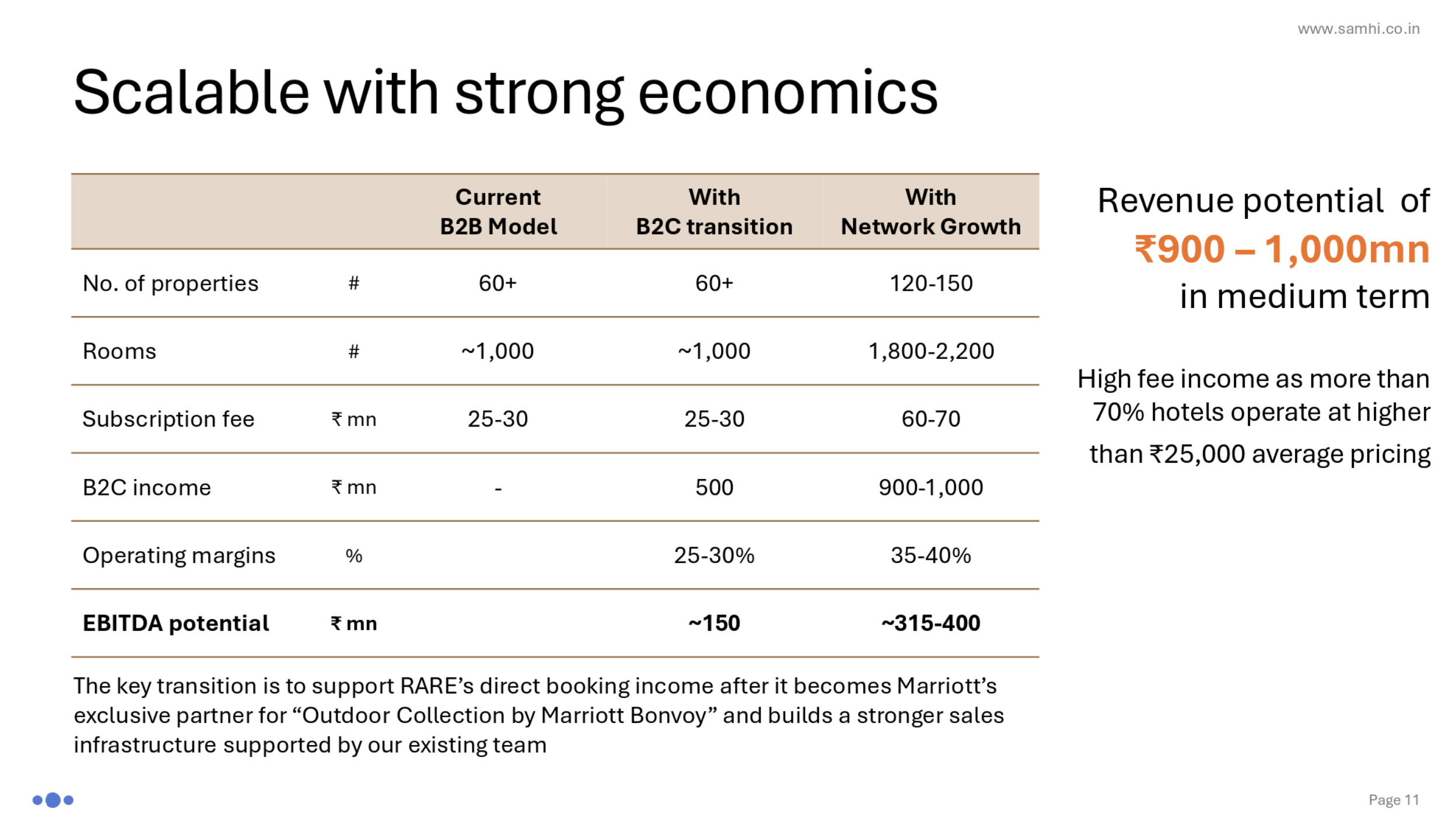
Key slide: Entry to B2C ownership at a smallish scale, higher revenue per room (expected for experiential locations) and lower margins (more operating costs due to location). When this scales and reaches Samhi’s target EBITDA margins, this will be interesting.
1 Like
Looking to understand a bit more on the operating structure and business model of RARE if someone could throw more light on the same, and how does Marriott fit in exactly.
Considering that RARE mainly earns revenues as follows:
- Fee income from Hotels listing on its platform(B2B)
- (Future) commission income as a % of Sales(B2C)
It seems that RARE operates in a similar business model as that of Airbnb but in a much more niche space of curated and experiential stays. Is my understanding correct?
How will Marriott earn revenues? Is it purely through the Franchise model?(Marriott lends the brand and hence earns a fixed royalty income)?
2 Likes
I was going through the GIC transaction and found 2-3 things:
-
GIC has acquired 35% stake in 3 subsidiaries (out of which 2 are Debt Free after the payment of debt) or 5 of the hotels (Most Popular Hyatt Residency with 300 rooms)
-
Compay has to go via JV route for further expansion in Upper Scale segment (High demand as compared to other 2 segments i.e upper midscale and midscale, High Margins, Capital Intensive) &, if GIC refuse then the SAMHI has the flexibility to do the project/acquisition independently.
-
Non Controlling Interest of INR 752 Cr should appear in the Balance Sheet - which is basically company has diluted its equity (by doing very complex transaction) - reason is simple ROCE<Interest Rate.
-
Why i Think this reaction triggered?
Vascon Engineers was holding OCDs of Ascent (Samhi Subsidiary) which is currently valued at INR 46 Cr and covertible into equity shares (condition - When Ascent cross INR 70 Cr of EBITDA).
Very High chances of achieving this by Ascent as Hotel Businesses are Q4 heavy.
You can check this in Annual Report - search “vascon”.
3 Likes
The Samhi is cheap but there is reason to that.
1 Like
2200 was full value for three properties estimated, Samhi stake 1450 cr as per GIC valuation for three properties, at current price remaining business is available at roughly 1500 cr. Its a deep discount.
With increasing oil prices, flight cost, gas shortages, Travel and Hotel industry will first indirect causality.
Never imagined Samhi would trade at these valuations again given the kind of expansion planned for and the numbers they showed this year..
Really a testing time for whoever invested..
Blessing for long term investors. Management has been walking the talk and market is giving opportunities to add. bad for swing and short/mid term investors.
While travel and hotels will get affected, it’s a black swan event and assuming demand doesn’t falter, we get back to normalcy with time. In the bargain though, Samhi has fallen more than 30-35% which has a lot to do with fear. Anyway pre war also this Stock was trading way cheaper than what I believed was fair value. Not concerned at all
7 Likes
Please look Market Cap and Enterprise Value
i came across recent blog on samhi turnaround story
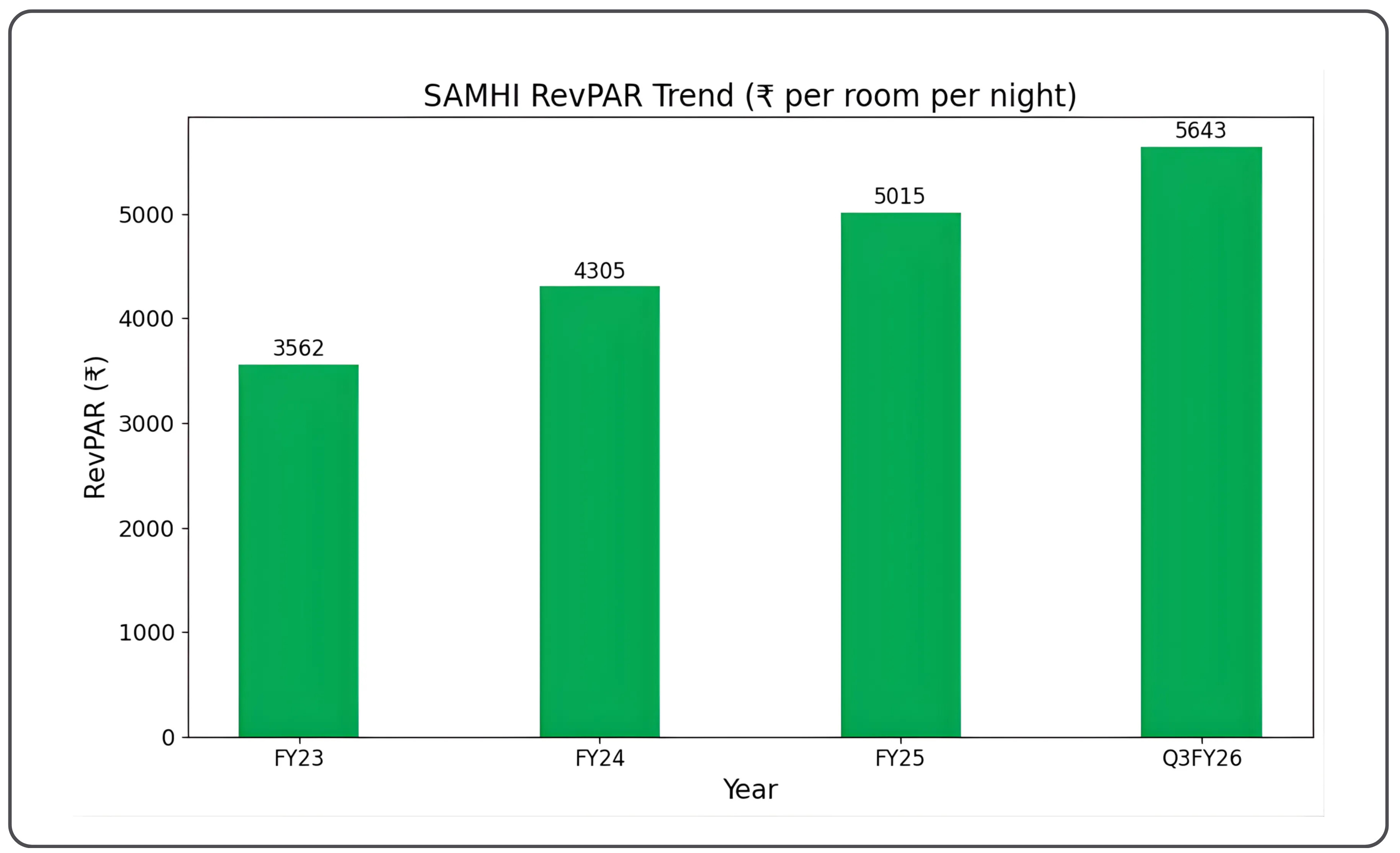
https://www.tradejini.com/blogs/samhi-hotels-limited-a-fundamental-analysis-of-the-turnaround-case
Revenue per room has gone up , which is positive sign
4 Likes
I’ve found this post very insightful and practical in terms of expectations.. Do read..
22 Likes
Profit more than sales. Some exceptional items or are the numbers correct?
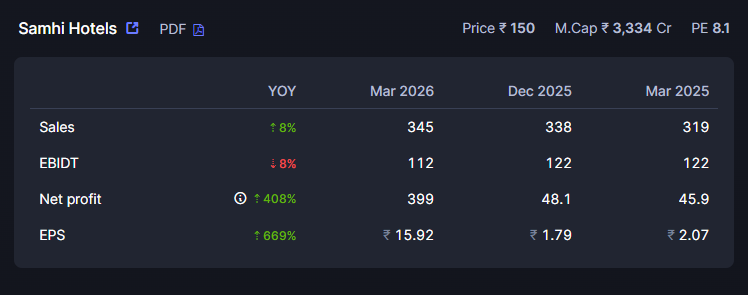
Edit: (AI Summary)
The Profit After Tax (PAT) is greater than the Total Income in Q4 FY2026 due to a massive, non-operating accounting credit related to deferred taxes.
Here is the financial breakdown for Q4 FY2026:
| Metric | Amount (₹ mn) |
|---|---|
| Total Income | 3,535 |
| Profit Before Tax (PBT) | 692 |
| Tax Expense (Credit) | 3,302 |
| Profit After Tax (PAT) | 3,994 |
The net profit was artificially inflated beyond sales volume by two distinct accounting adjustments:
- Deferred Tax Asset Creation: The company recognized a deferred tax asset of approximately 3,000 mn in FY26, justified by improved financial performance and greater visibility of future profits. In financial reporting, recognizing a deferred tax asset acts as a tax credit that gets added to the net income, rather than deducted from it.
- Exceptional Items (Impairment Reversal): The Profit Before Tax was further boosted by 245 mn in exceptional items. This was primarily driven by a 269 mn reversal of impairment on Property, Plant, and Equipment (PPE) and Intangibles.
Because these non-cash credits and reversals are added directly to the bottom line, the final net profit figure eclipses the total income actually generated from operations.
Excluding the non-cash accounting adjustments, the core business demonstrated solid operational growth throughout FY2026, though Q4 faced substantial external headwinds.
Here is the operational reality of the business:
Core Financial Metrics (FY26)
| Metric | FY26 Performance | YoY Growth | Notes |
|---|---|---|---|
| Total Income | ₹12,790 mn | +12.3% | Income grew despite multiple business disruptions. |
| Consolidated EBITDA | ₹4,626 mn | +8.8% | Growth was compressed by a GST rule change; excluding the GST impact, EBITDA growth was 13.0%. |
| Same-store RevPAR | ₹5,365 | +9.5% | Revenue Per Available Room shows a sustained upward trend for the full year. |
| Free Cash Flow | ~₹3,000 mn | N/A | Increased significantly from ~₹900 mn post-IPO. |
Balance Sheet Health
The balance sheet strengthened significantly during the fiscal year:
- Deleveraging: Net Debt-to-EBITDA dropped to ~3.0x, down from 5.3x at the time of the IPO.
- Debt Costs: The effective interest rate decreased by ~290 basis points to 7.9%.
- Credit Rating: Upgraded to A+ (CARE/ICRA).
Q4 FY26 Headwinds and Revenue Loss
While the full year showed growth, Q4 EBITDA contracted by 6.0% YoY (to ₹1,202 mn) due to compounding external factors:
- Geopolitical and Macro Disruptions: The company estimated a total revenue loss of ₹440-520 mn across the year from four events: the India-Pakistan conflict, monsoon disruptions, an airline crisis, and the Middle East conflict.
- March Drop-off: Revenue growth held at ~10.6% YoY through January and February, but fell to +6.3% YoY in March due to the Middle East conflict causing cancellations from foreign inbound travelers, airline crews, and MICE (Meetings, Incentives, Conferences, and Exhibitions).
- GST Impact: A sector-wide shift from a 12% GST rate with Input Tax Credit (ITC) to a 5% rate without ITC compressed EBITDA margins, costing approximately ₹180 mn on EBITDA for the year.
6 Likes
My Understanding for Samhi Q1 Concall
De-leveraging Turning Point: If the proposed ₹750 crore capital raise successfully pays down debt, converting strong EBITDA directly into free cash flow and net profit.
Global Capability Centers over 1,600+ expanding in India (especially in Bengaluru, Hyderabad, and Pune).should drive average daily rates (ARR) from ₹5,219 toward ₹7,500–₹8,000 , boosting EBITA
3 Likes
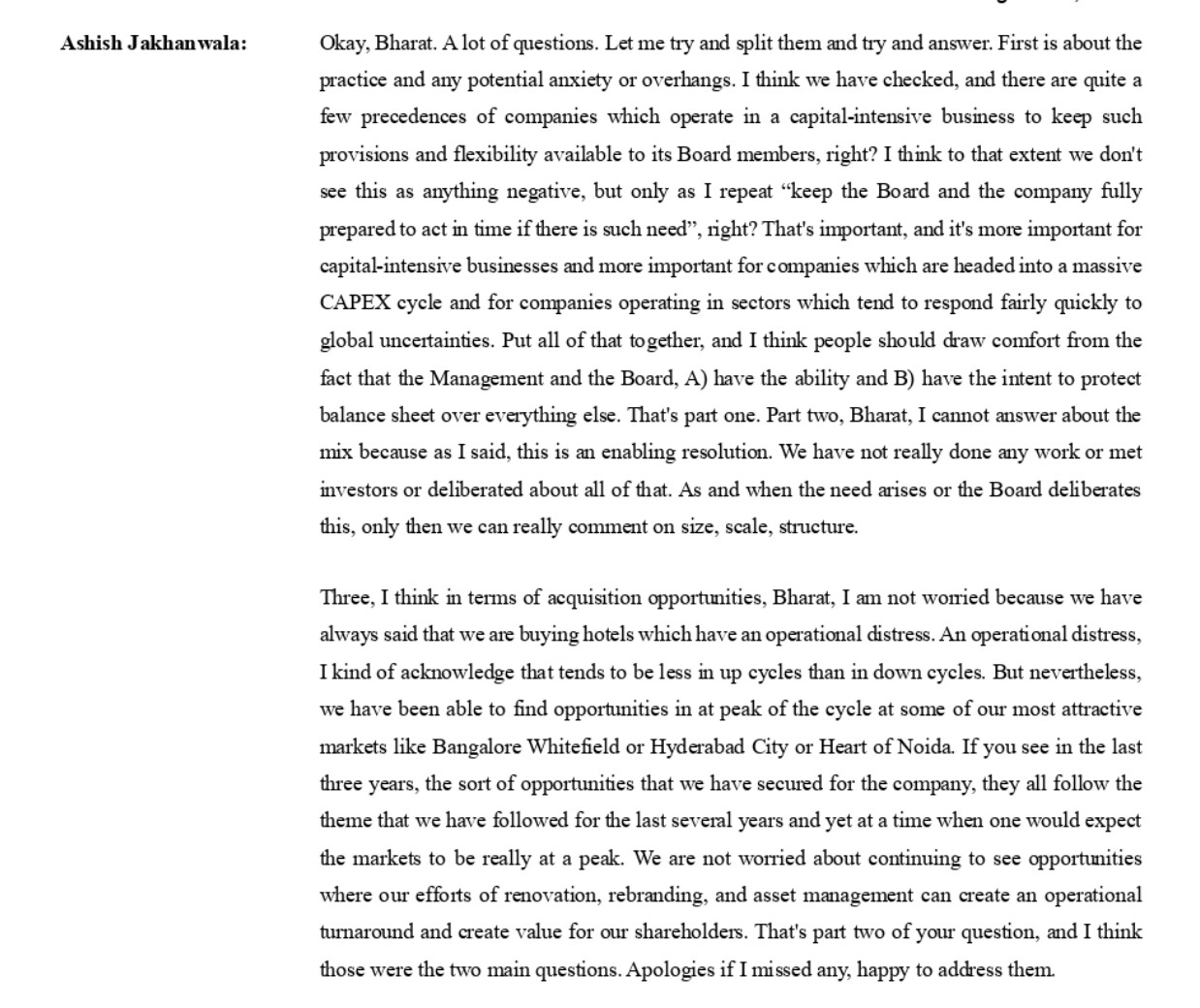
@Aiyappaa , Where do you see the guidance of ₹750 crore capital being used to pay down debt?
From the Q1 concall, management indicated this is enabling resolution and no analysis of use of potential funds been done yet. There is talk of acquisition of distressed assets and no mention of debt pay down though it could potentially be used for that purpose as well.
1 Like
I agree. Management has not explicitly mentioned that the cash will be used to reduce debt. However, until the fund is deployed toward acquiring the distressed asset, the cash will remain within the business, which could potentially help reduce the debt burden or support better pricing on interest rates.