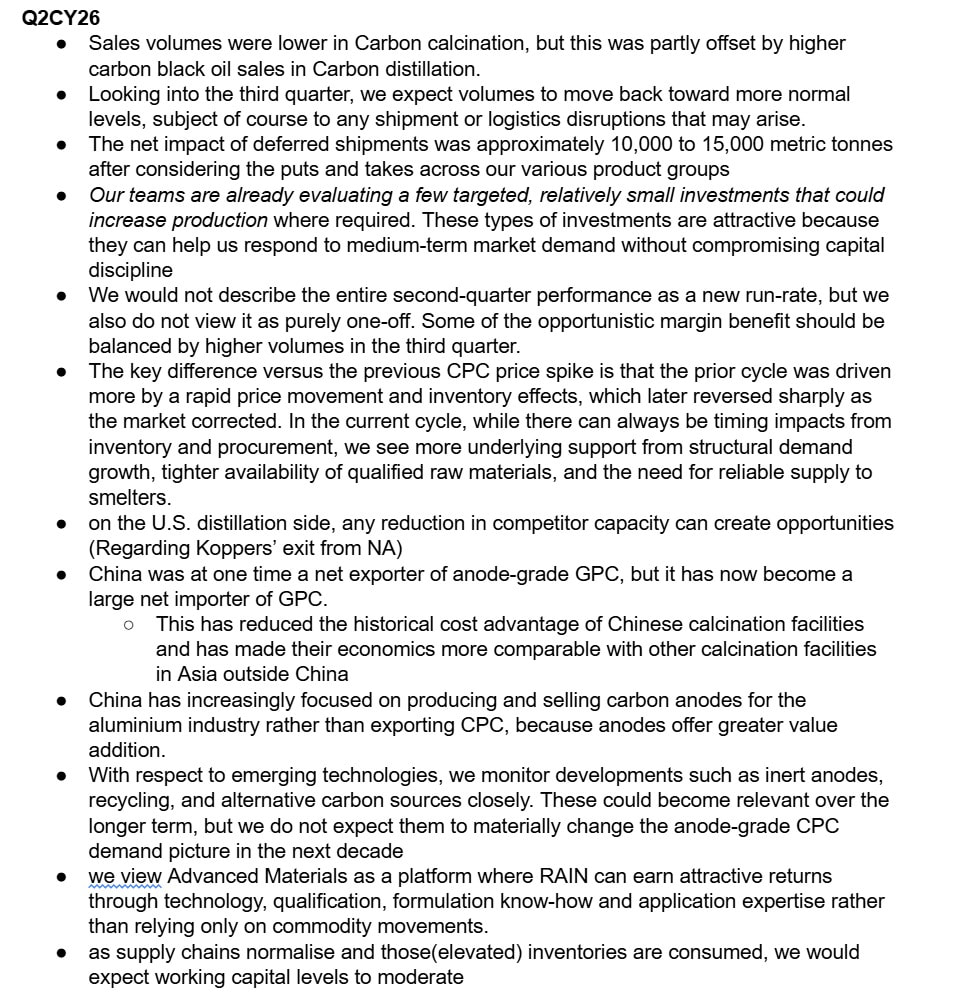
Rain_call.pdf (585.4 KB). Yesterday uploaded. Please can anyone explain reaon for huge fall in the share price suddenly, Thanks
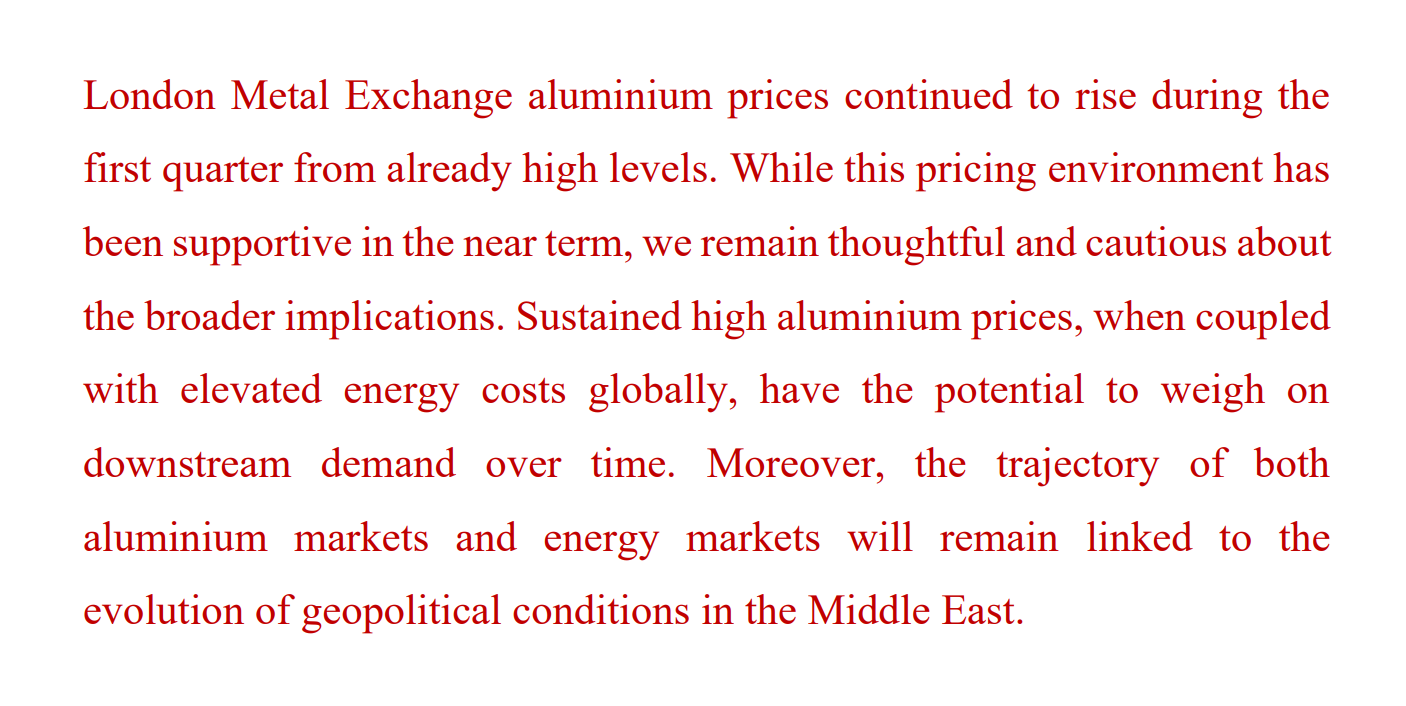
With the closure of the Strait of Hormuz and crude oil prices rising, I think it will have a direct impact on the aluminium industry, since almost 8% of production is dependent on the Strait of Hormuz.
Is anyone else tracking this, and how do we think this impact on the aluminium industry will impact RAIN?
2 Likes
 Rain Industries – Q4 FY’26 (Q1 CY’26) Results & What Really Matters
 Headline Numbers
-
Revenue: ₹4,521 Cr (+20.0% YoY | +5.1% QoQ)
-
EBITDA: ₹697 Cr (+83.1% YoY | +39.1% QoQ)
-
EBITDA Margin: 15.4% (vs 10.1% YoY | 11.6% QoQ)
-
PBT: ₹256 Cr (vs loss YoY, strong QoQ jump)
-
PAT: ₹158 Cr (vs loss YoY, ~4x QoQ growth)
 Key takeaway:
A sharp operational turnaround, with margins expanding meaningfully as revenue growth outpaced costs.
 What Drove the Performance?
-
Revenue grew ~20% YoY, but expenses rose only ~13%
-
Result: Operating leverage kicked in strongly
-
EBITDA margin expanded ~530 bps YoY
This is not just recovery, it’s early signs of a cycle turning
 But the Real Story = Management Commentary
 Rain’s management (known to be conservative) has dropped a very important signal
 1. Geopolitical Risk = Structural Opportunity
-
Ongoing Persian Gulf conflict
-
Region critical for:
-
Calcined Petroleum Coke (CPC)
-
Coal Tar Pitch (CTP)
-
These are irreplaceable inputs for aluminium production
 No CPC / CTP = No aluminium
 2. Fragile Global Supply Chain
-
~20% of global petcoke supply linked to the Gulf
-
Region itself imports ~33% of CPC
Highly interconnected system
Any disruption = global ripple effect
 3. Most Important Insight (Hidden in Plain Sight)
CPC & CTP Prices haven’t moved much yet
This is NOT stability
This is lag
 Translation:
-
Market has not priced the risk yet
-
But underlying stress is building
 4. What Could Happen Next
If disruption sustains or escalates:
-
Sudden supply shortages
-
Logistics disruptions
-
Sharp price spikes (not gradual)
-
High margin volatility
 5. Rain’s Strategic Positioning
-
CPC & CTP have no substitutes
-
Entire aluminium value chain depends on them
Rain operates in a critical bottleneck segment
 6. The Real Message from Management
“We are positioned at a strategic choke point in the supply chain.”
If disruption plays out:
-
Pricing power ↑
-
Margins ↑
-
Earnings can scale disproportionately
7. But It Won’t Be Linear
Management is also subtly cautioning:
-
Volatility will be high
-
Supply chain risks remain
-
Working capital & logistics complexity may increase
 8. Why Rain Thinks It Can Win
-
Diversified global sourcing
-
Integrated operations
-
Ability to reroute supply
In simple terms:
Better positioned than peers to navigate chaos
Investor Lens – What This Means
 Scenario 1: Conflict Escalates (Bull Case)
-
Supply tightness
-
Sharp price increase in CPC/CTP
-
Strong EBITDA expansion
-
Potential rerating
 Scenario 2: Conflict Eases
-
Normal cyclical recovery continues
-
No supernormal profits
Final Take
This is not just a good quarter.
This is early-cycle commentary with optionality
-
Earnings recovery has started
-
Margins are expanding
-
But bigger upside depends on geopolitics playing out
 Bottom Line
Rain is sitting in a position where, if supply disruption materializes, it can benefit disproportionately, and the market may not have fully priced this yet + A combination of debt refinance trigger, Battery anode material business playing out (optionality) & deleveraging play
If this cycle sustains, this could resemble past Rain upcycles.
If not, it remains a normal recovery story.
That’s the asymmetry worth tracking.
Note: Invested at lower levels & can be biased, so kindly don’t take this as a buy/sell recommendation, DYOR
7 Likes
Now JP Morgan has confirmed this too, what Rain’s management mentioned in their earnings presentation:
Hidden Time Bomb in Aluminum Markets: JPMorgan Warns Petroleum Coke Supply Disruption Could Trigger Next Aluminum Price Surge.
JPMorgan’s latest report warns that approximately 20% of the global supply of petroleum coke, a critical raw material for aluminum smelting, faces direct threat from a blockade of the Strait of Hormuz. Petroleum coke prices have risen only 21% so far, far behind crude oil’s surge of over 50%, signaling the market is severely underestimating this risk. Against the backdrop of an already projected global aluminum deficit of 2 million tonnes in 2026, shrinking refining capacity in the Gulf region and logistical disruptions could further tighten aluminum supply. While major producers such as Alcoa, Norsk Hydro, and Aluminum Corporation of China currently hold sufficient inventory, cost pressures have begun to transmit through the supply chain. With decarbonization technologies like inert anodes still in early stages, the aluminum industry is unlikely to break its dependence on petroleum coke in the near term, potentially intensifying upward pressure on aluminum prices.
As geopolitical conflict in the Persian Gulf continues to escalate, a long-underestimated potential risk in the aluminum market is coming to the surface. JPMorgan’s latest research report issues a rare warning that approximately 20% of the global supply of petroleum coke, an indispensable raw material for aluminum smelting, faces a direct threat from a blockade of the Strait of Hormuz. With prices for this material rising far less than crude oil so far, the market is severely underestimating a potential trigger for the next aluminum price spike.
JPMorgan’s commodities research team notes that petroleum coke prices have risen only about 21% since the conflict erupted, compared to Brent crude surging more than 50% and jet fuel skyrocketing over 80%, indicating that cost transmission at the raw material level has yet to be fully reflected. The bank had previously forecast a global aluminum market deficit of approximately 2 million tonnes in 2026. Should petroleum coke shortages worsen, this could further tighten an already strained aluminum market and provide strong support for aluminum prices.
The Invisible Strategic Material: Why Petroleum Coke Is the Lifeline of the Aluminum Industry
Petroleum coke, a byproduct of the oil refining process, has long lingered outside the mainstream commodities spotlight, yet it plays an irreplaceable role in aluminum smelting. In today’s dominant Hall-Héroult electrolysis process, carbon anodes are made from a mixture of calcined petroleum coke (CPC) and coal tar pitch, and are continuously consumed in electrolytic cells. Data shows that producing one tonne of aluminum requires approximately 0.4 to 0.5 tonnes of carbon anode material.
Looking at the market structure, roughly 80% of global green petroleum coke is fuel-grade, primarily used by the cement industry; only about 20% is anode-grade (calcined grade), which is required for aluminum and steel production. Although the metals industry accounts for only about 8% of total green petroleum coke demand, within the niche market for calcined petroleum coke, the aluminum industry’s demand share reaches roughly 40%, making it the single largest consuming sector.
What concerns the market even more is that the petroleum coke market is relatively small in scale, lacks transparency, and has insufficient financialization. Unlike mature futures commodities such as crude oil and copper, aluminum smelters have virtually no effective price hedging tools to offset petroleum coke volatility. This makes the material highly susceptible to dramatic price spikes when geopolitical supply disruptions occur.
Multiple Transmission Channels of the Blockade Effect and Cost Pressures
Tensions in the Strait of Hormuz are impacting the aluminum supply chain through multiple pathways. The Middle East accounts for approximately 40% of global crude oil supply, with the Persian Gulf representing about 20%. Crude oil shortages have already forced refining capacity contractions in multiple regions, directly affecting the supply of petroleum coke as a byproduct. JPMorgan calculates that approximately 20% of global petroleum coke supply is directly affected by this strait blockade, with the Asia-Pacific region likely suffering deeper impacts due to its heavy reliance on Gulf crude oil.
Furthermore, the Gulf region itself possesses approximately 7 million tonnes of annual aluminum smelting capacity, accounting for about 9% of total global capacity. Two smelters have already been attacked, resulting in the disruption of roughly 3% of global aluminum production capacity. More troubling is that the region needs to import approximately 8 million tonnes of alumina annually through the strait; now, with logistics lifelines obstructed, the risk of raw material shortages has surged. JPMorgan specifically cautions that even if the conflict ends, refining capacity will recover much faster than aluminum smelting; damaged smelters could take 12 to 18 months to repair, potentially creating a complex mismatch scenario where “petroleum coke arrives while electrolytic cells remain idle.”
According to the latest industry research, major aluminum producers are not yet facing immediate material shortages, but cost pressures have begun to materialize:
-
Alcoa (AA): The company disclosed that every $10 per tonne change in petroleum coke prices impacts annualized costs by $8 million. While currently holding 1 to 2 months of inventory, it warns that disruptions around the strait are increasing cost uncertainty for imported anodes and calcined coke, expecting price increases to gradually pass through after the second quarter.
-
Norsk Hydro: Carbon-related costs account for approximately 18% of smelting cash costs. Most contracts currently use 1- to 2-year quarterly pricing models, with no shortages yet.
-
Aluminum Corporation of China and China Hongqiao: Chinese operators typically purchase pre-baked anodes directly, with limited upstream visibility into petroleum coke. China Hongqiao holds approximately one month of anode inventory, with stable supply and moderate price increases that are easily absorbed under current high aluminum price margins.
-
Press Metal: The company purchases pre-baked anodes from locations including Shandong, China, maintaining 1.5 to 2 months of inventory, with secure supply.
Overall, carbon-related costs (including petroleum coke) account for approximately 15% to 20% of aluminum smelting C1 cash costs. While large-scale production cuts have not yet been triggered, if the strait blockade stalemate persists, high-priced raw materials will begin eroding smelter profits once low-cost inventories are depleted.
The Decarbonization Path Remains Long, Petroleum Coke Unlikely to Be Replaced in the Short Term
Although the aluminum industry is actively pursuing decarbonization, JPMorgan asserts that the industry will be unable to break its heavy dependence on petroleum coke in the near to medium term.
Why is the market seemingly slow to recognize or price in the supply chain risks surrounding calcined petroleum coke, given that these constraints are more likely to trigger a sharp price spike and physical shortages rather than a gradual increase? Additionally, why haven’t investors responded more positively to the recent developments by re-rating Rain Industries’ stock?
If this is a real lag in pricing or overlooked by the markets then this could be a BIG opportunity to get in this stock now.
Note: Invested at lower levels & can be biased, so kindly don’t take this as a buy/sell recommendation, DYOR.
8 Likes
Does any one has research report of Arihant Capital where they have given TP of 327.5
2 Likes
Today Hindalco mgmt on TV stated the hike in CPC and CTP prices. He also said they expect a further hike in the coming year.
Rain ind stock reacted positively to it.
5 Likes
SAIL coal tar auction prices much higher this time. Another indication of strong demand for Rain’s carbon products
https://www.bigmint.co/insights/detail/india-tight-supply-and-robust-demand-lift-sail-bhilai-coal-tar-auction-prices-higher-757730
5 Likes
It is Coal Tar, not Coal Tar Pitch which rain makes. It actually means the raw material prices for rain’s product has gotten expensive.
Edit : On second order thinking, it actually is a positive. The demand here shows the high structural demand in the up-cycled products. My bad.
In aluminium upcycle they are easily able the pass on higher raw material prices to their clients.
Same is the case with Green petroleum coke (GPC) which is the raw material for Calcined petroleum coke (CPC)
Rain Industries down in trade today due to expectation of Aluminium inventory coming to market after end of Hormuz blocade.
While Aluminium prices have corrected, it is not a clear negative for Rain. Infact mgmt has stated that higher aluminium price is a concern for them as it supresses the demand. Stable Aluminium prices around and above 2600-2700 dollar/ton is what is good for rain industries.
4 Likes
Turnaround confirmed and accelerating
What was signal in Q1 (May) is now proof in Q2 (August):
-
Two quarters, not one: margin now 15.8% → 18.2% quarter-on-quarter, not a one-off
-
All-round: Carbon margin 18.5% H1, Advanced Materials margin recovered from 4.3% (FY25) to 10.3% - the specialty chemicals side is finally working, not just Carbon
-
Volumes AND price: Carbon volumes 659kt (Q1), Adv Mat volumes up decisively - this is real demand, not just pricing
-
Global tailwinds intact - Middle East aluminum supply disruption + LME strength + BAM feedstock competition all supporting CPC pricing
10 Likes