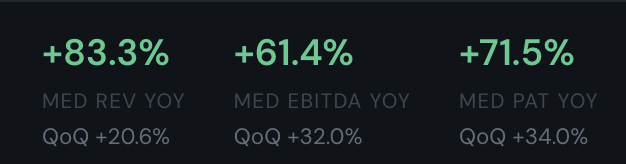
@narayans79 - There is a complete overlap between the 50 and 250. For someone managing smallcap indices, picking the 3-4 stocks from the 50 makes the most sense to make an impact. You can see how the perf diminishes as you go to the larger indices like the 100 or 250 though same stocks are present but at lower weightage. A lot of algorithms track these indices to take trades so as one index turns it attracts algos to increase risk, as this acts like an early signal for market health.
@Nakuljain04 - Volatility is hard. The best way I know is to move towards cash or more liquid names when I expect volatility and significant short-term drawdowns. Last year as well, this is what led me to buy a whole lot of Sai life in sept and then Hind zinc later on in December before moving on to the AI trades in Feb. Avoiding these steep drawdowns is crucial for maintaining a good alpha.
I know people who are undeterred by this kind of volatility as well and go through it because it suits their personality. I am personally OK with taking business risk or sectoral risk but always averse to market risk, so I do what I do. It may not suit everyone and there is no right way. If I could cultivate the ability take a 30% drawdown at pf level, maybe I would be able to zen through it but so far the max dd I have ever had is 17% and this level I have seen 3-4 times in the last few yrs as invariably the market bounces for me from this level but this time I felt it may not and I did not even want to face a 17% dd considering in absolute amounts, it was too big due to pf performance in the last year or so. I still have sufficient amount invested to not feel left out if there is a strong pullback as it happened this week.
@Garuna - Yes, the sideways market means most people have had zero or negative returns in the last 2 years and so are becoming more and more short-term to make something in the market. Its a zero/negative sum game at present and I think no one can make consistent money with these strategies though it feels lucrative. I have backtested earnings based strategies and they do really well but its so easy to build these with claude that I am certain there a few hundred of these bots trading the market which will explode to a few thousand shortly. There is no free lunch and these will find it hard to churn good returns. Right now though, they are doing quite well and its coming from technofunda/funda guys returns and possibly mental health, considering the volatility.
I have been thinking about the impact of AI on us through several posts here and this is a continuation of the same. I read a beautiful work on this (Introduction | The Last Economy) which I highly recommend. One of the core ideas is that intelligence so far has been priced as scarce by our economy but it is becoming so abundant that it will register as a collapse. Essentially people wondering why AI is not adding to GDP growth are looking at the wrong metric or rather, looking at the only metric we know to look at.
I will give a few examples. I was able to build a guitar amp sim in few days and I use it over the amp sim I paid a lot of money for. I have made the source open and the app free to use. This sort of devaluation of IP will come as a deluge to anything that is a software product or in general, knowledge work. This is great for me as a user as it adds tremendous value to me but will register as degrowth for the company making amp sims. We had a serious trouble with our 3D printer which without AI, we may have had to throw out. Claude helped my son debug the issue exactly to the thermistor which was burnt. This means we don’t buy another printer which will register as bad in the GDP but it is great for me. How many such great things are going to be measured as bad because we are measuring the wrong thing?
I have speculated here in the past that we might see token consumption being added to GDP. I think some form of it will most likely happen, though token is not really a good measure of intelligence since not all models need the same amount of tokens to solve the same problem. The argument I am making is that the revenue of Anthropic/OpenAI (and other AI companies whose revenue comes from selling tokens) is not a good measure of value added by them as the true value is far higher but currently not measurable or as the book argues, a single cured cancer knocks off $400k from GDP but saves a life.
The other thing is where revenue for AI companies will come from. The trillions in revenue these companies are vying for can only from from current wages. The world GDP is $120t of which $60t or so apparently is wages. The AI companies are eyeing 5-10% of this in the next 5+ yrs. This can only come through layoffs and this is already underway with several tech companies starting them to fund their AI capex (the Microsoft one being the latest). This can only mean severe loss off capacity to survive/consume which should hit the GDP significantly in the medium term if left unchecked.
Since the economy is a dynamic thing, all this may act as a balancing force. Without GDP growth, we might see funding environment for AI get harder and harder, through both debt and equity and also internal accruals (like Google struggling with search) which means we don’t get AI tokens cheap enough to matter. This doesn’t mean Indian IT will do well - that ship has sailed. It just means the adoption may take more time as the economy adjusts to this new reality. We can see one aspect of this (balancing force) already in memory prices which have gone up so much to make returns relatively unviable. This will give everyone time to adapt and go through this phase transition which at this point seems like a likely outcome. So though there is serious demand for tokens, supply might be hard to put up because of various constraints from cost of capital to memory prices to political will (may happen if democrats take both house and senate in the mid-terms). I don’t think it changes the value of companies participating in the DC infra much (just changes the shape of cash flows) but over a longer period other things can change as well (like changes in technology and competition)
Just thinking aloud