
I have been studying the power transmission space, specifically looking for smaller companies that can benefit from the serious tailwind in power generation and transmission, arising from renewables, data centers and transmission upgrades and grid modernization - both HVAC and HVDC, that can benefit not just from domestic but from international tailwinds. Of course tailwinds alone are never enough, there must be a moat, a uniqueness to the company and this is where a lot of the power sector companies fell by. Hitachi Energy and GE Vernova are likely the only ones that check all these boxes (except the criteria for being small and relatively undervalued). Schneider Electric keeps interesting businesses off the listed entity. Siemens and Hirect are also very interesting but derive bulk of the revenue today from railways which kept me out.
In power generation, I already own Mtar and TD both of which possess strong moats and ride the DC tailwind. In transmission, most of the companies are riding a commodity tailwind at best. Some like Quality Power do differentiate (esp their GIS tie-up with Hyosung gets them a foot in the door into DCs as Hyosung is a leader in the space, not just in GIS) as does RIR (compared to what they initially planned to do in power semis vs what they are currently doing, I am unimpressed and gave it a pass. Execution is seriously lacking though am unsure if its the govt holding them back or promoter’s lack of hunger). That’s the background to the one company that checked all the boxes for me (My search hasn’t been exhaustive by any means).
Yash Highvoltage is a SME in the power ancillary space. They make bushings (those things that stick out of transformer while taking the conductor in) that are used in high voltage and high current transformers. It is a very critical piece of transformers and is ~5% of cost (there are 7 of them used in each transformer - 3 IN, 3 OUT and 1 NEUTRAL). These are pretty much custom designed for each manufacturer/transmission project, so are not a commodity. The company makes decent EBITDA margins of 25% confirming the same. There are also only ~10 players that make these bushings like Hitachi Energy, ABB, Trench, Weidmann and few Chinese companies. In India, only Hitachi and GE make bushings and they use it for internal consumption. What Yash makes is what is used by Toshiba, Siemens, ABB, TARIL, Atlanta Electricals, BHEL and most other Power transformer manufacturers. Today Yash holds 70% market share in RIP bushings upto 245 kV and 35-40% share in OIP bushings in India. Exports are negligible at 7% and there has been a reason for that I think.
OIP (Oil-impregnated paper) bushings are a sort of a older technology and RIP (Resin-impregnated paper) is newer (POWERGRID adopted around 2016 or so). Interestingly Toshiba has recommended Yash’s name to POWERGRID for the same as per an article in 2017.
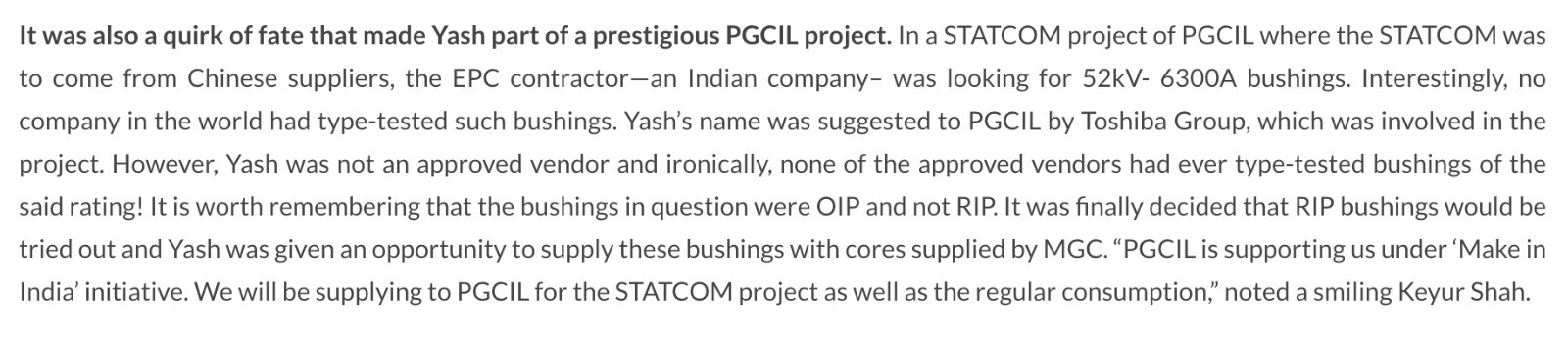
What I like is how the promoter has built this business over the last 15 odd years taking it from strength to strength. He seems to have cultivated the relationship with MGC Moser-Glaser from 2012 onward which over a period of time has led to Yash bringing their RIP bushing technology to India (MGC incidentally a 100+ yr old company at the time had invented the RIP technology in the early 2000s) by importing the core from MGC and assembling them here.
The assembly itself isn’t a straight-forward process as it requires a lot of precision as the way the insulator core is made is through radial arrangement of electric-grade crepe paper (likely made by Swiss company Weidmann) interleaves with Aluminium foil and impregnated with epoxy resin. The foil essentially then acts like stacked capacitors that equalise the electric field in both radial and axial directions - any imprecise arrangement can lead to a failed bushing and a failed bushing = transformer fire burning down Crores worth of equipment.
The company has a big 153 Cr greenfield capex underway today that is backward integrating into RIP cores which will be an import substitution - removing dependence on MGC completely. MGC appears to be helping out with the tech transfer through a project management company (my understanding could be wrong) - this is likely an arrangement that they must have gotten into back in 2016 because MGC held a 25% stake in the company until before the IPO.
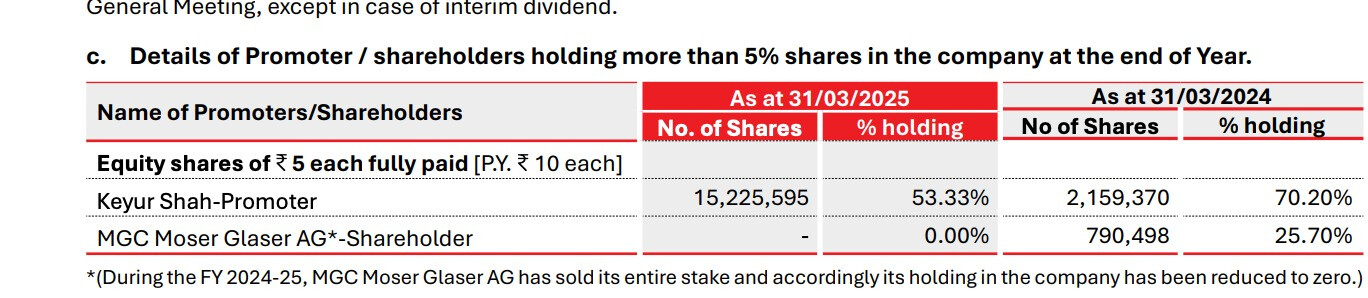
The promoter has bought out MGCs stake around 225 or so pre-IPO (am writing these from memory, so numbers might be off a bit) and Negen PMS as well seems to have acquired shares around this price (likely part funded the MGC buy out). It is my guess that the company had exclusivity as part of this earlier arrangement with MGC that prevented it from exporting RIP bushings abroad sort of similar to Aeroflex-Vertiv deal (they did export OIP in this period). Now with the tech transfer and removal of MGC board control, they should be able to export RIP bushings (with Indian made RIP cores).
The tailwinds I see
-
Transformer companies are doubling capacity and in concalls of TARIL, Apar, Atlanta etc. you can see references of bushings being in short-supply. Despite there not being any dumping duty etc. to protect company from Chinese competition, the customers still stick with Yash because qualification takes years and the company has a long association (and products are custom designed)
-
OIP:RIP mix today is about 50:50 (company did about 7000 odd bushings with roughly 3500 of each type) and revenue mix is 80:20 in favor of RIP because RIP is 4-5x the price of OIP in realisation. Order book today as well is 80:20 in favor of RIP - capacity itself is going up from 9000 today to 15000 and company is guiding for a ~65% util (a 40%+ growth visibility in volumes). The way OIP bushings supply is stressed more than RIP, my guess is the company is pushing out more RIP volumes as its more remunerative. The favorable RIP mix will aid in holding up margins despite the big capex increasing costs
-
The company has signed up agreements with Weidmann for distribution into Europe and North Africa, Electro link for UK and Ireland and has also established a US subsidiary - all in the last year post listing. Clear ambitions to push into export markets now that the exclusivity has ended. Export realisations are 2.5x domestic on OIP and in RIP as well I think is higher (can’t recollect exact figure). So export push opens up large margin expansion opportunity
-
The biggest of course is the backward integration into RIP core. If you see the imports reported in related party transactions over the years with MGC (since they had a 25% stake at that period), the RIP cores are roughly 30% of topline and roughly 70% of RM. FY25 MGC purchases are low because they dont have to disclose them as RPT
Back of the envelope yields core-as-%-of-bushings at ~40-50%. I feel Yash has a significant cost advantage making the core here because the aluminium foil, epoxy resin, copper conductor and labour are all significantly cheaper here in India. The crepe paper would continue to be imported but that’s only 25% of the overall cost of the RIP core. My guess is that with full operating leverage and 2-3 yrs into operations, Yash can comfortably hit a 40% EBITDA margin from the current 25% margin (please verify the math yourself)
-
The greenfield capex also gives them the capability to go up to 550 kV class bushings from the current 245 kV. Higher voltage and current classes have significantly higher realisations as they are way harder to make. This is another unlock and in higher class there are even fewer players. It also puts them on a path towards doing stuff in the HVDC value-chain in the future
-
Yash appears to have been 15% of MGCs revenues based on publicly available data for past years. RIP core itself could have a decent export market as Yash can now go head-to-head against MGC and that too with a significant cost advantage.
-
Yash and Quality Power bought Sukrut Electric from Maschinenfabrik Reinhausen. Both own 50:50 in the company as a JV. This company has complementary products and can be an optionality in the long run. Dont expect much from this.

So to sum up - I see volume, geography mix, product mix, backward integration all playing out in the next 2 years here. One more thing I liked is how efficient the company is with working capital. 50%+ growth between FY25 and FY26 with barely any growth in receivables. Bulk of the inventory must be RIP cores. Overall growth guided is for 40% for next few years and I do see a path to it with overall market size ~27k Cr and current sales ~240 Cr and current capex can do 700 Cr in 3-4 yrs. I think upto a 1200 Cr in this should be possible by a hungry and capable management if past is any guide.
Risks:
-
Capex execution and stabilisation remains key. The equipment is under commissioning as per recent call. They aim to do factory acceptance test and product approvals this year to start manufacturing by end of year. FY27 is still sorted even if there are delays by a few months. It doesn’t seem like this greenfield capex is something that the company conceived recently - to me it looks like this was always on the cards for a long time and such long-term plans and aspirations generally play out
-
Transformer companies backward integrating into bushings. I think this is not a very serious risk though there are talks here and there of it. Main reason is that its not something you can master overnight and product acceptance takes years. Also why would someone risk reputation to save 1% in EBITDA margins? The other thing is once Yash is backward integrated, the cost advantage would be untouchable. Also this business should have tremendous operating leverage - stuff like expensive machines, autoclave etc bring in inherent op. lev. - a business doing 20k bushings would have serious cost advantage to someone doing 1-2k for internal consumption (with imported cores)
-
Promoter is clearly market savvy going by the way he bought out MGC before IPO and also appears to be wanting to dilute another 100-110 Cr (enabling resolution of 150 Cr) for capex. You can see it either way - either he knows how to play the market towards short-term gains (very bad) or he knows how much value market can confer to people who play the long game with good ethics - I hope he is the latter but its hard to tell in SMEs.
Sources: AR, IPO docs, Choice broking report
Disc: I own a small pos here from 750 levels