Neuland 2.0: The Genesis of a High-Moat, Peptide-Driven CDMO Powerhouse
Neuland recently posted its Q4 2025-26 results followed by Concal. I have listened the concal and have read the conal transcript twice and came to conclusion that Neuland 2.0 is on the anvil.
Neuland 0.0 was a generic API manufacturer.
Neuland 1.0 was a CMS /CDMO player.
Neuland 2.0 is Peptide CDMO
The quarterly and full-year earnings conference call of Neuland Laboratories Limited (conducted on May 12, 2026) marks a defining inflection point in the company’s corporate journey. For the long-term observer, the spectacular Q4 and FY26 financial metrics are just the surface; the true narrative lies in the structural, fundamental transformation of the business model.
The management tone, operational pivots, and aggressive forward-looking investments signal that “Neuland 2.0” has arrived. Moving cleanly past its legacy constraints, Neuland is executing a sophisticated evolution: from a generic API manufacturer to a high-value Custom Manufacturing Solutions (CMS) and CDMO player, and now, into an advanced synthetic peptide powerhouse.
While the management explicitly notes the inherent “lumpiness” of a high-value CDMO model, the trailing numbers underscore a business that is structurally operating at a completely new scale. With every passing year new highs of lumpiness is created and then the new high becomes the base for next year. Ex:
I remember in Q4 FY 2022-23, the annual revenue had jumped to Rs 407 Cr as against quarterly revenue of around Rs 250 Cr and then Rs 407 Cr was considered as lumpy revenue on higher side. Come to Q4 FY 2025-26 average quarterly revenue is now above Rs 400 Cr and Rs 776 Cr is now new lumpy high which in coming years will become average quarterly revenue setting base of Rs 1000 Cr as new lumpy high quarterly revenue.
Entire concal was majorly focused on Peptide which was really a positive evolution as against previous concals where major discussion used to be on CDMO/CMS business and only passing reference was made on Peptides. Main highlights are as under:
-
We do have close to 8 to 10 peptide programs in our development pipeline, Some are advanced, some are early-stage.The programs that Neuland would expect to be commercialized in our peptide facility are programs that are not perhaps information on them are not available in the public domain.
-
Yes. So I think the pitch we make to peptide clients is that we’ve invested close to 16, 18 years in the peptide space, and we’ve kind of worked our way organically by making fragments, building blocks, Unnatural amino acid-based fragments and then slowly moved up the value chain, making even peptide APIs.
-
Our biggest strength is the fact that we have done a lot of process development for peptides in-house in Neuland. We’ve always had peptide R&D in Neuland for several years, focused on process chemistry, not medicinal chemistry. This is a skill set that is very important when it comes to engaging with clinical stage peptides, especially APIs.
-
So we were able to successfully showcase those capabilities. And once we showcase those capabilities and now we have also started investing and creating manufacturing infrastructure, it’s becoming easy for our clients to partner with Neuland. So that’s kind of what’s giving us traction in the peptide space.
Peptide(Synthetic Chemistry) Vs Biologics Complexities & Opportunity
-
Yes. Hi, Sajal, it’s always nice to hear from you. I don’t know if I would completely subscribe to the hypothesis. I think that I would agree with the basic concept that more value is in complex chemistry, complex modalities, but I would probably put peptides into that category as well.
-
I think today, if you see the explosion happening in the GLP-1 and the peptide arena, I think some of these peptides, especially the innovative volumes are going into multi metric tons and the commercial value for a CDMO business is running into billions of dollars per molecule.
-
So I would argue that the peptide CDMO opportunity is as or more attractive than maybe some of these oligo, ADC kind of opportunities because even if you take just based on my limited understanding of the oligo business, the oligo CDMO business is not as big as the peptide CDMO business.
-
That’s because oligos have not reached the kind of scale. ADCs is again slightly different because there’s a math component, there’s a biologics component over there. And I think, yes, it is definitely a future modality from a CDMO perspective. I think the way Neuland is approaching it is that we are a small company. I think we are really scratching the surface when it comes to this business.
-
I think we have a long runway of growth in front of us. I think if we continue to sharpen our skills in the small molecule, complex small molecule place, we strategically get into the peptide and start making complex peptides in a meaningful way. And then we slowly start looking for other adjacencies. For example, a peptide capability can help you make linkers for ADCs. So then you’re slowly getting into the ADC space through the peptide capability. And then maybe future through some strategic acquisitions, etcetera, you could climb yourself into these new modalities. But I would see a decade of growth by being invested in these current skill sets, including peptides. But I would not say we should be limited to this area. That’s where I would agree with you that you should keep going into these adjacencies.
But I definitely see peptides as more compelling today compared to, let’s say, an oligos or even some of these RNAi-based therapies. ADCs, yes, I agree, but ADCs is a different ball game. And I think that’s something maybe a future adjacency that we would pursue. -
I’ll just give you the businessman’s perspective. I’m not a scientist or a chemical engineer. But I think your encapsulation of the challenge is very accurate. I think synthetic chemistry-based techniques give far higher scale and are more reliable over long-term.
The biological processes are always challenging. Just if you look at peptides, for example, the 10-15 years ago, the largest volume peptide would be, say, leuprolide, maybe 100 kilos per year. Today, some of the GLP-1s are made at a metric ton scale.
The reason why the industry is able to make metric tons of peptide is because of the advancements in synthetic chemistry, our ability to maybe avoid bypass these cumbersome downstream techniques and come up with modern techniques, which avoid stuff like lyophilization, etcetera.
The reason that has happened is because academia and industry has invested a lot in chemical engineering techniques that avoid the use of these biological processes and have brought in synthetic processes. I think we as a CDMO cannot obviously make those kind of investments in fundamental research, but our R&D groups would follow those developments very closely. -
I think synthetic chemistry-based techniques in peptides, maybe even in oligos would be the area we would like to focus on. And I think there’s a lot of growth opportunities over there.
Growth and Margin guidance:
· I think the 18% to 20% is a fair assumption not necessarily linearly. I think margins, I think it’s definitely we’ve always been a little bit conservative in terms of how we’ve looked at our margins. That’s because how we fundamentally budget our numbers, whether it’s exchange rates, raw material pricing, volumes, we tend to be slightly on the conservative side and therefore, the margins play out better than expected.
· I don’t know off top of my head what the H2 versus H1 is. So, I don’t want to comment on it. I think you can see a trend line, Shyam. I can’t give you a better prediction than that. So I would say nothing has changed fundamentally. I think that things are looking slightly better than what we typically paint the picture to be.
Conclusion : 20% growth and 25% margin seems achievable for at least next 5 years.
Ø Capital Allocation strategy :
· I think our planning and I think the way we are thinking about capital allocation has become a little bit more long-term from being tactical. I think just to illustrate this point, I think 2, 3 years ago, we built a production block for a CDMO molecule. And we built that block because we had a long-term contract that was secured. And therefore, for us, it was a very comfortable investment.
Now I think for us, our thinking also has fundamentally started to change because now when you are at a INR2,000 crores revenue and you’re going to grow, eventually, you will be adding hundreds of crores every year, maybe INR500 crores, maybe even in the future, INR1,000 crores a year, which requires a different level of preparedness in terms of creating a base, creating production blocks and being ready to engage, especially with newer clients, clients like big pharma clients.
So, I think that’s the game that needs to be played and that requires a different mindset of capital allocation, which is what was being referred to in the opening remarks.
Ø Impact of Biotech funding:
· So Vivek, if I were to understand your question correctly, you’re talking about how the funding environment is affecting our business, right? And I think as we have said in the past, I think a lot of our business and our growth is driven more by molecules which are in the close to commercial and in the clinical phases.
· And a lot of the funding has affected more the discovery in the early phases. So, we haven’t seen that affect our business as much. But at the same time, it affects the pipeline funnel over a period of time. But the focus for us continues to be molecules where the IND is being filed that is where they are entering Phase I onwards.
So I think there, we continue to have good visibility. And irrespective of the funding environment, molecules with good data continue to do well. And I think our focus, the BD team’s
Ø Peptide Opportunity:
· Yes. See, I think if you look at the market potential, I think we’ve also had outside consulting firms evaluate this space before we committed to our peptide investment. We were told that it’s a $5 billion, $6 billion, just the CDMO space, $5 billion, $6 billion market opportunity, and it has a very healthy CAGR as an industry because there’s a lot of GLP-1s coming in.
· It’s not just about the weight loss drugs that have been commercialized, but it’s also about the next gens, not just from the large companies, but other companies as well. So there is a plethora of development candidates, which are peptides. And that creates a very attractive value proposition. So, I think the short answer is that it has the potential to create another Neuland for sure.
· It may take a few years, it may take more than a few years. I think that really depends on the nature of the opportunity. I think from Neuland point of view, I think we are looking at this business as a current capability plus peptides. So, we’re not really looking at leaving our small molecule capabilities. We are looking at adding that on.
· And we think there’s a lot of magic that can happen between small molecules and peptides. There’s a lot of also work you can do on the small molecule side, which lead into the peptide business. So, I think aggregately, it will be a very exciting business model. How big this business can be, I think, really depends on how the opportunities play out. Our goal is simply to just be kind of one of the on the forefront, at least from our part of the world and make investments, be
The Big Thesis Pivot: From a Forgotten Pipeline to the Main Stage Headline
In prior earnings calls, Neuland’s peptide capabilities were typically discussed in a muted capacity or viewed as localized research projects. This call turned that historical trend on its head. Peptides were a major highlight of the current call, reflecting a full-scale commercial commitment.
-
16–18 Years of Knowledge Compounding: Neuland did not stumble into peptides overnight. The management highlighted that they have spent nearly two decades organically compounding capabilities in this domain—starting from peptide building blocks and unnatural amino-acid fragments, before systematically moving up the value chain to complex, clinical-stage peptide APIs.
-
In-house Process Chemistry Moat: Unlike standard medicinal chemistry setups, Neuland’s foundational edge is its deep internal capability in process chemistry and chemical engineering. This specialized skill set allows the company to master scalable purification, bypass biological process limits, and drive synthetic chemistry solutions at commercial scales.
-
The Multi-Metric Ton Peptide Opportunity: Amid the massive global explosion of metabolic and GLP-1 therapies, peptide opportunities have evolved from tiny, multi-kilogram batches into complex, multi-metric ton commercial requirements with multi-billion-dollar potential. Neuland is aligning its strategy to tap exactly into this mega-trend.
Capacity Building Over Order-Matching: The New Capex Paradigm
Historically, Neuland operated with a highly constrained balance sheet, exercising extreme capital discipline. The legacy approach was largely tactical: management would add capacity or build a specific production block only when a firm, long-term commercial contract was fully signed and secured.
In Neuland 2.0, that playbook has been revolutionized:
· Building for Scale: Now operating on a firm base of over INR 2,000 crores in revenue, adding increments of hundreds of crores annually requires the infrastructure to be laid ahead of time. The management’s mindset has fundamentally evolved from tactical to long-term capability building.
· Pre-emptive Pipeline Loading: Rather than waiting for delayed client agreements, Neuland is initiating validation, qualification, and pre-commercialization runs right out of the gate. They already possess high visibility on an internal funnel of 8 to 10 peptide programs currently in their development pipeline to feed directly into this new facility.
- Scientific Depth via a New R&D Center: Alongside manufacturing capacity, capital allocation is heavily targeted at a brand-new R&D center. This center acts as a structural enabler, designed to help Neuland engage far earlier in the drug lifecycle with clients and seamlessly scale complex, long-cycle customer programs from inception to commercialization.
Broadening Big Pharma Relationships & Capability Compounding
· Neuland is no longer viewed by global innovators as just an alternative generic source; it has transformed into a strategic partner of choice.
· Deeper Big Pharma Engagement: Over the past year, Neuland has systematically strengthened its Key Account Management structure and deployed dedicated operational resources specifically to manage and support large-scale, highly complex projects. This tactical step enhances execution reliability and directly paves the path for deeper engagements with Big Pharma companies.
- Modality Adjacencies as a Long-Term Vector: The management’s strategy elegantly demonstrates the compounding nature of chemical knowledge. For example, mastery over complex peptides opens up adjacent opportunities to develop specialized chemical linkers required for Antibody-Drug Conjugates (ADCs). By leveraging specialized small molecules and peptide capabilities, Neuland is positioning itself to smoothly step into future complex hybrid modalities over the next decade.
The Trend Line of a Resilient Future
Investors who obsess over quarter-on-quarter lumpiness are missing the forest for the trees. Because high-value CDMO molecules do not respect arbitrary financial year boundaries, individual quarters will always experience volatility based on shipping schedules.
However, as CEO Saharsh Davuluri eloquently summarized, if you zoom out and assess Neuland’s performance over a longer 10-to-12 quarter horizon, a beautiful, compounding trend line emerges. Backed by a clean balance sheet featuring negative net debt (net cash positive by INR 157 crores) , a clear leadership transition geared toward day-to-day scalability , and a major commercial leap into complex peptides, Neuland 2.0 is perfectly armed to conquer the high-moat pharmaceutical landscape of tomorrow.
Disclosure : Invested from lower levels for last 4 years and now more confident to continue my position for next 5 years.
Pursuant to Regulation 30 of the SEBI Listing Regulations, we wish to inform you that the Board of Directors of the Company, at its meeting held today, i.e., September 7, 2026, approved capital expenditure of ₹126 crores towards the purchase of approximately 134 acres of land situated at Auro Industrial City, Kakinada, Andhra Pradesh, including other related expenditure. The Company also has a right of first refusal to purchase an additional contiguous land parcel of approximately 66 acres at a later date, taking the potential aggregate land parcel at the said location to approximately 200 acres.
Ballpark assumption : Land cost is generally 10% of project cost. Project capex plan in future could be around 1000-1500 cr over a period of time. Fixed asset turnover can be assumed at 2.
This exchange filing from Neuland Laboratories indicates their strategic focus that it is not trying to be a niche player in CDMO model.
Here is an analysis of this announcement from the perspective of chemical process engineering, capacity economics, and corporate credit:
1. Process Chemistry & Plant Engineering: The SPPS / LPPS Split
The capacity configuration in Module 1 reveals how they plan to solve the peptide yield challenge:
- Reactor Configuration: Module 1 has 7,000 L total reactor capacity, split as 750 L Solid-Phase (SPPS) and 6,250 L Liquid-Phase (LPPS).
- The Hybrid Play: Relying exclusively on SPPS for long 30+ amino acid chains generates massive error rates and solvent waste. The heavy weighting toward LPPS (6,250 L) indicates a fragment condensation / hybrid approach. They build shorter fragments (e.g., 10–15 amino acids) on the 750 L SPPS bed, then perform solution-phase coupling (LPPS) to assemble the final macromolecule.
-
Downstream Bottlenecks Addressed:
- Chromatography: Supported by three Dynamic Axial Compression (DAC) columns (one 45 cm, two 60 cm). These are critical for separating crude peptide impurities (deletion sequences) from the target API.
-
Lyophilization: Two freeze dryers (100 L and 200 L) to handle moisture-sensitive peptide cakes.
Parallel Execution: Housing SPPS and LPPS in separate suites prevents cross-contamination and enables simultaneous batch runs.
-
Module two is planned to provide an overall reactor capacity of up to 18,000 L, comprising three 5,000 L LPPS reactors, as well as either a 1,000 L or 2,000 L SPPS reactor, and smaller reactors of up to the 1,000 L scale. This flexible configuration will allow Neuland to support a broad range of peptide programmes and production scales.
Key Plant Insight: Jumping from 750 L to potentially 2,000 L SPPS in Module 2 signifies that Neuland’s anchor innovators are progressing from clinical/pilot quantities to multi-kilogram commercial-scale offtake.
3. De-Risking Strategy & Customer Visibility
From a capital expenditure and credit underwriting perspective, Neuland is mitigating project risk through three specific actions:
-
Anchor-Customer Driven Design: Module 2’s instrumentation and reactor configurations are being co-engineered with a specific customer. This avoids speculative capex and ensures immediate ramp-up post-commissioning.
-
Therapeutic Diversification: While the global rush is centered entirely on GLP-1s for obesity and diabetes, Neuland explicitly highlights oncology as an active early-stage pipeline driver. Oncology peptides command higher pricing per gram, involve smaller total batch sizes, and are less sensitive to commodity pricing pressure.
-
Human Capital Moat: Backing Module 1 with 212 dedicated peptide experts points to high process-engineering overhead, which creates high switching costs for innovator clients.
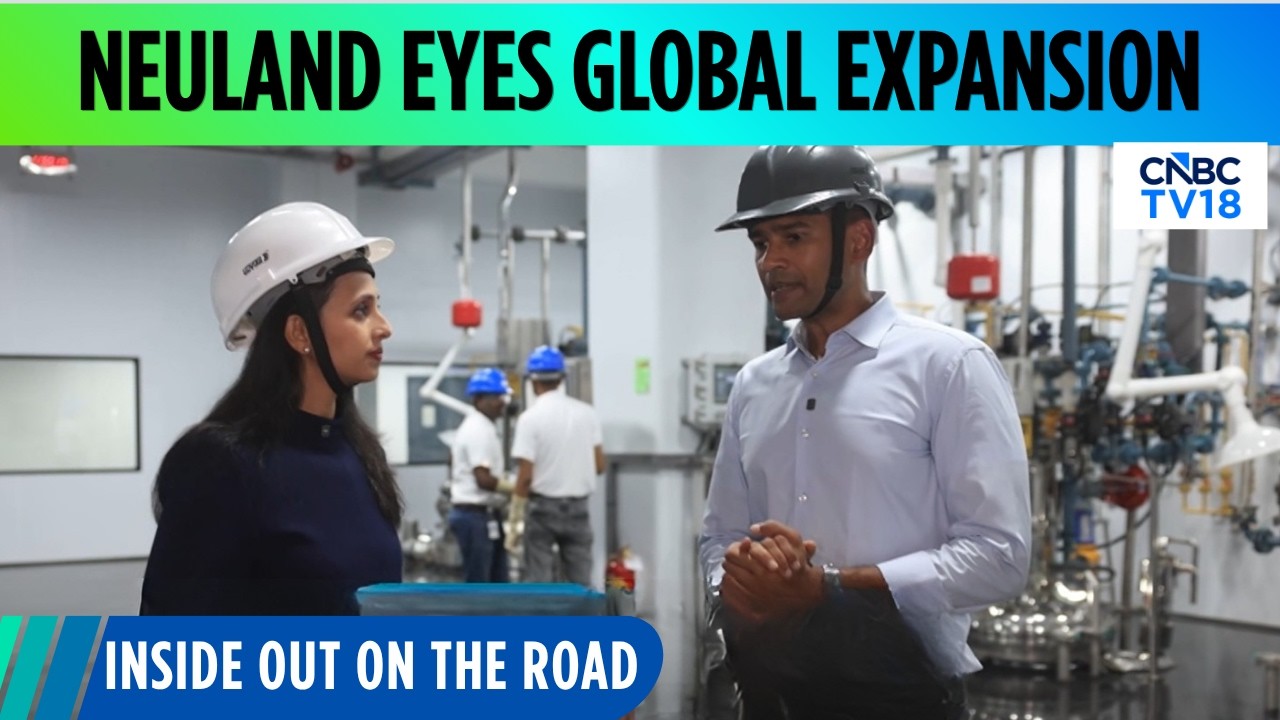
The company’s latest discussion with CNBC TV18 gives a useful glimpse into how management is thinking about peptides, custom manufacturing, the CMS business, and the opportunity emerging from the global pharmaceutical industry’s shift towards India. The most interesting part of the interview is that management is not presenting peptides simply as another capacity expansion. The larger ambition appears to be building capabilities that allow Neuland to become a long-term development and manufacturing partner for innovative pharmaceutical companies.
The emergence of GLP-1 drugs has brought peptides into the mainstream pharmaceutical conversation. According to management, the global peptide API manufacturing market was around $7 billion last year and is estimated at approximately $9 billion currently.
India, however, is still at a very early stage in commercial peptide API manufacturing for innovators.
That is important.
Neuland is not entering a mature Indian peptide market and trying to take market share from established domestic players. Instead, it is attempting to build capabilities before the Indian industry has really developed.
The company has commissioned a new peptide facility in Hyderabad, with the overall investment close to $30 million. Module 1 represents roughly $20 million of that investment.
The facility currently has around 7,000 litres of capacity.
Management indicated that Neuland has around eight to nine peptide projects, within a broader portfolio of roughly 90 projects.
Two of these peptide programs currently have sufficient visibility to potentially occupy most of Module 1.
Importantly, these programs are still around the end of their clinical stages. That means investors should not treat the available capacity as equivalent to immediate revenue.
This is one of the areas where management was deliberately cautious.
The commercial opportunity will ultimately depend on whether these molecules successfully move through clinical development and, if approved, how much API the innovator requires.
Neuland does not expect to manufacture the already commercialised large-scale GLP-1 drugs.
The reason is straightforward. The scale required for existing blockbuster weight-loss drugs is enormous, and Neuland believes it is too late to compete for that particular opportunity.
Instead, the company is targeting the next generation of peptide programs.
only a couple of the peptide projects are specifically related to weight loss.
The rest cover areas such as Metabolic diseases, CNS and neurological indications, Gastrointestinal diseases, Oncology, Other emerging peptide applications.
Management pointed out that there are more than 1,000 peptide programs globally across pre-clinical, clinical and commercial stages.
If even a fraction of these programs progress successfully, the addressable opportunity for specialist peptide CDMOs could expand significantly
Management specifically highlighted oncology as an area where peptides are becoming increasingly relevant.
This is an example of an important characteristic of the company’s strategy: the company is trying to build infrastructure around emerging technologies before the demand becomes obvious to everyone.
Whether that translates into attractive returns will depend on how successfully these capabilities are converted into commercial programs.
The 10-Year Growth Trajectory
| Market Metric | 5-Year Outlook (By 2031) | 10-Year Outlook (By 2036) |
|---|---|---|
| Global Peptide API Market Size | ~$12.05 Billion | ~$18.5+ Billion |
| India’s Peptide API Share (Value) | ~8% to 10% (up from ~4.5% in 2026) | ~12% to 15% |
| India’s Generic Peptide Volume Share | >45% of global volume | >55% of global volume |
| India’s Growth Speed | ~17.97% CAGR (Sustained double global average) | ~14% CAGR (Stabilising as generic market matures) |
| -chatgpt result |
Also Saharsh mentioned India’s share is Negligible right now (nearly zero)!
And further can reach $2Bn over 5 year period and then to Multi Billion Dollar over 10 year period.