
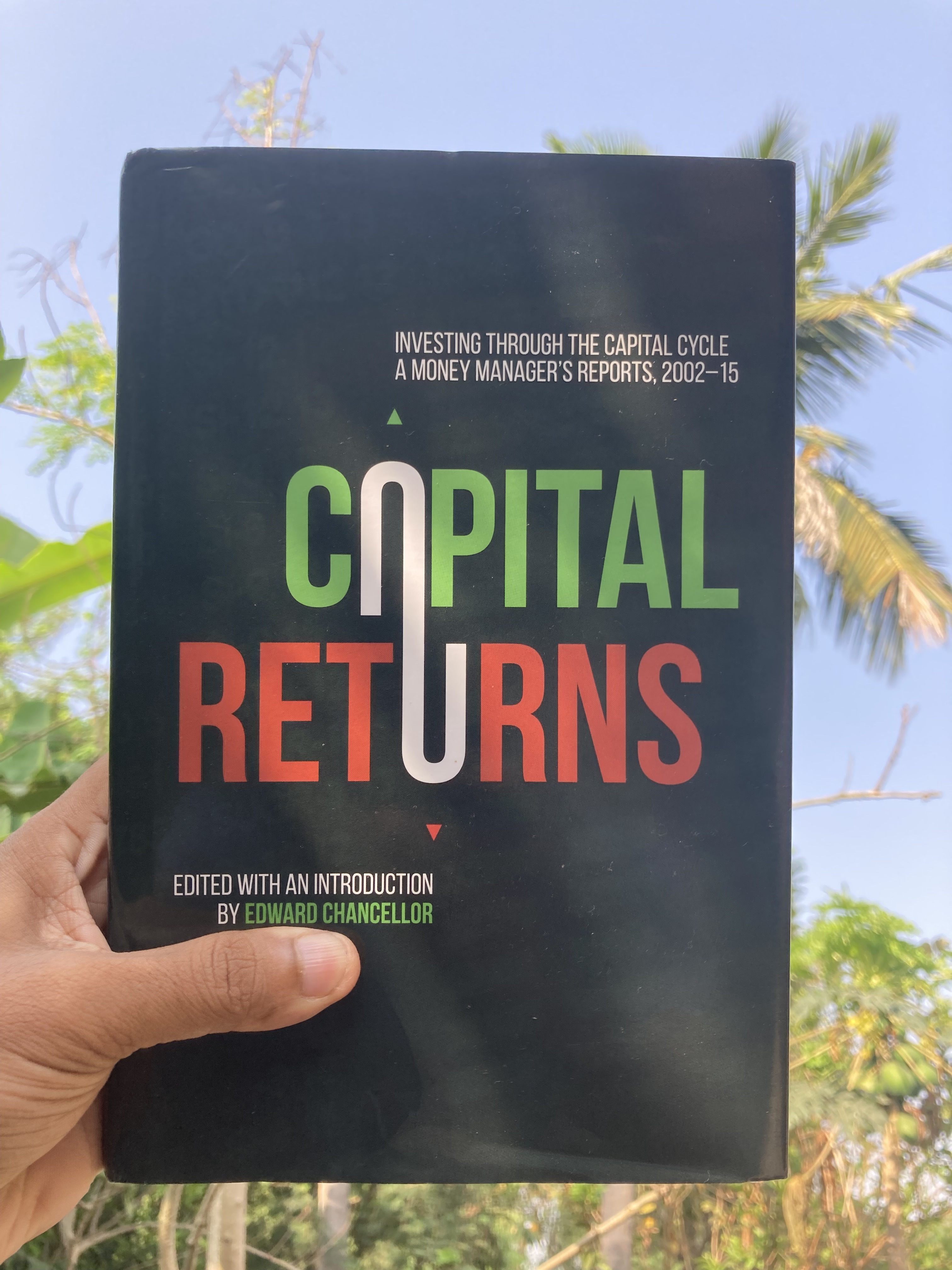
Capital Returns, Marathon Asset Management, 2015 - This is a collection of investment reports by Marathon’s portfolio managers between the years 2002 and 2015. Most (> 50%) of the letters are focused on the capital cycle analysis which is the phenomenon of excess profits driving excess capital into a sector thereby driving down the returns for everyone leading to a mean reversion and the idea that the best time to invest in that sector/country/economy then would be when capital is being withdrawn due to drying down of the profit pool leading to consolidations and liquidation of assets.
The reports are scathing on investment managers and PE firms for their proclivity to push companies to expand and then financing the same at the peak of the cycle earning fee income with scant regard to returns. It is also equally scathing on managements for value-destroying M&As driven by equity dilutions and buybacks at the peak of the cycle. Banks and lending businesses in general also get their fair share of brickbats, along with brokerages and their short-sighted research analysts and what I loved about all this was that it was written with a lot of specific examples and not in retrospect either while maintaining a consistency of opinion and a long-term focus across years. The central banks and politicians are not spared either with the lower interest rates prolonging the fate of the living dead questioning the very basis of capitalism.
Some parts I liked (paraphrased for brevity)
• High current profitability leads to overconfidence among managers who confuse benign industry conditions to their own skill - this is encouraged by media looking for corporate heroes
• Neither the M&A banker nor the brokerage analysts have much interest in long-term outcomes
• Delay between investment and new production capacity means supply changes are lumpy (cobweb effect in economics)
• Last commodity supercycle between 2002-2011 was driven by China’s investment heavy economy - as commodity prices rose, profitability of mining companies took off
• There is a inverse relationship between capex and investment returns (impact could last upto 5 years)
• combination of overconfidence, base-rate neglect, cognitive dissonance, narrow-framing and extrapolation drive the capital cycle anomalies
• co-operation in basic industries is crucial for shareholder value creation (look out for next outbreak of peace in competitive fronts)
• imposition of exit barriers can lead to survival of the unfittest
• Large number of IPOs and high M&A activity in any sector tend to occur in the later stages of the capital cycle
• Easier in a consolidated market to premiumize as having high volumes allows for wider price ranges
• There is no cure for high prices like high prices (peak oil)
• The whole industry is justifying higher investments based on inflated expectations of future oil prices (on rising oil investments in 2012)
• Mispricing within the growth stocks - Underestimation of the durability of the moat and underappreciation of the scale and scope of addressable market (value in growth)
• Reason why corporate profits lags GDP - Profitability is driven by favorable supply-side than by high rates of demand growth
• No correlation between long-term GDP growth and equity market return - China is a classic eg. with real equity return being negative despite stellar growth. Investors should not expect earnings to grow along with economy
• Double agents - When customer is not involved in purchasing decision, higher prices can be used to bribe the purchasing agent and can result in higher profit margins and sales volumes (Any business where agent gets between customer and producer)
• New entrants will struggle in a business with thousands of products of low volume - such markets make it difficult for new entrants to compete (Medical devices for eg.)
• High organic returns can be diluted quickly by poorly conceived investment decision and ill-timed buybacks
• When one company decides that buybacks are the thing to do, its competitors will play the game too. Competitors also raise capital at the same time as they don’t want to be left out (of the funding advantage)
• “Our job here is to create goodwill and not pay other people for goodwill” - (Rupert, CEO of Richemont)
• Equity is always the most expensive way to pay (Rupert)
• As banks hold onto less of the debt that they originate, they are bound to have less concern about longer-term credit quality. originate-then-distribute model is leading to a decline in quality of lending
• Moral hazard - the ability to take risk at other people’s expense
• Bank was borrowing short and lending long exploiting the latest financial innovations (a.k.a pass-the-hot-potato)
• Innovation in capital markets and the pursuit of fee-driven approaches has shifted risk to those least capable of evaluating it
• Deadly sins of banking - imprudent asset liability mismatches, supporting such mismatches by clients, lending to “can’t pay, won’t pay” types, reaching for growth in unfamiliar areas, off-balance sheet lending, getting sucked into virtuous/vicious cycle dynamics
• Economic recession is like a forest fire that destroys the deadwood and weaker trees so healthy young plants can grow and prosper. ultra-low interest rates prevent these and allow corporate zombies to continue limping
• Determination of the wealthy to earn somewhat more than risk-free rate which are near nothing will do more to restore equality than wealth taxes (fool and his money…)
The book closes with a primer on how the Chinese economy functions - with its investment led growth and supply-side excesses which kill profitability for everyone and how businesses aren’t allowed to die (exit barriers) and carving out of businesses from state-owned firms for public listing and manipulation of books and the difficulty to make returns. The final section was satirical but bit unfunny for my tastes (Marathon analysts aren’t Vonnegut) and can be comfortably skipped but the rest of the book was a calming read espousing the virtues of a long-term approach keeping the noise out. 9/10