
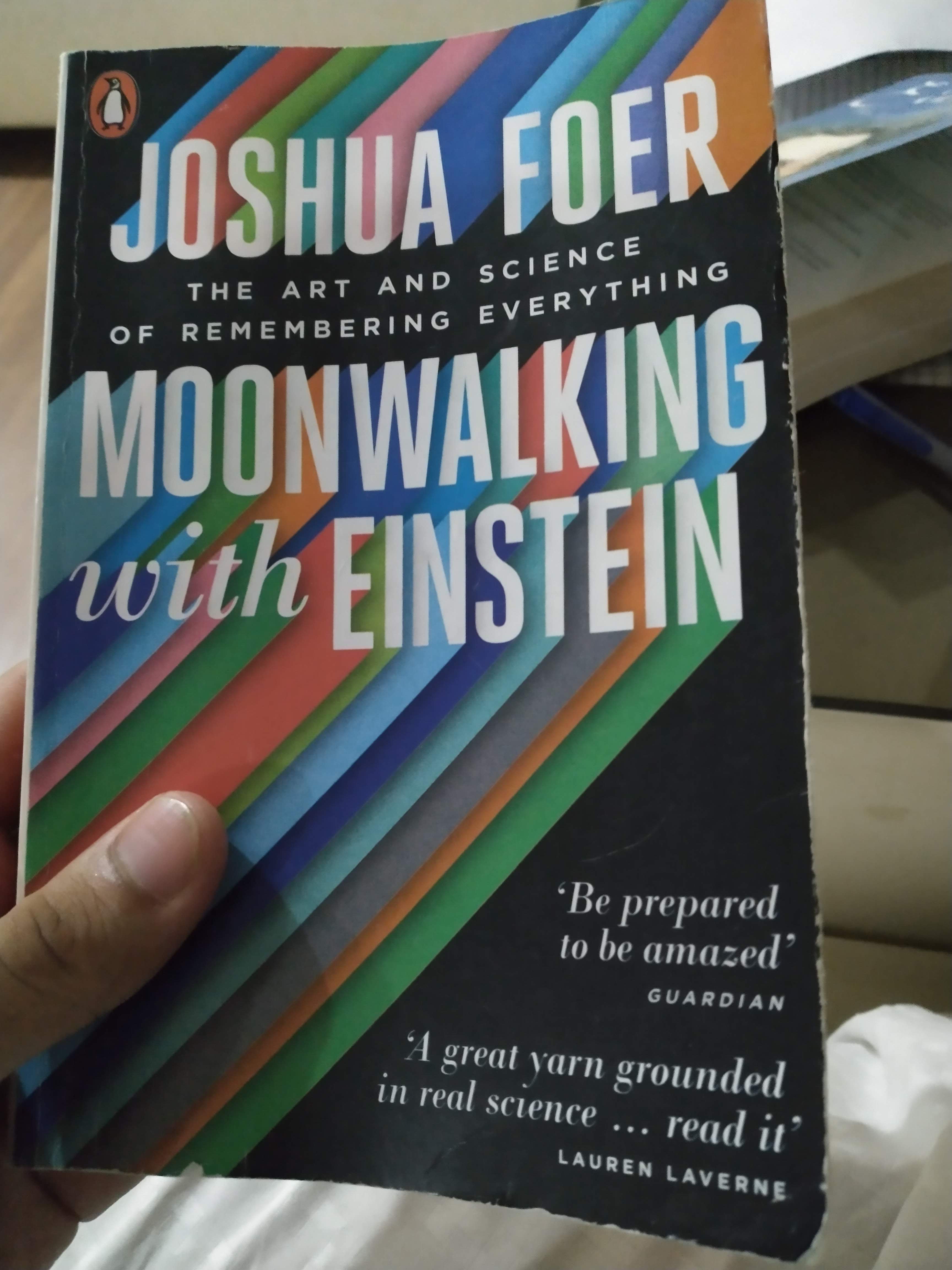
Moonwalking with Einstein
Joshua Foer (2011)
I had always read the stories of humans blessed with impeccable memory and it had made me believed that they have had some serious genetic advantage in life. I now realize that I got it all wrong. I wish that I had read this book some time ago. A good memory is more a result of one’s technique rather than genetics.
I read this book with another similar book called Unlimited Memory by Kevin Horsley a few months ago which is also worth a read and throws some light on absolutely useful memory techniques.
These days, our memory is externalized such that unlike historical times such that we don’t need to remember vast amounts of information. But as is the case with knowledge, you need knowledge to grow knowledge. Its just like compounding money. Retaining information is essential to making useful insights. Memory is important in this age, well much more important than many of us have been led to believe.
The book has a theory part and an autobiographical part in which the author tells us about his journey into the US memory championship. Some of my insights/notes from this book are
- Historically, traditions often focused on memory techniques to pass on folklore and religious scriptures in absence of writing. But somewhere in the past few centuries, memory traditions have taken a backseat.
- We might be bad at remembering words or sounds but are great at remembering images. That is why we forget names but recognize faces.
- To remember more, one must take a fact and put it in a web of associations, analogies, feelings, distinct images in such a way that it is intertwined with the information you know. Good memory skills work in connecting the unknown to the known.
- Our brain is a great filtering mechanism. Any information not useful will slowly wither away. That is why skills are lost over time if not practiced. It’s probably an evolutionary tool to keep us alive.
- But all memories are stored somewhere. They are not lost but rather inaccessible. They are just lost in the background over time waiting for the right cue to bring it back which rarely arrives. Somewhere in the mind, there’s a trace of everything you have ever seen.
- Monotony collapses time, Novelty unfolds it. Time seems to pass faster as we grow older because we have fewer of new experiences.
- Our brains remember distinct memories much better because those memories have no rivals. We don’t remember the lunches we ate because they are not distinct and similar to all other lunches. Our brain remembers distinct events much more sharply than normal events. To remember something, make it absolutely distinct from everything else.
- Memory making is an act of creativity. The more creative you can get with information, the better it sticks.
- The book also talked about the curve of forgetting and the role of repeated repetition in memory-making.
- The man who remembered everything like a photograph(he was using similar memory techniques but doing it unconsciously) was unable to hold on to any job or work in real life. Almost all similar savants end up like this. Our brains are efficient because of their ability to forget stuff and focus on important things. Forgetting makes us human. No one would like to drown in a sea of useless data.
- Memory masters use techniques such as memory palace, mnemonic system, chunking, visualization, etc. Memory palace is the most common method. They are a little difficult to explain here but worth a read.
There is a lot more in this book, especially in the theory part which I have missed.
Joshua Foer’s narrative swings back and forth from theory of memory to his practice in an attempt to compete and win at the US memory championship. He talks about his chance encounter with certain memory contestants and his stint in memory competitions who eventually become his mentors. He trains for less than a year and wins the US memory championship. And he was not blessed with a good memory but was like any layman.
This book was one of the most enlightening and fun reads I have had in a long time. And made me understand to view information in a way that would help me in the future while learning new stuff. Some people might not like this book as much as I did. Memory is something I have been absolutely curious about for the past year and reading this book was a delight.
9/10