
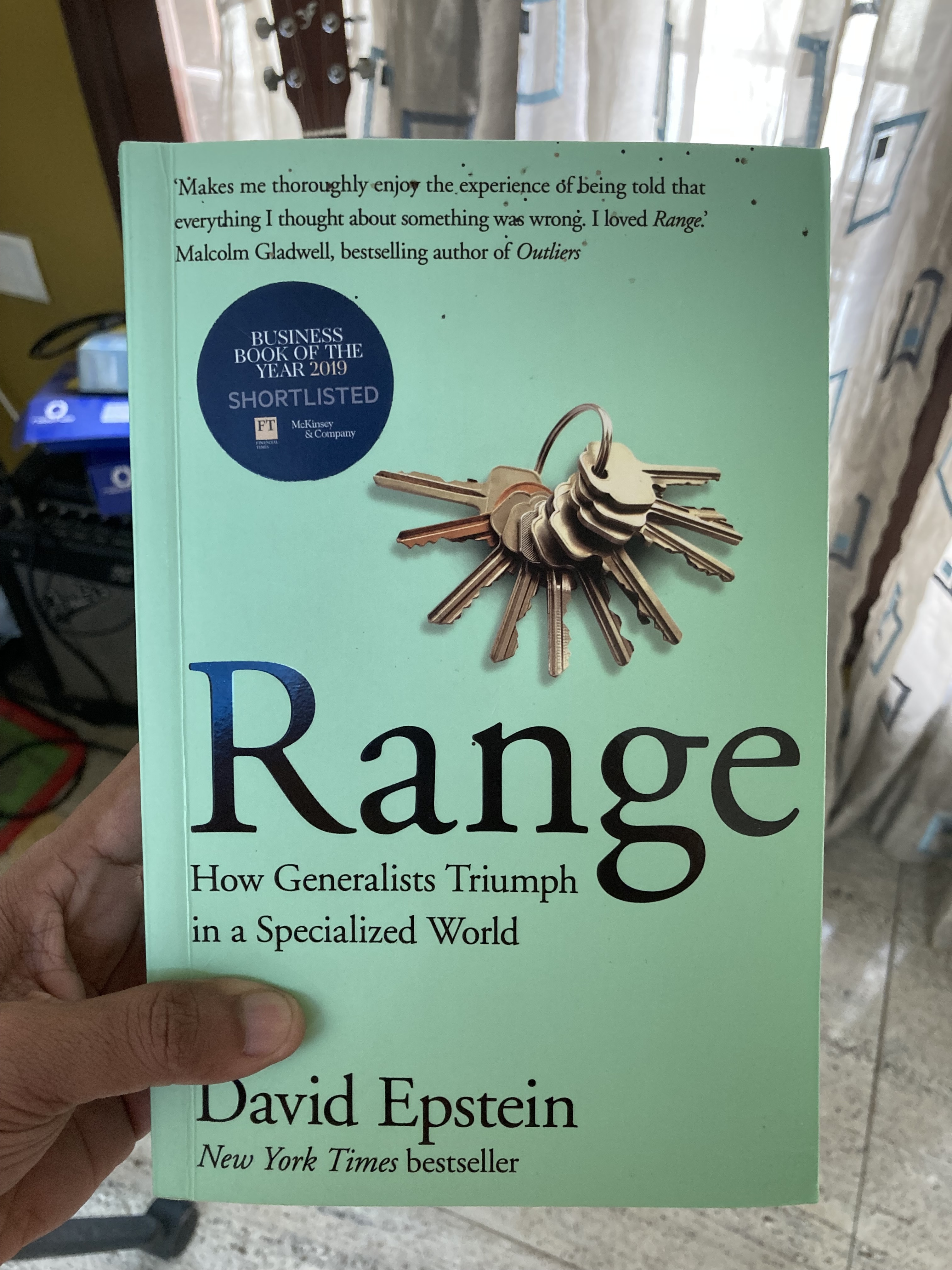
Range, David Epstein, 2019 - So a full book got written on the subject of specialists vs generalists - it was a long-time coming. There are fields where being a specialist helps and ones where being a specialist is almost a curse. These are what the author calls kind vs wicked environments. Kind environments can produce a Tiger Woods or Polgar sisters (Golf and Chess) with early specialization and deliberate practice (like the 10,000 hour rule).
A lot of what we encounter in life however are wicked environments - ones that don’t play by fixed rules but instead adapt - and it is in these that the author thinks generalists thrive. Even in kind environments like Tennis, some take on a sampling period like trying different sports and only much later specializing - like Roger Federer.
In kind environments patterns repeat over and over, more practice yields accurate feedback and correction cycle and continuous improvement (poker, chess, firefighting). In wicked environments, there are no fixed rules, they are often unclear or incomplete, may not have reliable repeating patterns and feedback is often delayed, inaccurate or both (financial or political trends, employee or patient outcomes). Wicked environments need abstract thinking, drawing upon many disciplines for analogues (far transfer).
There are several examples in the book from the figlie, Kepler, Van Gogh, Yokoi, Darwin and several important concepts like “far transfer”, “match quality” (simply having a vocabulary for these things somehow makes them more usable).
Some parts I liked, in no specific order
- When doctors joke about left-ear surgeons, we have to check to be sure they weren’t joking (Atul Gawande on specialists)
- The most-effective learning looks inefficient, it looks like falling behind
- Highly credentialed experts can get narrow-minded and confident and hence get worse with experience
- Chunking - the ability to bucket patterns for faster retrieval (Anyone who has worked with sorting and searching algos can relate) is useful in faster pattern recognition (in the context of chess)
- In narrow-enough worlds, humans may not have much to contribute for longer (AI)
- Flynn effect - Apparently IQ keeps increasing with every passing generation (due to our increased ability for abstraction)
- Pre-modern people miss the forest for the trees, modern people miss the trees for the forest
- Fermi-problems - Quick back of the envelope calculations to approach problems with no prior experience
- Sampling period is integral and not incidental to the development of great performers
- Brain areas associated with focused attention, inhibition and self-censoring were turned off when musicians were creating. While improvising musicians do the opposite of consciously identifying errors and correcting them (classically trained musicians hence struggle to play jazz which is creative while classical is re-creative)
- In classroom environments, conceptual problems are turned into procedural ones that can be executed (teachers giving hints). Japanese do this better (bansho)
- Struggling to generate an answer on your own, even a wrong one, enhances subsequent learning
- Interleaving improves inductive reasoning
- Knowledge structure that’s so flexible that it can be applied in different domains and novel situations (far transfer)
- Each time Kepler got stuck, he unleashed a fusillade of analogies (light, heat, odor, boatmen and currents, brooms, magnets etc.) to understand planetary motion
- Evaluating an array of options before letting intuition reign is a trick of the wicked world
- A problem well put is half-solved (best problem solvers begin with typing the problem up)
- Degree of fit between the work someone does and their abelites and proclivities is “Match quality”
- knowing when to quit is a big strategic advantage
- I have been obsessed with an idea for a short time but later lost interest (Van Gogh in a nutshell)
- Our work and life preferences do not stay the same because we do not stay the same
- the further the problem was from the solver’s expertise, the more likely they were to solve it
- People who win in Kaggle health competition more often have no medical or biology background and no ML expertise either
- Academic departments no longer merely fracture into subspecialities, they elevate narrowness into an ideal
- Generalists tended to get bored working in one area for too long. They added value by integrating domains, taking technology from one area and applying it to others.
- Higher the domain’s uncertainty, the more important it was to have a high-breadth team member
- Most cause-effect relationships in the wicked world are probabilistic
- Dropping one’s tools is a proxy for unlearning. Experienced groups became rigid under pressure and regressed to what they knew best
- Consensus is a nice to have but we shouldn’t be optimizing happiness but our decisions
- Take your skills and apply to a new problem (across domains) or take your problem and apply new skills
For someone like me who has always had one foot outside of whatever it is I have been doing, trying completely unrelated skills/domains every 3-5 years, this book only confirmed my beliefs and hence isn’t a good read but if you believed the contrary, it may be worth your time. 9/10