
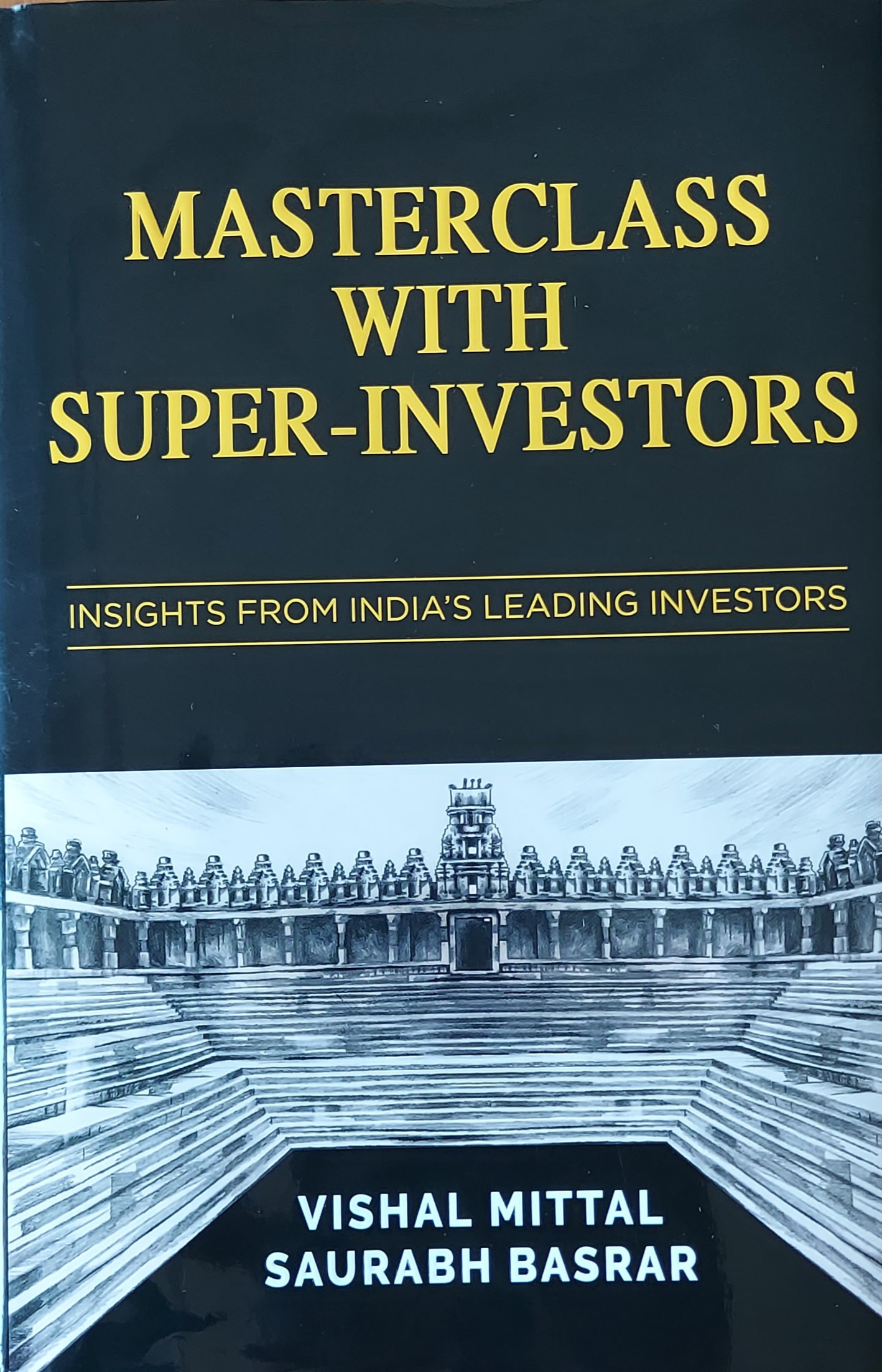
Book Review - Master class with Super-investors – by Vishal Mittal and Saurabh Basrar.
This book has interview of 11 great investors in India equity name like Ramesh Damani, Ramdeo A, Hiren Ved, Vijay K etc. The interviews are lengthy and provide useful insight. One interview is of 40 + pages. Typical interview starts with their initial investments. That will be on ear of 1980-90 type. The book has investors’ best idea and details why he selected those stocks (case studies). It gives us idea of history of Indian stock market, with broader and stock specific market. After reading the book one get idea of how investor evolved from his initial investment. Also investors discuss their mistakes and logic behind that.
Common takes are as follow:
- All are absolute bullish on India story
- Most suggest to back up great idea with significant allocations
- All are humble and consider market is right
- Contrary to point 4, many have successfully timed market right as bullish and bearish and did allocations accordingly
- Most are very avid reader
Below I find interesting:
A. Ramesh Damani has interesting takes on top and bottom of bull and bear market.
“At the top of the bull market, news headlines will be very positive. It will say that investors are flocking to India; sensex makes new highs, corporate records high profits etc. But market will go down those days. It reacts negatively despite the good news coming out. It indicates there is selling going there; smart money is going out in anticipation of bad times.
Typically at the bottom of bear market, headlines will be very negative like Rs. At 70 to a dollar, India has payment crisis, corporate profits are dismal, issues with government etc. Despite that individual stocks are going up instead of down.
B. Rajashekar Iyer – He breaks valuation in 3 parts, Like If co is making 1000 cr profits, to do that you need to invest 16000 cr in bank @ 6%. Second part if growth, if you think it may grow at minimal nominal GDP @ 12-15% than add another 15000-20000 cr of value. 3rd is other opportunities co can exploit. Sometime 3rd component is negative in depressed market. In extreme bear market, mkt cap is lower than 1st component.
C. Hiren Ved: Interplay between PE and EPS is beautiful. Most people tend to just look at the earnings. But PE is the leading indicator whereas EPS is a lagging indicator. PE goes up is due to liquidity or confidence about future or pre-empting an earnings recovery. In 2008 downturns, initially companies not much affected in terms of earnings but PE got compressed. Companies was said that there is no problem in India, it’s in USA. Actual earnings fall happened in last Quarter of FY 2009 but market bottomed out much before the earnings fell.
D. Hiren ved on cash call: In Mid 2008 we realize valuations becomes expensive however we realized that sweetest money is made in the final lap of bull rally. We didn’t sell at the top but started selling when market falls to 18500-19000 from 21000. And we were 55% cash, we looked like hero. On up side we started putting money from March 2009. Market was locked up in 20% up post elections in April-May 2009. We couldn’t deploy full cash and underperformed the market that year. For aggressive cash call you need to be right at both ends. After that we made policy to take out maximum of 15% cash call.
End…