
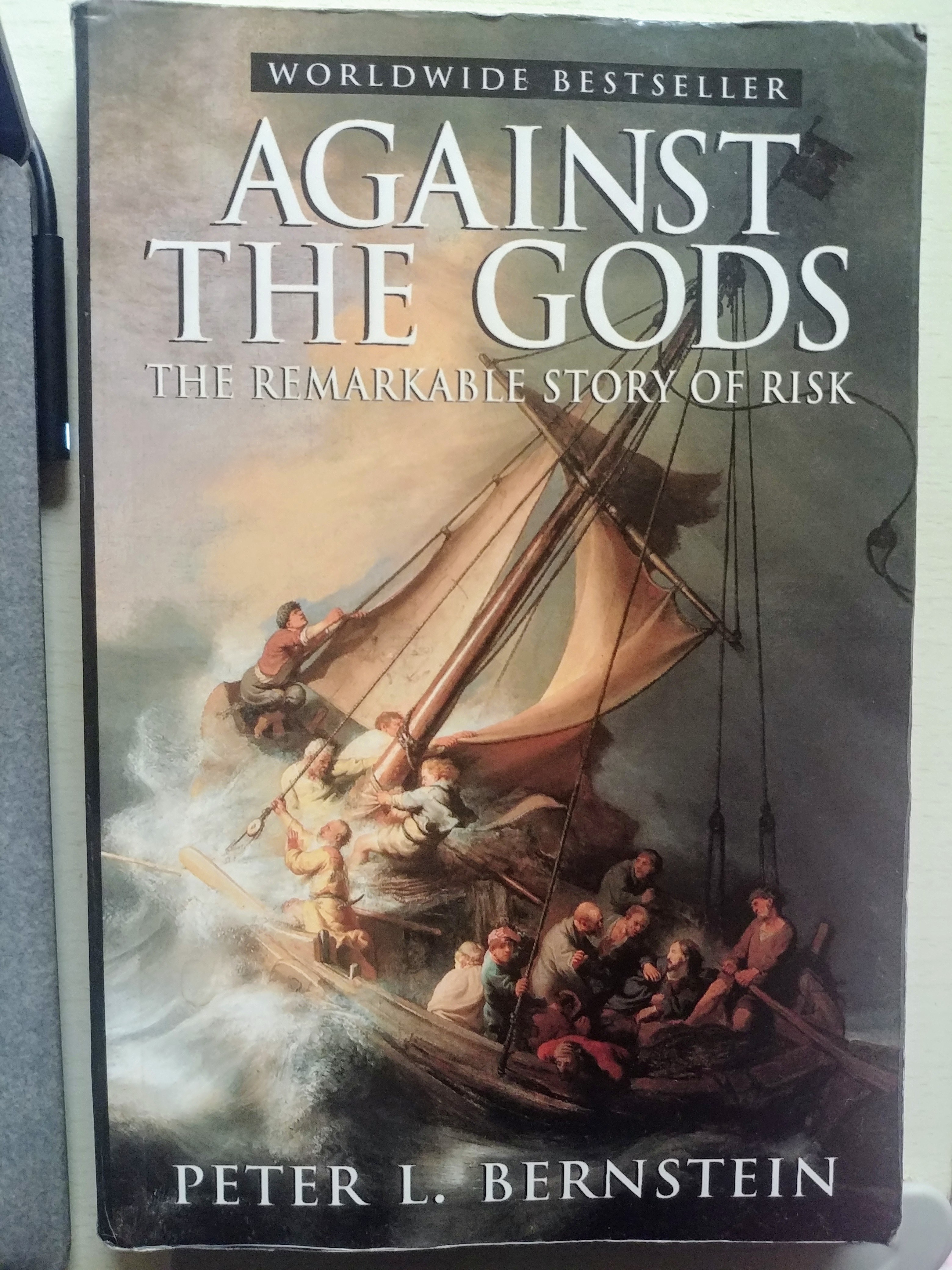
Against the Gods, Peter L. Bernstein, 1996 - This is a remarkable book on the remarkable story of Risk. There really can’t be anything more comprehensive than this on the subject. While there are brief references of dice and related games running back thousands of years, a bulk of the understanding and work has happened only in the last 450 years. It is interesting to note that without the carrying over of the zero and the Hindu-Arabic numbering system to the Western world, there may have never been any progress, because without zero, the Roman number system couldn’t lead to natural number sequences - For eg. what comes after I,X and C? In the Hindu-Arabic system with zero, you know that after 1,10 and 100 comes 1000. How elegant! It took Fibonacci’s Liber Abaci to overcome the hurdle posed by the church to let the ‘infidel symbols’ to be adopted for mainstream use. Looks like this happened in th 9th century but then the middle ages followed - when you believed that everything in the future was dictated by a higher power, the impetus to look towards a future that was pliable by mortals was never there, which might explain the lack of any sort of progress in the middle ages. Risk management after all requires us to behave as free agents who could manipulate outcomes.
The earliest reference of probability happens only in 1500s with Cardano the gambler/polymath from Italy having used it in games of dice where he figured out the odds of favourable outcomes to unfavourable ones. Some of the more concrete work was done by Pascal and Fermat when they tried to solve a problem of a half-finshed game where one player was leading the other and they had to figure about the likelihood of either one winning the game in the 16th century. Pascal’s Triangle was an older version of the modern ‘permutations and combinations’ in 7th grade math. Pascal wrote something on the lines of ‘fear of harm ought to proportional not just to the gravity of the harm, but also to the probability of the event’ - with that Pascal probably was the first to link probability and expected value. We are still in 1662. Graunt follows as the man who unwittingly pioneered statistics as field when he was compiling births and deaths in London during the great plague of 1665.
Statistics and the mathematics of odds, naturally lead to insurance in the unlikeliest of places - at Lloyds coffee shop where sailors from the ships used to hang out where the earliest underwriting was done. ‘The value of an item must not be based on its price, but rather on the utility that it yields’ was the theme of an essay in 1731 - sort of the earliest version of Bernoulli’s utlity theory which followed shortly. Bernoulli had a problem with ‘Expected value’ computed with probability because the utility is dependent on the particular circumstances of the person making the estimate. There is no reason to assume that the risks anticipated by each individual must be deemed equal in value - which was phenomenal leap in the understanding that Risk depended on perspectives of the individual - He essentially understood that ‘Gut rules the measurement’!. With this he formulated his pivotal idea - ‘Utility resulting from any small increase in wealth will be inversely proportional to the quantity of goods previously possessed’.
de Moivre, Gauss, Laplace follow with binomial distribution, ubiquitous normal distribution and the Gaussian functions for representing the probability density. Galton (Darwin’s half-cousin) with a deep interest in peapods, stumbled upon the concept of regression (larger peas don’t produce larger and larger peas forever and neither do small peas produce smaller and smaller peas, forever) and correlation (taller parents had taller children). Examples of these today are all over the place - we know the economy will recover when its going through a slowdown (doesn’t imply recovery is around the corner but we know that eventually, it will) - high performing fund manager of today will be the mediocre one of tomorrow and so on.
Since the war and afterward, significant contribution to the subject has come from Keynes - who junked the peapod analogy as he found it applicable to nature but not to human beings. He also took a dim view in modeling the future against the past and built on Popper’s wisdom in saying ‘We simply do not know’ in trying to calculate probabilities of uncertain events like war or interest rates 20 years into the future. Two more groundbreaking innovations since 1950 are Game theory and Markowitz’s modern portofolio theory, both of which are excellent subjects on their own, the latter despite the brickbats it has received, since it was the first one which tried to manage risk with mathematics instead of flying seat-of-the-pants.
More modern developments in risk include works in chaos theory and in the field of behavioural finance by Kahnemann, Tversky and Thaler (Things that Kahneman expands on in Thinking fast and slow are already here in this book). When reading Kahneman’s Prospect Theory with the backdrop of Bernoulli’s Utility theory, the dramatic improvements made in marginal utility, reference points and framing etc. show how far we have come in the recent years. I may have missed Bayes, Newton and Einstein but they have played a significant secondary role in a lot of these developments above.
The last 3 chapters of the book stick to current financial markets and discuss the crash of 1987 which was triggered by portfolio insurance (and of course how it came about), derivatives and the reason for their existence despite the caveats and so on. This is already becoming a long review, so I think its better I stop here and say this book is essential reading for anyone remotely interested in the fascinating subject of Risk. 11/10
P.S. This was a used book. Looks like it was previously owned by an Insurance company. Appeared unused though 