
Comparative Analysis of Macpower CNC Machines Ltd and Jyoti CNC Automation Ltd:
In the capital-intensive machine tool industry, management philosophy serves as the foundational architect of a firm’s corporate trajectory and risk tolerance. These core beliefs determine whether a company prioritizes organic, disciplined growth or aggressive, technology-led expansion. Within the Rajkot industrial cluster, the strategic evolution of Macpower CNC Machines Ltd and Jyoti CNC Automation Ltd offers a masterclass in how divergent “corporate DNAs” dictate operational realities, even when influenced by the same regional tailwinds.
1. Comparative Leadership Philosophies and Corporate DNA
The strategic divergence between these two firms is best understood by contrasting the “Dhandhawala” approach of Macpower with the “Temple of Technology” globalist vision of Jyoti. Macpower’s philosophy, steered by Rupesh Mehta, is rooted in the traditional “dhandhawala” mindset—a no-nonsense focus on business fundamentals, cost-efficiency, and a profound aversion to debt. This has fostered a lean organization that operates with virtually zero interest expense.
Conversely, Parakramsinh Jadeja has positioned Jyoti as a high-stakes, technology-first entity. This vision was solidified by the 2007 acquisition of the French firm Huron Graffenstaden, signaling a preference for rapid technological leapfrogging fueled by institutional capital and global expansion.
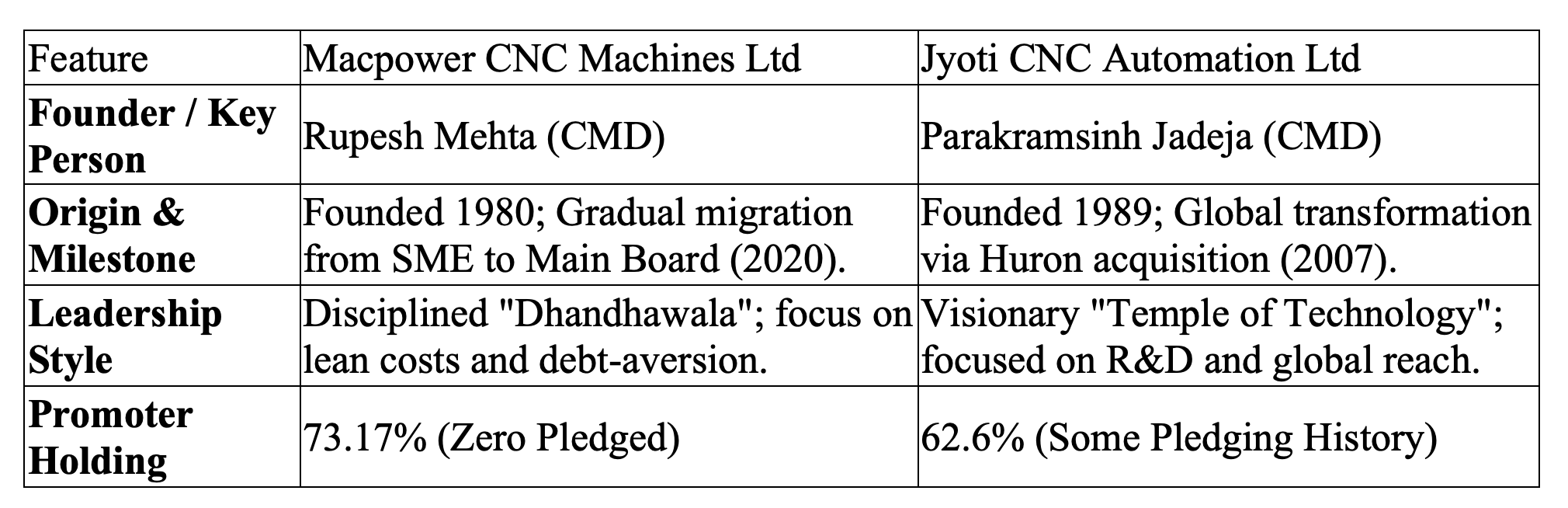
These divergent management styles fundamentally impact long-term scalability and financial agility. Macpower’s debt-aversion provides a near-flawless balance sheet that serves as a safety net during cyclical downturns, though it necessitates a more incremental pace for massive capital deployments. Jyoti’s high-leverage strategy, while facilitating the capture of high-end global markets, requires navigating escalating interest costs and the pressures of institutional performance expectations. Ultimately, these philosophies directly dictate the technological ceilings of each firm, defining whether a company builds its capabilities through internal evolution or external acquisition.
2. Technological Roadmaps and Industry 4.0 Integration
In the modern manufacturing landscape, proprietary technology and software integration serve as the ultimate “moat” against global competitors. As the industry moves toward “lights-out” or unmanned production, the “brain” of the machine—the CNC controller—becomes the primary differentiator. While both firms are attempting to break the monopoly of global controller giants, they operate with vastly different R&D depths.
Macpower is currently elevating its profile with the NEXA series, moving beyond basic lathes into high-end VMCs (Vertical Machining Centers) and HMCs (Horizontal Machining Centers). This transition is supported by their proprietary “Macatrol” controller, aimed at providing cost-effective performance.
However, Jyoti occupies a more sophisticated plane, leveraging a dedicated R&D team of 140+ engineers compared to Macpower’s 30+ staff. Utilizing Huron-integrated expertise, Jyoti offers established 5-axis simultaneous machining centers, such as the Tachyon Beta series and heavy-duty VTLs (Vertical Turret Lathes). Their Industry 4.0 integration includes:
-
7th Sense Platform: A proprietary system providing real-time performance and productivity analytics.
-
PreciProtect: AI-based collision prevention designed to sense potential accidents and protect expensive spindles in real-time.
-
HUMA (Human Machine Interface): A patented, intuitive touchscreen interface designed for remote monitoring and “unmanned” operational efficiency.
The impact of these technological choices is starkly visible in the “Average Unit Realization.” Jyoti’s command of complex, AI-integrated 5-axis technology allows it to realize approximately ₹46 Lakh per machine, more than double Macpower’s ₹20 Lakh. This realization gap underscores the difference between a firm successfully transitioning to the high-end (Macpower) and a dominant, technology-led global player (Jyoti). This “brain” power, however, requires a massive physical infrastructure to produce at scale.
3. Manufacturing Infrastructure and Scalability Benchmarks
Capacity expansion is the critical lever for capturing the “China Plus One” and “Aatmanirbhar Bharat” tailwinds. Both firms are engaged in significant capital expenditure (Capex) programs to meet burgeoning order books, but their geographic and operational scales remain distinct.
Macpower is executing a 30-acre greenfield expansion in Rajkot, targeting a capacity of 10,000 machines per annum over the next five years. Jyoti is pursuing an even more aggressive target of 16,000 machines by late 2026. Beyond its Rajkot base, Jyoti has strategically acquired 20 acres in Tumakuru, Karnataka, to penetrate the South Indian manufacturing belt and has doubled its capacity at the Huron facility in France to 240 high-end machines annually.
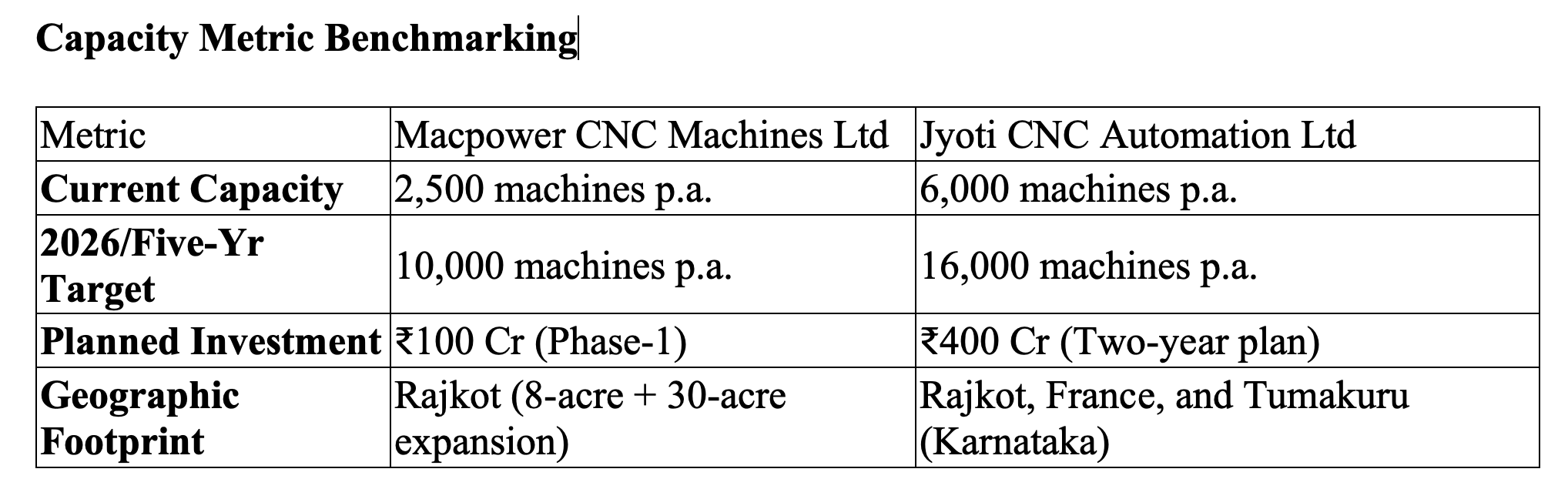
The allocation of new capacity impacts long-term revenue visibility. Macpower’s decision to reserve 50% of its new capacity for the defense sector provides “stickier” revenue and long-cycle visibility, offsetting the cyclicality of its traditional MSME base.
Jyoti’s aerospace-heavy order book (accounting for ~39-41% of its total) provides a 24-to-30-month revenue runway but demands constant technological parity with global standards. These massive physical investments are the foundation upon which their disparate financial architectures are built.
4. Sector Concentration and Strategic Risk Profiles
The strategic risks inherent in these firms are tied to their target markets. High-moat sectors like Aerospace and Defense offer superior margins but present unique execution and working capital challenges.
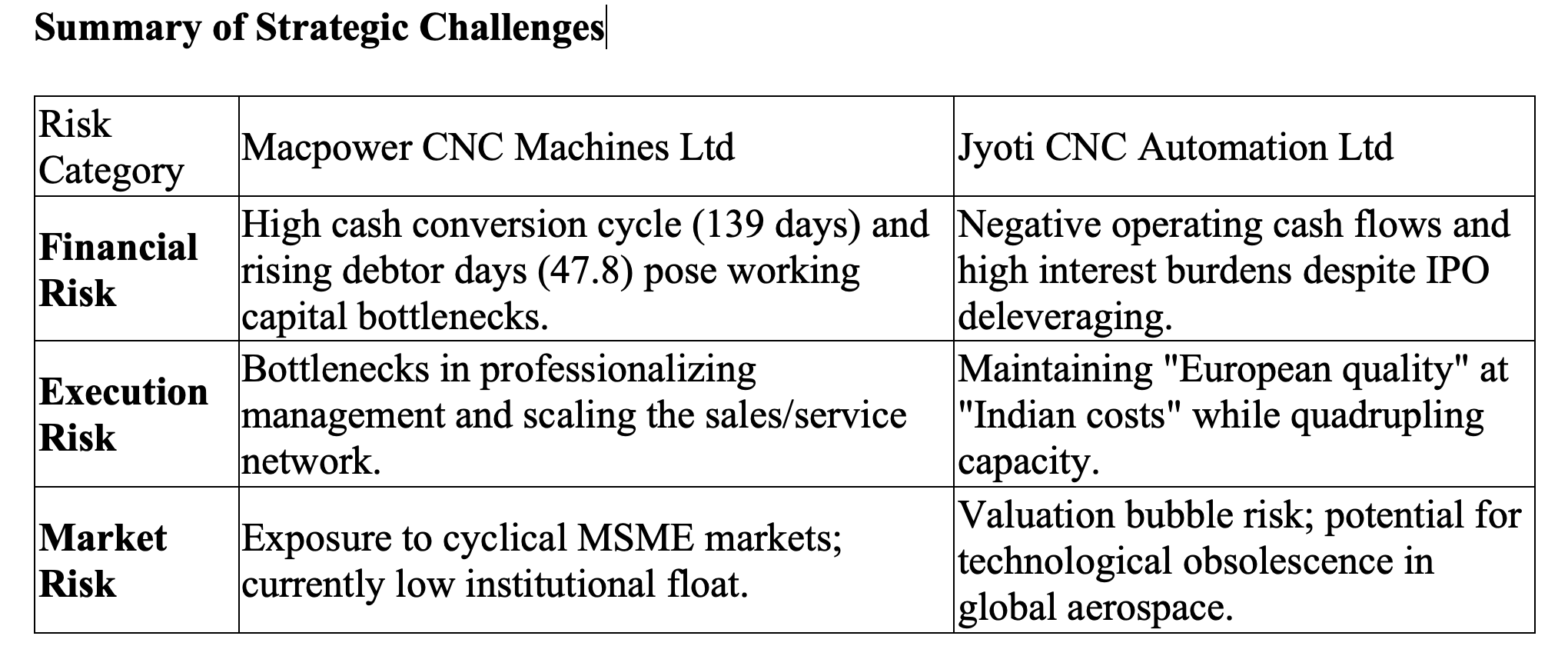
For Jyoti, the 24-to-30-month visibility in its aerospace-heavy order book is a massive strategic advantage, yet the persistent negative operating cash flows highlight a critical vulnerability in its “Technology Bet” model. Macpower, conversely, must manage its working capital cycle more aggressively to prevent the high-margin defense pivot from being throttled by debtor-day extensions.
Macpower CNC Machines represents the “Compounding Machine” archetype—efficient, debt-free, and poised for a valuation rerating as it scales into a mid-cap entity.
Jyoti CNC Automation represents the “Technology Bet”—a high-octane entry into the global high-tech landscape that promises massive scale if it can execute its ambitious expansion and financial management without error. Both remain cornerstone players in India’s drive toward becoming a top-three global machine tool market by 2030.