YoY Growth (%) = [(Q4 FY25 Value – Q4 FY24 Value) / Q4 FY24 Value] × 100
For KRN’s Q4 FY25 Revenue:
You provided:
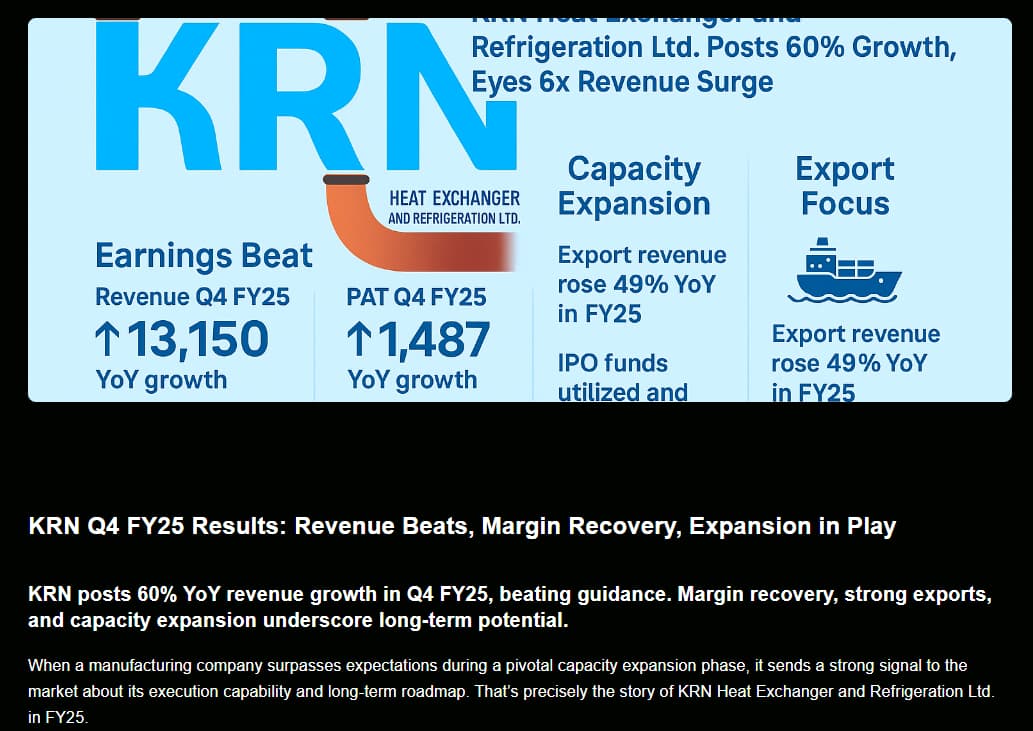
Q4 FY25 Revenue from Operations = ₹13,150.24 lakhs
Q4 FY24 Revenue from Operations = ₹8,201.57 lakhs (implied from reverse calculation)
YoY Growth (FY)
= [(FY25 Value – FY24 Value) / FY24 Value] × 100
Thanks
I am invested in Krn
I don’t see negative cash flow
You are possibly looking at the large amount shown as investment but that was the reason for the capital raise.
If you look at cash flow prior to it, I don’t see a issue
If they raise another cash for another plant without fully utilising the current one and without generating profit, then I would be very suspicious
@Vikas2412 ..Vikas ji pls check their presentation >https://www.bseindia.com/xml-data/corpfiling/AttachLive/243421f3-f86f-4685-a870-3cbbc50bc1c1.pdf
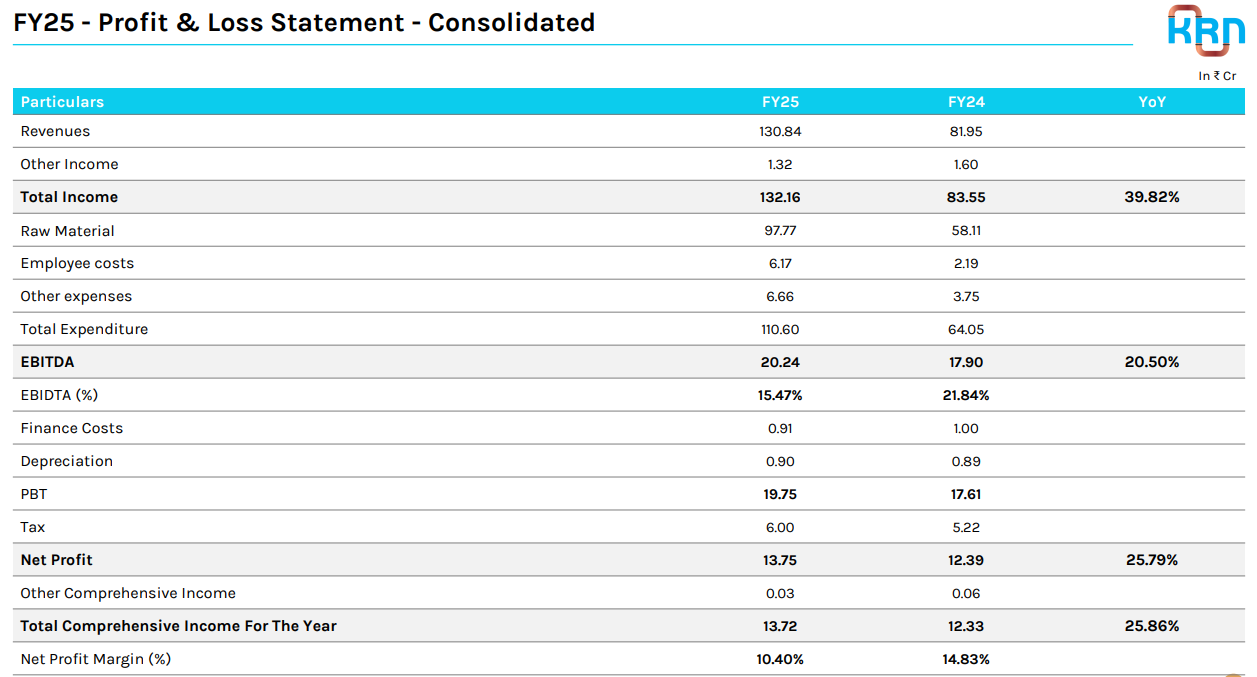
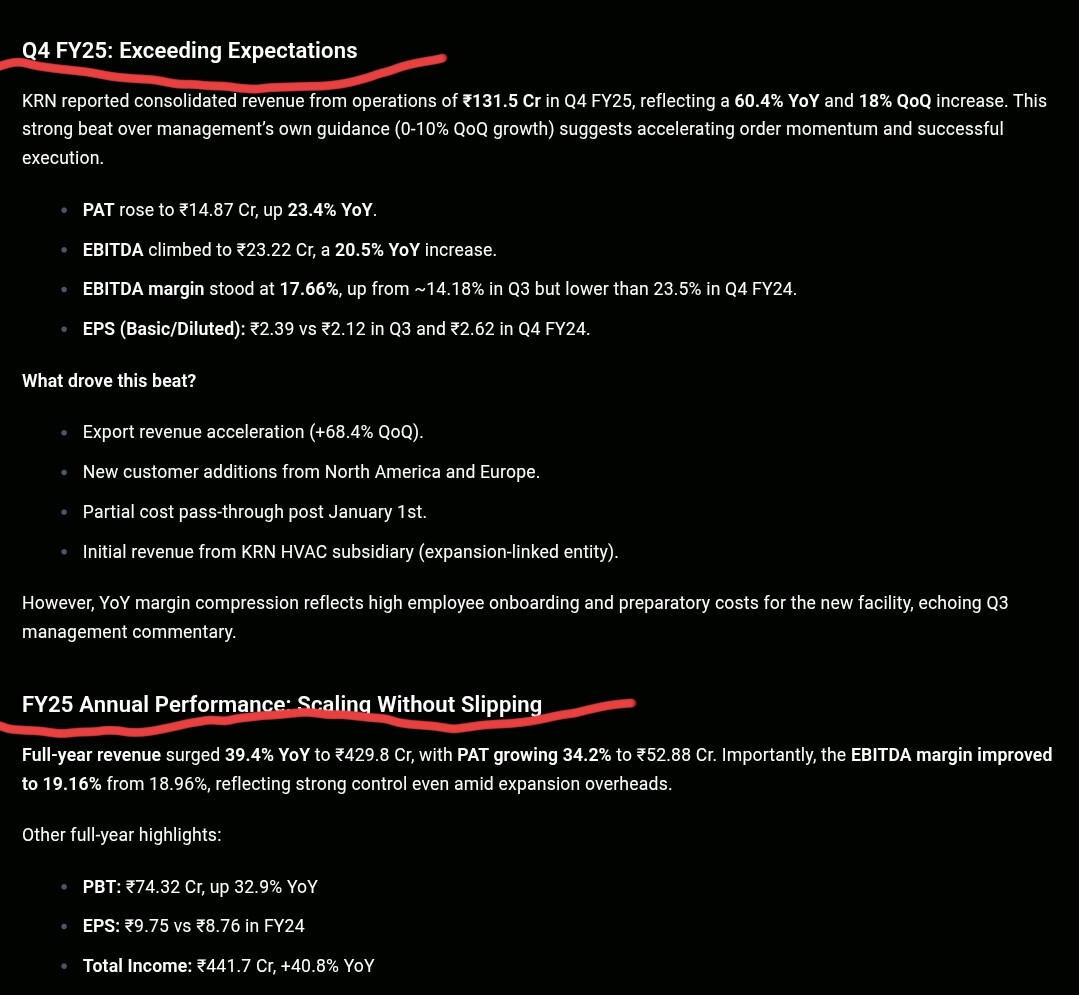
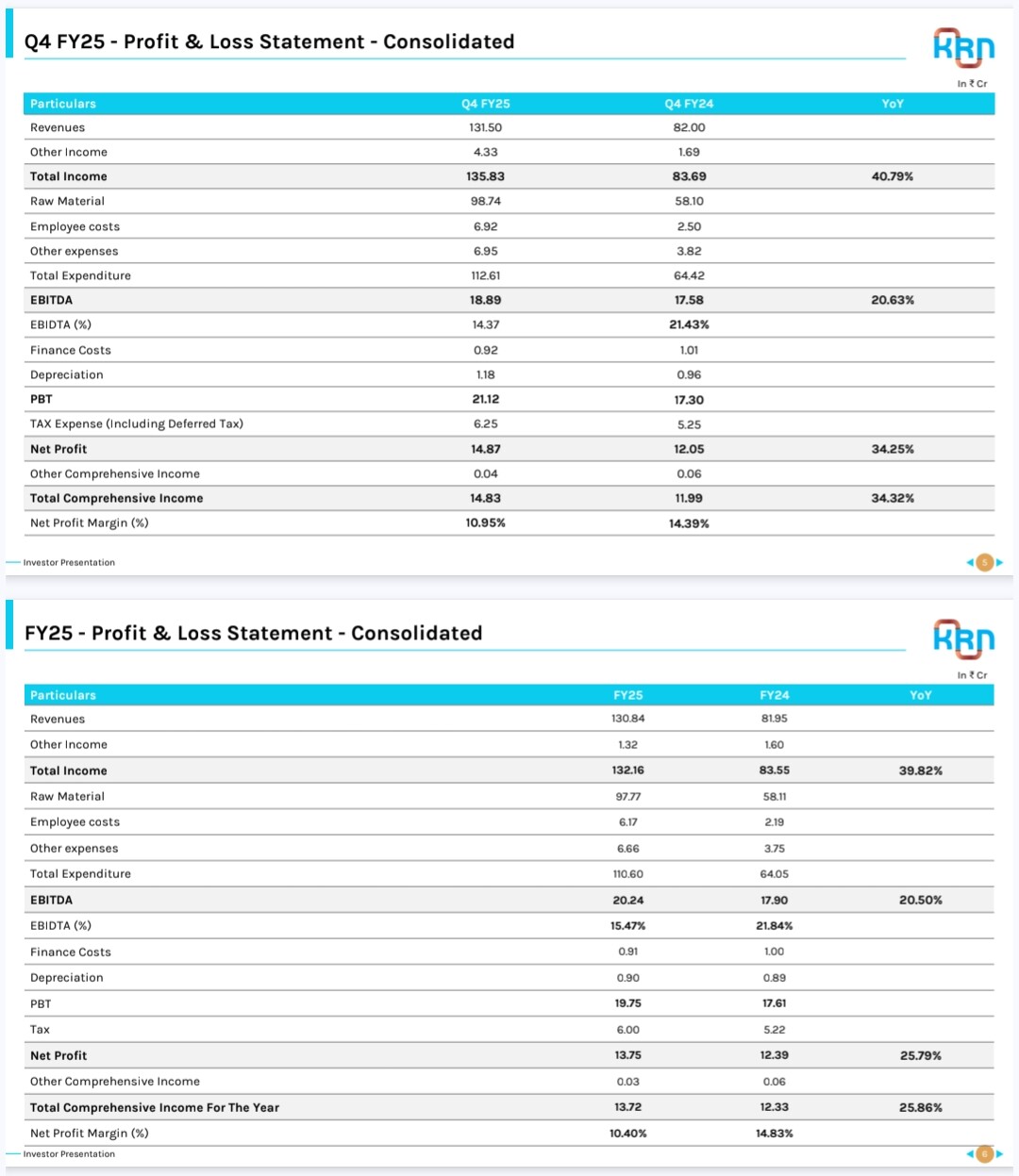
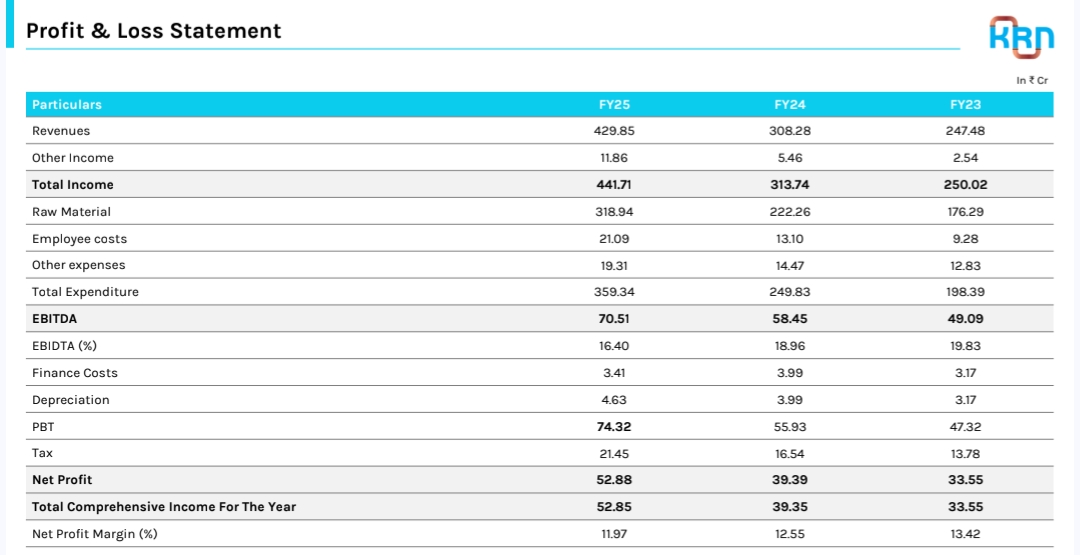
YoY topline growth 40%, the auto analysis has different figures.
Why i keep coming back to auto analysis part is, when such so called AI’s dont fetch the correct figures it might be time consuming to gather correct picture unless one is a blind follower of such auto presentations.
The auto analysis is on point , I think there is some misunderstanding from your end.
There are basically two YoY growth figures.
One is for growth in Q4 which is 60.4% and other is for whole financial year that is 39.4% .
To be honest, they have not presented their own data in the correct form in IP.
It’s always good to look at audited financial statement for numbers 
@Vikas2412 Thank you for clarification..I am still learning around here…my intention was to understand results…so YoY its 40%.
Yes, so there are two parts.
YoY for quarter (Q4) is 60% and for full year(FY 25) it’s 40%.
How is the company making mistake in such simple calculation? Maybe it is time for AI to definitely replace them xD As a rule always look at audited results first and then promotional material like investor presentation as they’re unaudited
Q2FY26 Can someone care to explain, how their latest consolidated figures are less than their standalone numbers ?
@Surender that Explains & makes sense. Even trade receivables for Standalone increased 179 % (by ~118 Cr) & trade payables for consolidated increased 182%
Management’s commentary summary on Standalone vs. Consolidated Financials Discrepancy:
The standalone revenue (227.22 crore) was significantly higher than the consolidated revenue (154.46 crore).
Management explained this was due to a large inter-company sale of raw materials from the parent entity (KRN Heat Exchanger) to its new subsidiary. This was necessary because the new subsidiary’s vendor codes with international raw material suppliers were not yet established. The subsidiary has not yet sold all the material it purchased from the parent, leading to the discrepancy after inter-company eliminations during consolidation. This is expected to normalize by the end of the year.
KRN Heat Exchangers Picking Up Heat: Rs. 1000 Cr MOU With Rajasthan Govt. and Capacity Expansion
Latest media interaction…multiple margin expansion levers.
Valuations @780 is at a PE of 80 (screener) which provides no comfort…languishing at these levels for almost 12 months. The market dosen’t seem to be wary of the high multiple.
Regulars here…pl share your thoughts on the valuations and possibilities
Disc - Not invested
Don’t judge a company from their PE only.
Recently, they have done a 6x expansion in the Rajasthan Nimrana plant.
Right now, this plant is running at 20%. And as this plant ramps up there PE is rerated.
They targetted 20% utilization in FY26, and they achieved it. Now watch for 50% utilization which is target given by management.
Existing capacity is running at 100% capacity utilisation. H1 sales is 270 cr. So we can expect 540 cr of sales from old capacity for the entire year. New capacity is 6 times of that existing one. 20% utilisation of fresh capacity can add another 360 cr of sales. This makes total sales around 900 cr. Current PAT margins are around 12%. Meaning year end PAT will be 12% of 900 which is 108 cr. This makes the forward PE to 40. Depending on what PE you want to give to this stock, you can arrive at the marketcap, compare it to the existing market cap and see the difference.
Less capacity utilization for new facility may mean higher fixed costs which need to be absorbed by comparatively lesser sales. This may impact margins in short term until it achieves higher utilization
Could any one please elaborate on the sustainability of KRN Heat Exchanger’s EBITDA margins, particularly given the ₹350 crore capex investment targeting a ₹1,800 crore revenue run-rate while aiming for 16%+ margins (excluding PLI incentives and RPS impacts)? I’m concerned about the rapid approval from Havells for the refrigerator segment—what barriers prevent major OEMs like them from pursuing backward integration/new entrants competition into heat exchanger/ finned tube manufacturing, and how does the company mitigate risks from new entrants, especially considering the relatively modest R&D expenditure?
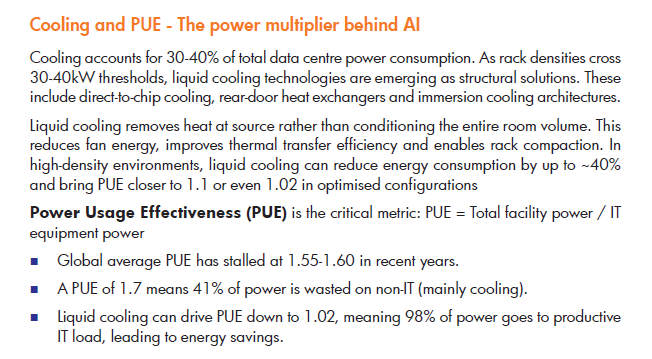
My main area of concern with KRN is that HVAC may not be used as much in big DC, as immersion cooling is more effective than the latter when scale is involved. Atleast for now that is my understanding. Citing sources: Antique report, and some research I’ve done.
HVAC works better for lower-dense areas and smaller areas, while liquid cooling works with higher loads. Right now its a hybrid model DCs are using, but that has already shrunk the HVAC market that one had envisioned for DCs.
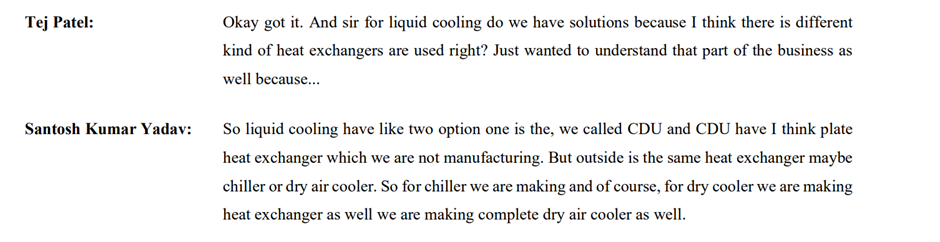
Liquid cooling might be a risk at the indoor evaporator level, but not at the outdoor condenser level (60%+ of KRN business) as heat would still be required to be thrown out of the DC. Someone clarified this in a concall, pasting the snippet below:
HVAC will not disappear from data centers, but its role may change.
Liquid cooling works better for very high-density AI racks, but HVAC is still needed for:
Right now most data centers are using a hybrid model (HVAC + liquid cooling), not pure liquid cooling, because liquid cooling is expensive and complex to implement everywhere.
So instead of HVAC demand disappearing, it may shift toward hybrid cooling solutions where both technologies coexist.