Good lore and much to think about.
Good lore and much to think about.
The company’s receivables is very high in proportion to sales. One need to track it going forward. Also,.any insights as to what will the receivables going forward?
Any update on the wagon business with respect to the approvals before we get any sale done. What are the execution risk in that regard?
Recievables days are in range of 70. I don’t think that qualifies as very high.
Two possibly important articles related to upcoming competition in container manufacturing
There is an Economic Times article titled “Tycoon Gautam Adani eyes container manufacturing on the back of Budget 2026 announcement” (unable to post link)
APSEZ was one of the participants at a meeting called by Sarbananda Sonowal, the Union Minister of Ports, Shipping and Waterways in Mumbai on Friday to elicit industry views on taking the scheme forward, multiple sources said.
But other than that, there is no “official” release from the Adani group.
And, a Livemint article titled “India’s container sops draw interest from global shipping behemoths: Sonowal” (again, unable to post a link)
India is in talks with global shipping giants and domestic companies to set up container manufacturing facilities, according to Union minister Sarbananda Sonowal
Several companies have expressed interest in manufacturing and demand aggregation for containers made in India, Sonowal, ports, shipping and waterways minister, said, citing names including the world’s largest container shipping line Mediterranean Shipping Company (MSC); second-placed and Danish giant A.P. Moller - Maersk and No. 3 and Marseille-based CMA CGM; along with domestic firms including JSW Group and Container Corp (Concor).
“We will facilitate them to invest in container manufacturing in the country," he said in an interview with Mint.
However, all this applies to “standard” containers used by shipping lines. And not to the domestic, special containers that Kalyani builds. That said, it may limit any future plans Kalyani may have to go into manufacturing standard containers at scale. Naresh Kumar already mentioned that they can do it with government support. But now that government support is here, it may attract lot more competition from players with very deep pockets.
I wonder if opens the door to Kalyani being acquired.
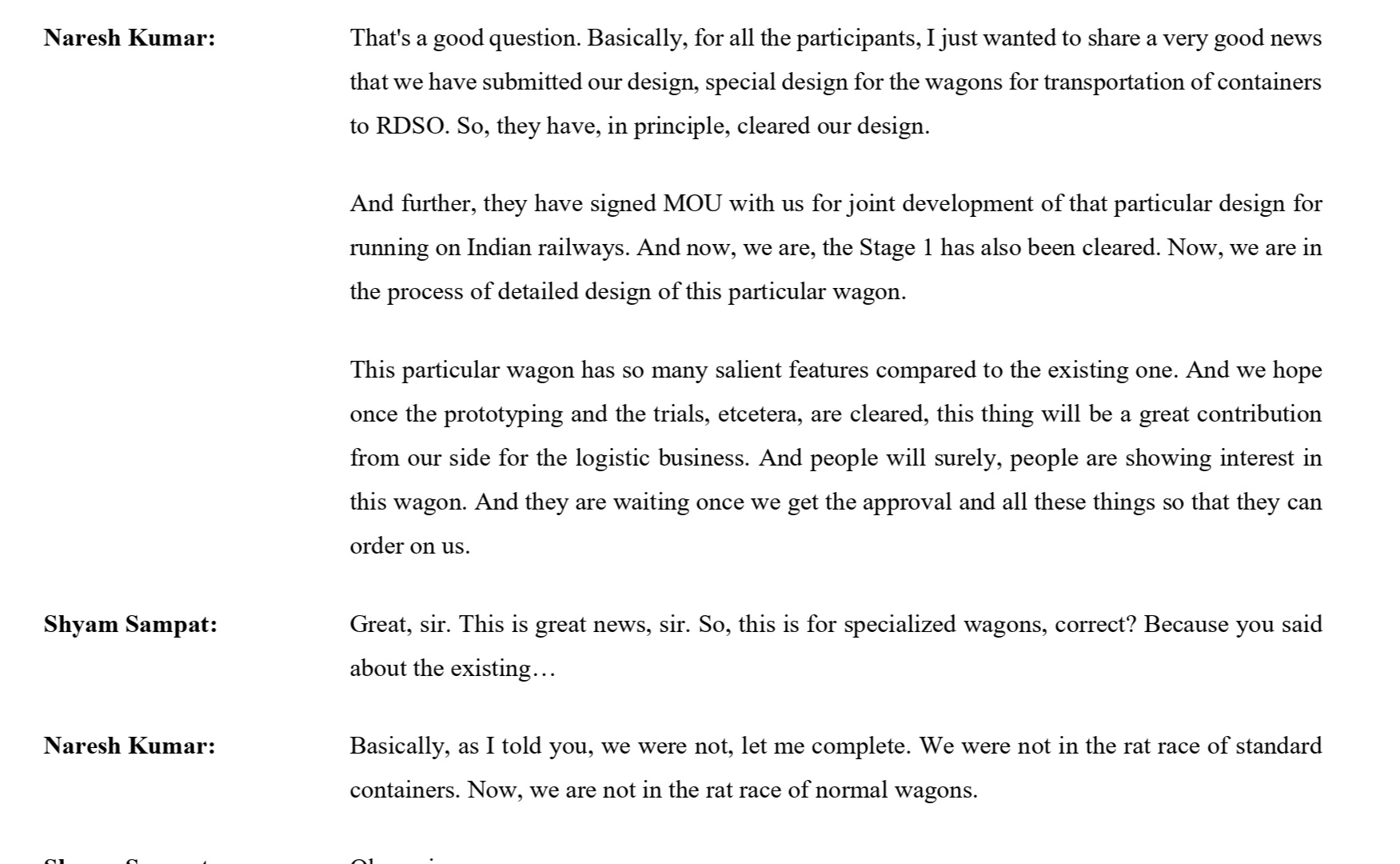
There is wagon optionality also opening up, Designs submitted by Mr. Naresh have been accepted by RDSO which are efficient than traditional wagons. You are correct, Kalyani is now a very attractive asset and may see future M&A interest.
On competition in containers, yes lot of players will enter. But Kalyani differentiates itself with specialized containers. ISO demand is cherry on top for it.
The ISO incentive should give the company confidence to expand container capacity in a meaningful way. At the same time, shipping lines are keen to diversify their supply chains. Once Indian pricing becomes competitive, a good amount of export demand can shift here.
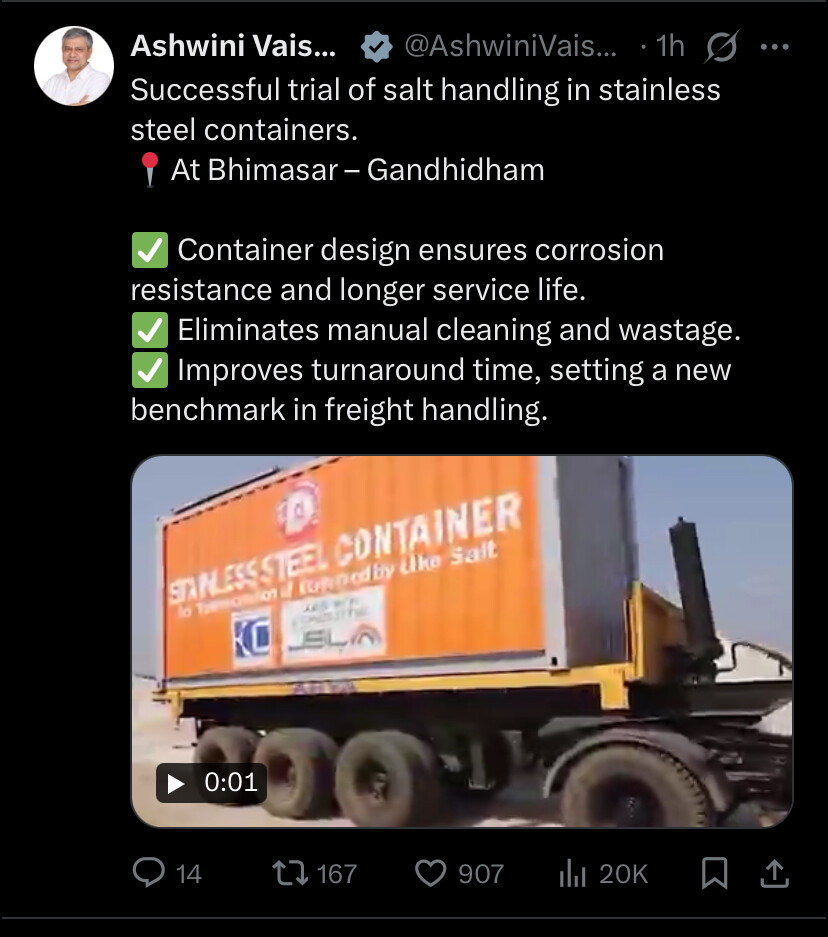
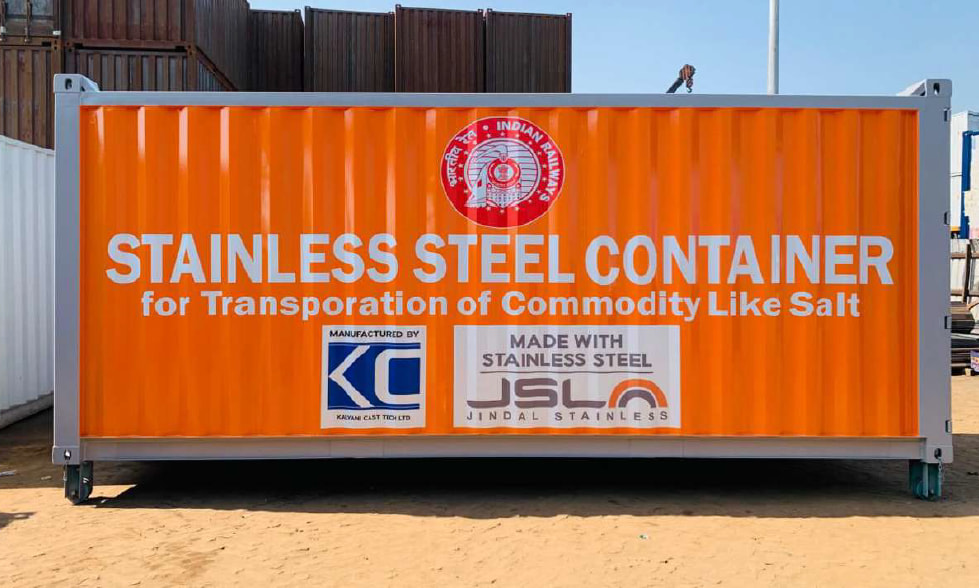
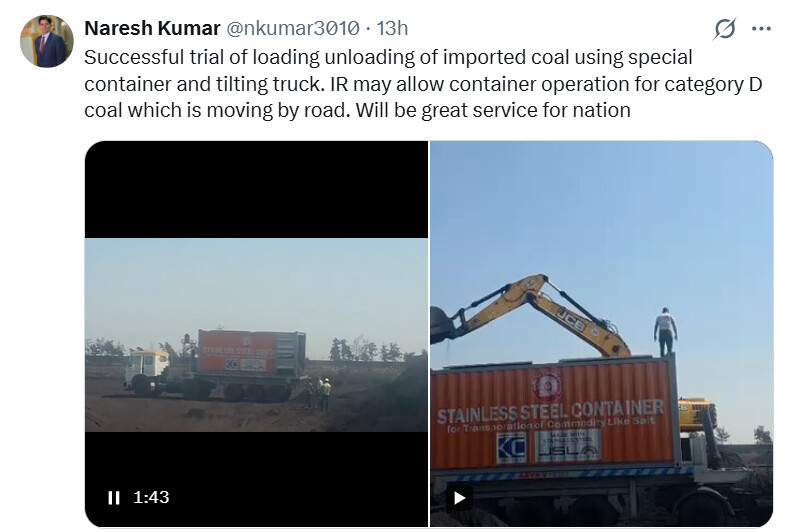
Just saw a video on twitter posted by Minister of Railway showcasing successful trials of handling Salt. Notice the logos. Seems it is also approved by RDSO.
Who Owns Them? (Heavy Vertical Integration with Ports/Shipping)Yes, many are owned or tightly linked to major port operators and shipping lines—exactly the vertical integration model you’re worried about with Adani. This isn’t accidental; it’s how China built maritime dominance (ports + shipping + manufacturing + leasing).
| Manufacturer | Approx. Market Share / Capacity | Ownership / Key Links | Notes on Port/Shipping Ties |
|---|---|---|---|
| CIMC (China International Marine Containers) | ~40-50% (world’s largest, ~2M TEU/year, 11+ factories) | Controlled by China Merchants Group (25-30%) and COSCO (20-25%). Both are massive state-owned conglomerates. | China Merchants = world’s largest port operator (terminals in 50+ countries). COSCO = top shipping line + ports. Classic vertical integration. |
| DFIC (Dong Fang International Container) | Part of top 3-4 (~15-20%) | Fully under COSCO Shipping Development (part of COSCO Group). Acquired/integrated in 2021. | Directly tied to COSCO’s shipping and port empire. |
| Singamas | ~10-15% | Controlled by Pacific International Lines (PIL), a major Singapore shipping line. Also operates its own container depots/terminals. Sold some plants to COSCO in 2019. | Shipping line + terminal operator owning manufacturing. |
| CXIC Group | ~10-15% (strong in specials/tanks) | Private Chinese group (founded 1996). | Less direct ownership tie, but operates in the same ecosystem and sells heavily to shipping lines. |
| Maersk Container Industry (MCI) | Smaller but key in reefers (~5-10% in premium segment) | Still owned by A.P. Moller-Maersk (after failed 2021-22 sale to CIMC, blocked by US antitrust). | Maersk is a shipping + port giant (APM Terminals). They kept it for vertical control in cold chain. |
Key pattern: In China (and to some extent globally), the biggest container makers are arms of (or controlled by) the same state-backed giants that dominate ports, shipping lines, and logistics. This creates “feedback loops”—e.g., COSCO ports demand COSCO-branded boxes, CIMC supplies its owners cheaply, etc. It reduces risk, secures supply during booms (like COVID), and locks in margins across the chain.Relevance to India and Adani’s Potential DisruptionYour concern is very well-founded—this is exactly how the Chinese model evolved, and Adani is signaling the same playbook.
Emerging Indian players: There are new/small manufacturers popping up (e.g., in Gujarat, with government push for “Make in India” containers). But they’re tiny compared to Chinese scale—India currently imports most containers (often empties repositioned from China).
Adani’s move: Following the 2026 Budget (₹10,000 crore scheme for local container manufacturing), Adani Ports (APSEZ) is actively planning entry into container production. They aim for large-scale facilities (potentially 1M TEU/year capacity) to produce dry, special, and reefer boxes. This fits their “end-to-end logistics” vision: ports (they handle ~45% of India’s container traffic) + rail + trucking + now manufacturing.
What this means for small Indian players (drawing from China/global examples):
Disruption is likely: Adani can leverage their ports/logistics for captive demand, cheaper financing, scale advantages, and branding (“Adani containers” on global routes). Just like CIMC/COSCO, they could undercut on price while ensuring supply for their ecosystem.
Consolidation path: In China, small players got absorbed, exited, or specialized. India might see the same—small manufacturers either partner with Adani/big players, focus on niches (e.g., specialized/repair), or struggle.
But positives too: Local manufacturing reduces India’s import dependence, creates jobs, and stabilizes supply (fewer empty imports). Government incentives could help smaller players if they scale or innovate.
@RocketMan Vedansh I know you addressed it in an earlier post about the incoming competition but Adani ports has been a player who consciously look for deep backward integration to become to lowest cost logistics player and it has been a common theme globally that most market share consolidated among these ports players who backwards integrated into the container biz. Will this be a key thing you will monitor i.e an exit trigger if say Adani declares a large capex into this biz ? (Above data collated by grok so pardon if there are any data inconsistencies)
Not necessarily. If Adani Group adds capacity, it will likely be focused on ISO containers.
As incentives are rolled out, it’s natural to expect multiple players to set up new capacities, and Kalyani will be one of the beneficiaries. What sets it apart, however, is its design-led approach toward specialized containers and wagons.
ISO demand can support earnings in the short to medium term, but over the long run, the core thesis depends on the company’s ability to scale specialized solutions.
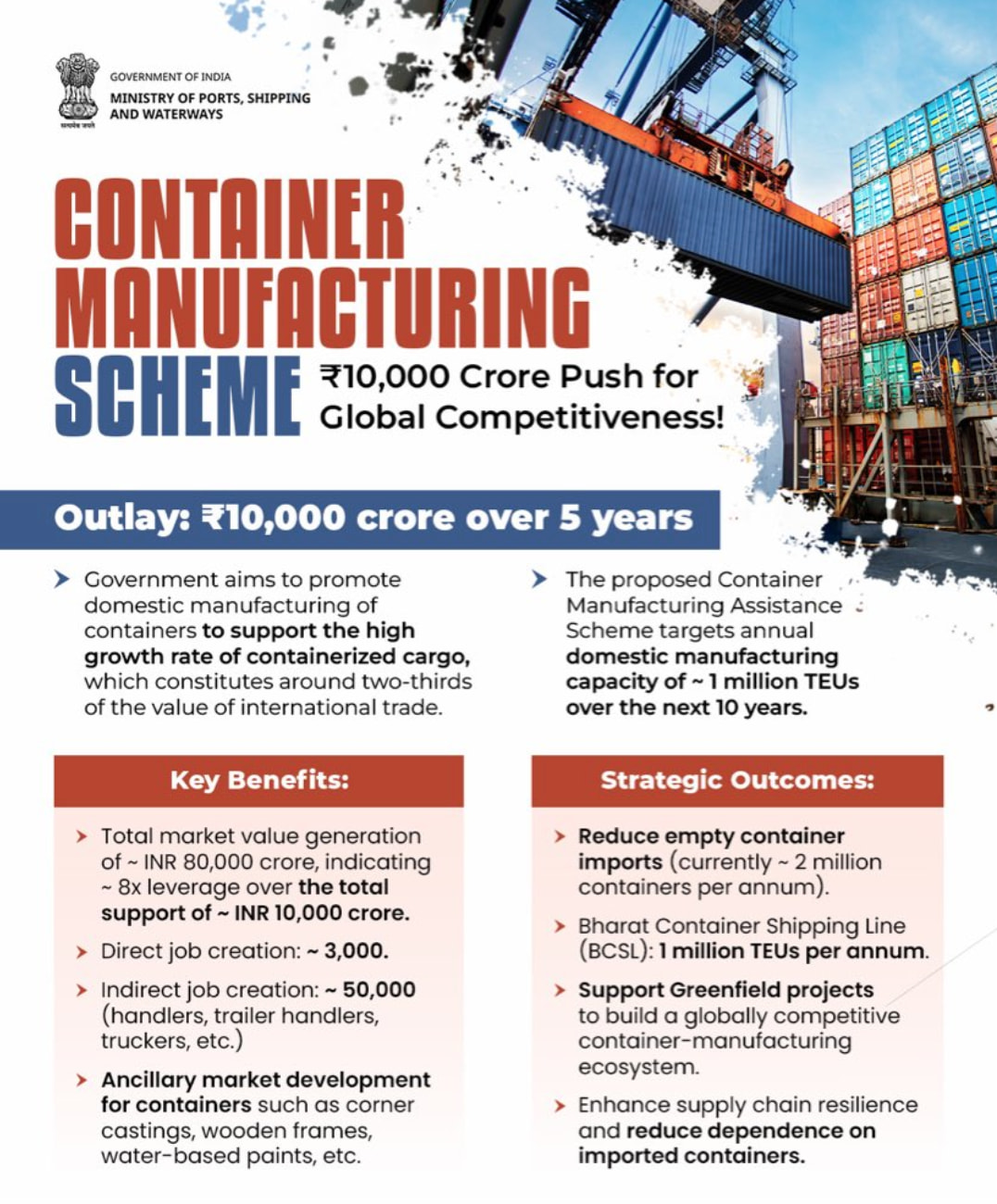
Orders for commercial shipbuilding have started to flow in, driven by the Shipbuilding Financial Assistance Policy 2.0 (SBFA 2.0). Incentives are already attracting orders, and it is only a matter of time before the Container Manufacturing Assistance Scheme (CMAS) begins to draw container orders as well. Shipping lines and leasing companies are increasingly looking to de-risk their supply chains.
Orders from Bharat Shipping Line will anchor domestic container demand, with 100% of its requirements expected to be sourced locally.
Coal’s contribution to Indian Railways freight revenue : ~45% to 50%
~ 15-20% of that would fall in Category D.
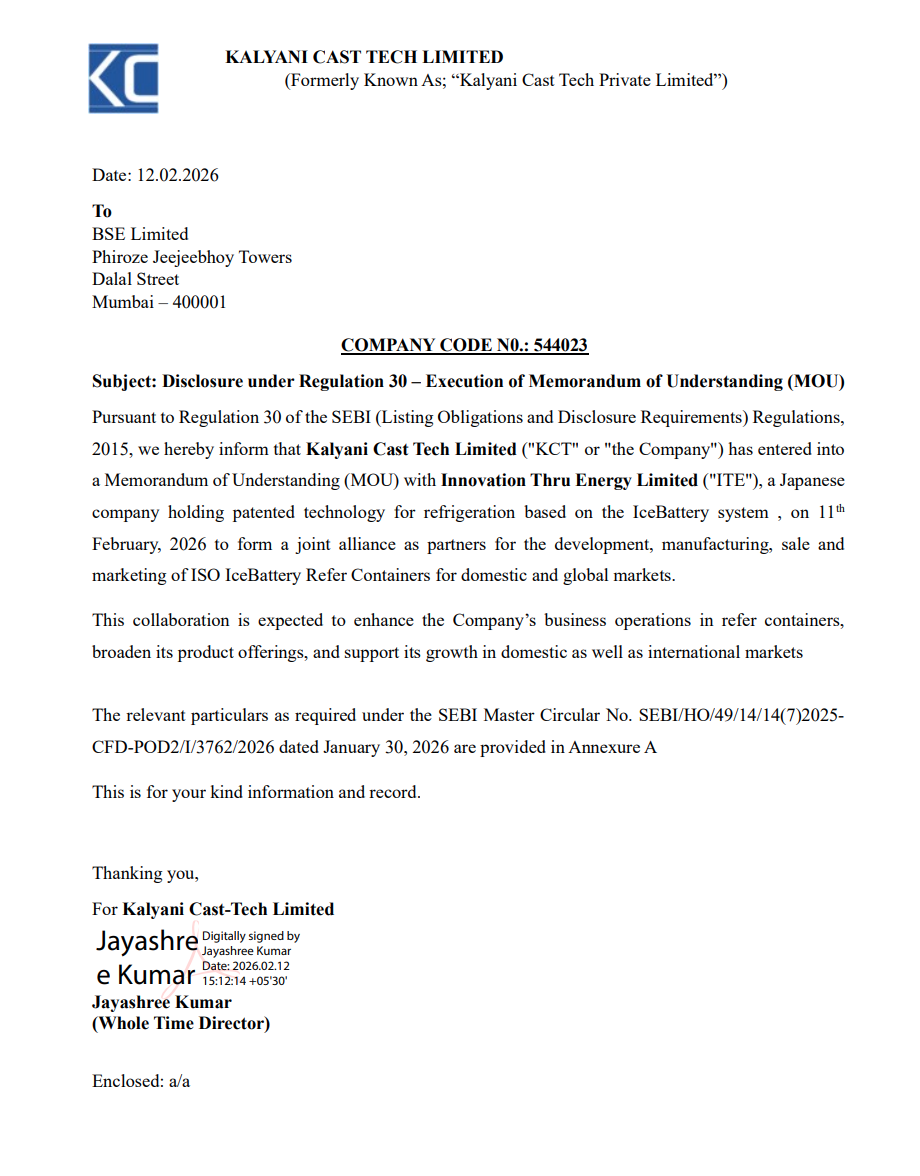
Went down the rabbit hole. The MoU on icebattery tech is huge. The reefers will be designed not only for domestic market but global as well. India suffer huge losses every year due to poor cold chain logistics and many countries face similar problems. These reefers can preserve the cargo for 90-144 hours (in a single charge) and eliminate the need for diesel generators or any other source of electricity on the go.
KCT has a lot of tailwinds now. Next concall should be fascinating.
Disc: invested
I’m waiting for the container policy fine print. If incentives apply to all container types, no company benefits more than Kalyani, it’s a game changer.
Good overview
From the latest article posted by Sougata it seems that my last mentioned point is not correct. Containers do come back, thanks to the technological advancement and collaborative approach of various companies involved.
The direction of policy is clear. Govt wants to promote container manufacturing to bring efficiency in exports and domestic logistics. In India the time lag between the policy making and actual result on ground is slightly bigger compared to other countries.
I also believe that it is not just container manufacturing that will do well, but the enabling environment like cranes, reachstakers manufactures will also do well. So companies like TIL, ACE will get positive tailwinds as govt has announced incentives even for this industry in the last budget.
I personally think what triggered this policy was Bharat Shipping Line, to scale it to its full potential, around 10,00,000 containers would be required, which, if imported from China, could lead to a forex outflow of nearly 30,000 crore. Instead, by announcing a 10,000 crore incentive, govt. can curb this outflow, build a domestic industry, and boost GST collections.
That seems to be the underlying rationale behind the policy.
Also, to put the size of the incentive in context, the PLI scheme for AC manufacturing had an outlay of 6,238 crore, so 10,000 crore is relatively substantial. Let’s see how it plays out.
Containers do come back but its a very complex process so much that leasing giants are formed in the process. I was reading the drhp of APPL containers and they have already started the leasing services. Will post a detailed write up once I am finished. Whats interesting is the foldable containers which KCT is making to stack them up and ship cheaper.
This is a very high entry barrier business as in the country of origin must be export dominated to succeed. This should have multiple winners so lets look for them as well but KCT is the only pure play I could find till now. We can also look to steel suppliers like JSL if you notice they provided the raw material for salt resistant container recently developed.
Was fiddling around with gemini pro on the container business. Sharing an interesting takeaway:
The Value Chain Reality Check (Who Actually Makes the Money?)
If you look at the 50-year history of global container logistics, the wealth does not accumulate where most retail investors think it does.
Here is the hierarchy of profit in the container world:
The KCT Takeaway: If KCT only builds standard steel boxes, they are playing the worst-margin game in the sector. Their only path to premium valuation is their transition into Specialized Containers (IceBattery/Dwarf) and Wagon Manufacturing.
Below is the vision of the promoter: