
JM Financial - seems to be getting the attention now.

JM Financial - seems to be getting the attention now.

JM Concall


Very +ve concall and heartening to see the IPO market updates : pipeline of 45 IPO transactions aggregating to 1 lakh crore
Bajaj investment might be helpful in long run with - firstly to establish a valuation for the home loan business
they can sell portfolios to Bajaj housing just like the past from its affordable housing fin.
Any view on these regulatory issues for which JM Financial was penalized by RBI and SEBI. Looks like there have been questionable practices. Below cases are not very old.
I think this issue solve,last qtr and fy year result and comentry of promotors achived nicely .
JM Financial Q2 FY26 Results
The Positive Highlights
Investment Banking Remains Strong: The Corporate Advisory and Capital Markets division continued to perform well, with its PAT growing 41% YOY.
Large Future Pipeline: A key positive for the company is its filed IPO pipeline, which has grown to ₹1,20,000 crores. On the earnings call, management stated they typically earn about 0.8% to 1% of the issue size on these deals.
Fee Income at Record High: The company’s fee and commission income reached its highest ever quarterly level at ₹341 crores, a 20% increase year-over-year. This aligns with the company’s “asset-light” strategy.
Affordable Home Loans Growing: The affordable housing segment’s AUM grew 28% YoY, crossing the ₹3,000 crore mark. The profit for this division doubled to ₹13 crores. This follows a small stake sale in Q1 to Bajaj Allianz, which set a valuation for the business at approximately ₹3,100 crores.
Shareholder Payouts: The company declared an interim dividend of ₹1.5 per share, following through on its earlier promise to increase payouts as the business requires less capital.
The Challenges and Investment Costs
Strategy: Where the Money is Going
On the call, management explained the current spending is part of a clear strategy to grow its Asset Management business by launching new Alternative Investment Funds (AIFs).
Balance Sheet Update
The “clean-up” of the old, risky loan book is progressing as planned. The “Non-Core” book has shrunk by 59% YoY, and the Asset Reconstruction (ARC) business has recovered ₹1,273 crores in cash over the last 12 months.
However since the concall the share price has continued to decline. Am I overlooking something?
Disc - Invested
Results are good.. wealth management segment is cyclical in nature. Due to current sideways market, it will feel the pressure but in next bull run, it should outperform.
Invested with large allocation
Other Wealth management companies have reported good numbers in Wealth mgmt
For e.g: Nuvama wealth and private wealth grew by 25%+ and 35%+
Motilal private wealth also grew by 30%+
But market is punishing JM financial because their welth management did not perform well this quarter and it might be due to still their major revenue might be coming from Broking transaction based income
It is because their wealth management is not doing well compared to peers
Look at Nuvama’s wealth management and Private wealth management
JM’s wealth management is similar to Motilal’s wealth management where majority of revenues still come from Transaction based broking income. That is why motilal gets low PE in wealth management sector. Motilal has made their revenue quality much better in last 1 year by reducing broking income share
Also their RM addition and branch addition is not going very aggresive as they told in Q1
Just check RM addition, AUM addition and Wealth mgmt branch addition QoQ (Q2FY26 vs Q1FY26)
I am from non-finance background but have been tracking JM Financial. Any specific views on whether management is walking the talk w.r.t their individual businesses?
The following company came up few Qtrs. back in the watchlist, because JM financial had gone through serious mess in the past for its real estate exposure and the company’s conscious attempt to clean that exposure free the stucked capital by moving to Incremental ROE business. so, the following Article , specifically focus majorly on just one primary question, if the clean up done in the business is for the sole purpose for incremental ROE or company is into rethinking mode what lies ahead?, well obviously not talking company specific , but any other company would be on the incremental ROE path, the second question is once the path towards incremental ROE taken , whether company would move forward without looking backwards ( Repeating same mistakes again) and achieve that milestone without Distract itself? , Let’s Analyse:
The purpose of writing the post is recently I had attended the conference call of JM Financial ltd of Q4 2026 , but I did not got chance to ask question to management due to lack of time , However my specific question was on the ROE of private markets side, The company as a whole still employs more than 60% capital on the private market side , however the ROE generated from the same is merely 8.3%. The headline numbers deserves attention because overall from 9.4% last year to 11.7% ROE deserves appreciation. The point is Blended ROE for the company is 11.7% but the ROE of private markets is just 8.3%. Though overall ROE of company i.e. 11.7% is also not good because when a company gets its dirt business clean up , investors expect more and expectation of the management is also same they told that market as a whole will get normal around q3 of FY-27.
I would like to present some numbers and calculation of the above ROE for the readers reference and able to articulate with the numbers:
So , from the above calculation you can see that company is consuming a lot more capital and dragging ROE down. However, company sees a lot more potential in the syndication business and also looking to grow other business as well but by continuing with huge chunk of capital into business with an ROE of 8% to 8.5% , will drag overall ROE downwards. so if want to build a thought process behind why the company would like to continue with it, it creates fundamentally Two questions:
Whether markets for other business are facing slowdown hence management is not aggressively redeploying, seems nothing like that because management itself indicated that management is growing its housing finance business , wealth management, asset management business and yes forgot to mention its capital market and advisory business ( which management indicated that their second half will be quite better).
Or the company is trying to create an ecosystem because it serves the client in many ways, for me Second question seemed more relevant to me.
Going forward, I would like to present another calculation of ROE, because 8.3% as we are seeing is still not adjusted , I would like to give a read:
So, don’t misread that revenue is falling, but moving towards high fees and high margin business dragged revenue down but most importantly when the company which had impairment reversal , if not considered then adjusted ROE would be around 4.3%. So, not a doubt on the operational capability of the company but a doubt on operational profitability of the company, which lands us on the primary question which we asked firstly whether company is on a path to generate an ROE of 15% or 15% ore more.
Coming on the valuation side, company is trading around 1.1 to 1.15 price to book , so I find that reason very conclusive that why JM financial is running around their book values.
The positive thing about the company is management is serious about return ratios and a shareholder focused approach. However company has to relook their capital deployment strategy because if company had successfully pivoted the stock won’t trade around book values and If ROE which if optimally hovers around 14-15% next year, then a rerating based on PE gets triggered because company is already qualified into capital light business from capital heavy business, and its competitors like Nuvama Wealth Management trades around PE of 25-27. so looking forward if JM financial comes around then a PE rerating is awaited.
So, concluding the article, lastly the management had came around various dark clouds and hopefully they will still come out by rising once again.
Happy Reading.
Disclaimer - I am not an financial advisor , this is for only educational purposes and for the love of Reading.
Can someone please help me understand how did Promoter holding increase from 56.9% in Dec’25 to 57.07% in March’26.
There is no info on open market purchase, preferential issue or warrants.
Hello readers, I choose to post this writeup when actually i was reading about edelweiss financial services , I am not saying it is a perfect way to compare but it signifies what JM Financial is actually missing and trying to gain.
Well, First of all why I had selected Edelweiss Financial services for one on one battle against JM Financial because both businesses have almost same line of business and almost trading at same market cap, so I would like to throw few questions to you as a reader :
Does the same identical business and market cap make same trade at identical valuations?
Does every progressive financial business in the space of NBFC cum AMC business trade above price to book value i.e. more than 2 times, 3 times , 4times and so on?
It created curiosity to dig deep in the company because when I was reading about edelweiss , an almost similar story of private credit happened few years back before JM financial fiasco. so, now edelweiss is acting for me as a reference point, because the journey they have followed is or will be now followed by JM Financial. lets start with the story first what happened at edelweiss and what happened at JM Financial to take the topic forward.
For Edelweiss, the problem became particularly visible in the aftermath of the IL&FS crisis and the broader NBFC liquidity crisis.
The group’s consolidated net debt had reached a very high level. Edelweiss subsequently embarked on a multi year balance sheet repair programme, reducing wholesale credit exposure, selling or monetising stakes in businesses, shrinking borrowings and redirecting capital towards businesses that could grow without requiring a proportional increase in balance sheet.
Edelweiss reported consolidated net debt of approximately ₹28,750 crore in FY20, which had fallen to around ₹11,170 crore by FY25 a 61% reduction. At the same time, its ECL Finance wholesale assets fell from approximately ₹13,500 crore in FY20 to ₹2,500 crore in FY25, an 81% reduction.
Therefore, The strategic objective is :
“Reduce the amount of shareholder capital trapped inside lending and redeploy the organisation towards businesses where other people’s capital can generate the assets and Edelweiss can earn fees.”
That is the significance of the group’s expansion in mutual funds, alternatives, asset management and insurance.
Consequently, Edelweiss’s transformation is not merely a deleveraging story. It is an attempt to change the nature of the earnings generated by the balance sheet.
Coming to JM Financial, they faced a related challenge, particularly within its Private Markets and distressed credit businesses.
The company had accumulated substantial exposure to wholesale credit, including real estate, bespoke financing, distressed credit and financial institution financing.
JM therefore announced in FY24 that it would pivot its wholesale credit model away from predominantly on balance sheet lending towards syndication, private credit and alternatives, while simultaneously increasing its focus on fee and commission generating businesses such as investment banking, institutional equities, asset management, mutual funds, wealth management, broking and investment advisory. Management estimated that this transition could release approximately ₹2,000 crore of incremental cash over three to four years. So, from the guidance of releasing cash, they have been so far recovering that incremental cash , but the transformation was not painless.
In FY24, JM recognised approximately ₹985 crore of loss relating to fair valuation of investments and loans in its distressed credit business, primarily linked to one large account. The group subsequently proposed an equity infusion of up to ₹600 crore into JMFARC. In other words, JM’s clean up involved not merely collecting old receivables, but also recognising losses, restructuring exposures and accepting that some legacy capital would not be recovered at its previous carrying value.
By FY26, JM’s Private Markets balance sheet had changed materially:
Standard loan book fell from ₹10,215 crore in FY24 to ₹4,010 crore in FY26, Borrowings fell from ₹12,741 crore to ₹6,245 crore, Gross debt To equity fell from 1.9X to 0.9X , Net worth of the Private Markets segment remained around ₹6,578 crore.
JM’s Management itself describes the current strategy as one of strong repayments and prepayments, with incremental real estate lending increasingly backed by cash flows or syndication, while the non core loan book is expected to substantially run down.
Its ARC business also provides another mechanism for dealing with distressed assets, acquiring stressed financial assets and attempting to maximise recoveries through restructuring, settlements, enforcement, management changes and other resolution strategies.
so, for now, at first glance, the two stories appear remarkably similar and that too had some common points which are:
had significant exposure to credit
experienced the consequences of a difficult wholesale credit environment
recognised losses and provisions on problematic assets
reduced balance sheet exposure
pursued recoveries
reduced leverage
and began shifting capital towards fee generating financial businesses
Now moving Forward , JM Financial today has a substantially larger net worth base than Edelweiss, yet the market assigns a much lower price to book multiple to JM , and that leads to question : “Why is the market willing to pay approximately 2.5 rupee for every 1 rupee of Edelweiss’s book value, while paying roughly 1 rupee for every 1 rupee of JM Financial’s book value?”
Therefore , the first conclusion is NOT JM Financial is CHEAP and Edelweiss is EXPENSIVE, but the real question is , “What does the market believe each company can earn from its existing net worth in the future?”
The two companies may have travelled along similar roads of balance sheet repair, but the market appears to be assigning them very different values for the businesses that will remain after the clean up is complete.
Now, before coming to core conclusion of writeup , i would like you to go through a comparison between the two and then go through the core conclusion.
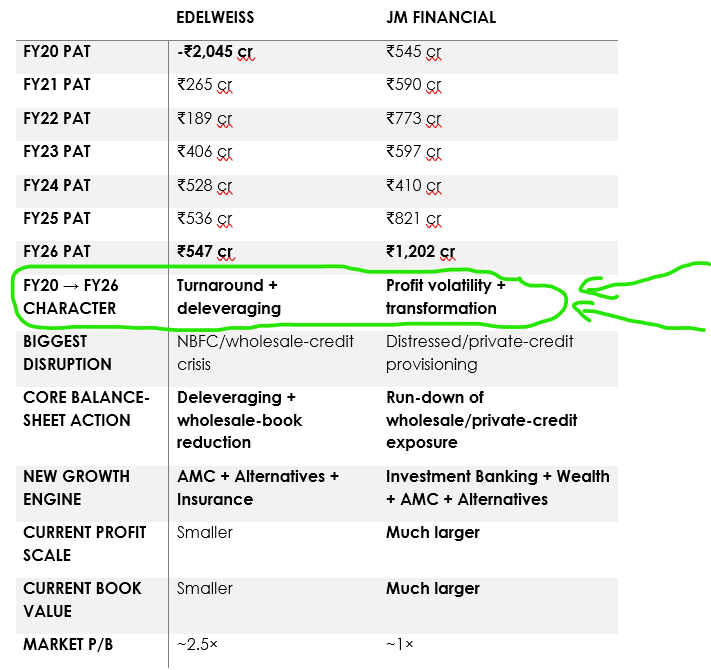
CORE CONCLUSION:
Both are very Interesting companies at this stage, however Edelweiss is rewarded because they have already transformed but JM Financial is yet to be transformed, meaning thereby market is still waiting for the Transformational evidence.
To elaborate this in simple words : As per the guidance by the management of JM Financial , they have cleaned up their balance sheet and accordingly initiated recoveries and in majority of the instances they have recovered most of it , but what the market is telling is that you have now cleaned up and increased your base capital , now give me evidence in the form of incremental ROE invested in other asset light businesses, Once an evidence is visible , I think it will be the first rerating trigger for the company.
The purpose of the article is not to define cheapness of one stock and expensiveness of the other but sometimes as a reader it creates question regarding a company with so much to bring on table and legacy which can’t be ignore, why such a company is not getting honoured by the markets? and what they are exactly telling that the company is lacking?
Disclaimer - I am not a financial advisor , This is for educational purpose and from a reading point of view .
Happy Reading.


