
Passive investing is big in the West and growing in India. Influencers often say large cap funds easily beat the Nifty 50, and if you pick one start date, many of them do. I wanted to know how many beat it consistently, because that’s what matters when you pick a fund today and hold it for years.
So I looked at every 3 to 10 yr holding periods, one starting on each day, so no single start or end date decides the result. Each period is compared with an index fund rather than the index, since you can’t buy the index itself (it’s the index TRI minus what today’s index funds on it lose a year).
A fund counts as beating it consistently if it was ahead in at least 7 of every 10 periods, because being ahead about half the time is what you’d get by luck.
(Funds that were closed or merged are counted for the years they ran, so the weaker ones that got shut down don’t drop out of the numbers)
note - Indian direct mutual fund were launched from 2013 onwards , so data isn’t much unlike US.
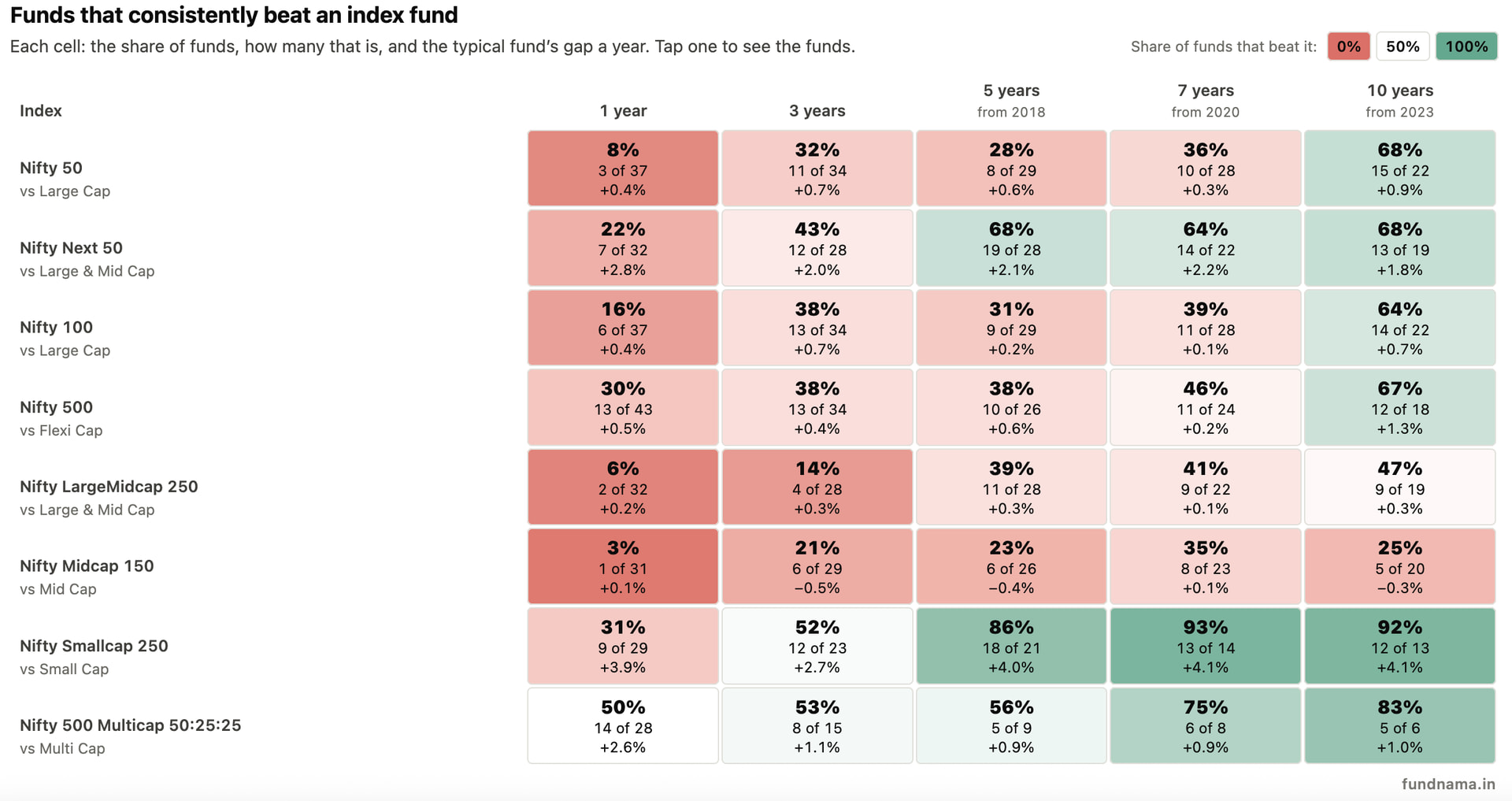
Funds that consistently beat an index fund over different periods:
From the data , the findings -
- 16 of 29 large cap funds (Direct) were ahead in more than half their periods, but only 8 were ahead in 7 of 10. [ half can be attributed to randomness, it’s 7 of 10 that matters]
- In large cap, mid cap, flexi cap and large & mid cap, most funds didn’t beat an index fund consistently.
- Small cap went the other way: 18 of 21 Direct funds beat it consistently, and the typical one was ahead by about 4% a year. Also Small cap 250 index has huge tracking error , most likely due to low liquidity .
- 10 yr rolling return comparison show that more active funds might be able to beat index but since active mutual fund data is only from 2013, the 10 yr rolling return would be skewed towards recent bear market ( hence I prefer 5 or 7 year rolling return )
What I conclude from this:
- In Direct plans, the typical large cap, flexi cap or large & mid cap fund did beat an index fund, by a little (about 0.3% to 0.6% a year over 5 years). But at most 4 in 10 funds did it consistently, so if you pick one today you’re more likely to pick a losing horse. In Regular plans the typical fund was behind.
- Not every index is equally hard to beat. Over the last 10 years the Smallcap 250 was fairly easy to beat for active small cap funds. The Midcap 150’s lead looks recent: the typical mid cap fund (Regular) was a little ahead of it over 10-year periods (+0.3% a year) but behind over 5-year (−0.9%) and 3-year ones (−1.6%). So we can’t know whether the index will keep that lead.
note - data source