Great articles to read on the web

Honestly, this isn’t practical for a retail investor with a full-time job. Tracking even 10 companies in the Indian markets is a huge task, and on top of that, you’re expected to monitor what’s happening in multiple global markets as well.

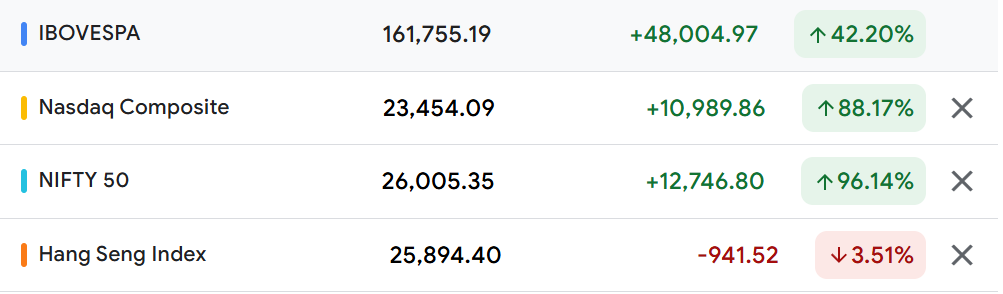
This year, everyone suddenly feels FOMO about not investing overseas because NIFTY hasn’t been performing, but just a year ago, hardly anyone cared about other markets.

If you zoom out, the 5-year performance shows that NIFTY is still outperforming other markets. We can’t have double digit returns every year.

10 Likes

Hi, applying Modern Portfolio Theory (MPT) with a macro view is an interesting approach to investing in today’s global environment. I’ve been using it myself last one year and am glad to see my portfolio becoming a bit more stable. I wanted to share benefits of doing this with the community since it’s a useful way to reduce volatility by leveraging the negative correlation between different world economies.

Personally, I find identifying growing economies and taking advantage of corrections in major indexes much simpler than analysing multiple company balance sheets and trying to forecast their individual performance. The only FOMO I have is that my exposure to these global markets is still under 10% of my portfolio :grinning_face:. Yes the 40% returns from other markets last year could be an aberration, however the concept is worth studying.

4 Likes

When comparing Nifty 50 USD with S&P 500, the returns are not even close. The S&P500 has outperformed any Indian index in dollar terms by a huge margin. Also note that the S&P 500 is a basket of 500 companies with a higher business quality than NIFTY 50

The 10 year performance is not even close. NIFTY 50 USD has a 10 year annualized return of 6.46% as compared to a 11.43% of the S&P over the same time horizon.

So basically S&P 500 offers higher growth, higher quality and higher diversification than any Indian index.

The conclusion is that Nifty outperformed other markets over the last 5 years in ₹ terms. In constant currency, not so much.

8 Likes

Let the learned investor of this community read our post and take their own investment calls🙏🏽

2 Likes

Yeah definitely

I just wanted to point out that NIFTY didn’t outperform global markets in constant Dollar terms

The Google Finance returns are deceptive. They don’t take into account currency depreciation

4 Likes

Early signs are kicking in. Google’s new AI model is a threat to ChatGPT, so they’ve started pouring their focus into improving ChatGPT. And once that’s done, Google will probably hit back with their own upgrades, and somewhere in between a new Chinese AI will show up. There’s really no end to this.

Imagine Burry is right and the bubble pops, which stocks will be most impacted? Nvidia, Oracle, Meta, more pain for Neocloud operators like Coreweave, Nasdaq will crash somewhat - 10% ? 20%? 30% ?.. its nowhere as bad as DotCom Bubble. I doubt Cisco had any moats like Nvidia (CUDA and NVLink). Berkshire has taken a position in Google recently, they usually tend to sit out of bubbly sectors.
Chinese Models are expected to take a huge chunk of Commercial API (higher ARPU than consumer) marketshare due to their cheap token costs.

Open AI has leveraged smartly without taking debt in their own books. Demand is still not the problem, the problem is ROI and if Open AI taps out, will Uncle Sam intervene? because AI is deeply strategic. Heck they even took stakes in Intel and Rare Earth Cos.

If Nvidia runs fast, they risk accelerated depreciation of their older GPUs. If they run slow, they risk competitors catching up (ASICs) and might become a commodity (i’m unsure of this part).

5 Likes
1 Like

*When Burry is proven right (Jk ;))

This is an interesting take. Google has launched its own TPUs for Gemini and yesterday Amazon announced its own chips. Competitive intensity is increasing, no doubt.

2 Likes
2 Likes

A comprehensive write-up on India’s Power sector by Varad Dongre.

He writes about the electricity landscape today (including generation/transmission/distribution); the expected surge in demand and drivers for the same; breakdown of investment needed in infra to meet this demand.

This is an intermediate to advanced level read.

It weaves-in various threads ranging from AI data centre investment requirements, green hydrogen investments, inadequacy of the current transmission grid, discom losses etc., all into a single coherent narrative.

Be warned - You will require more than a few re-reads to get through the entire stuff (atleast I did). But pretty much worth the effort.

I will be using it as reference material as the article is very well researched, and replete with the latest facts and figures for India.

20 Likes
3 Likes
4 Likes

The max fall will depend on the initial fall, if the initial drawdown triggers margin calls, then the major fall will happen.

1 Like

After going through recent posts, it appears that, various Global Indices have given better returns than NIFTY 50 or even NSE500 for that matter over past few years.

This is good because if an investor has diversified portfolio divided across 2-3 geographies, probably it will reduce portfolio volatility to a reasonable extent. If you add GOLD ETF to that, it might be more stable.

Each individual economy will have its own good years and Not So Good years, and geographical diversification can help an investor.

There could be some benefits in having geographically diversified portfolio of Index Funds.

Whether an investor can practically track 2-3 economies is the part of implementation, but in theory, this diversified approach sounds useful. There will be few years like 2008-09 and 2020 when all indices will give Low or Negative returns but GOLD ETF can help in such cases to some extent.

As an investor, it could be difficult to predict or imagine “which economies will perform better in a given period”; hence all such observations will be only in hindsight. Also, an investor should have a meaningful exposure to International equity to make an impact on his/her portfolio.

Having said this, It was useful reading all these posts.

I do not have any exposure to International Equity or Gold ETF or Parag Parikh Flexicap Fund as of today. One of the reasons for this is “it was difficult for me to have a meaningful exposure to International equity or Gold ETF since I was focused on Individual domestic stocks most of the time, but I am open for widening my circle of competence if possible.”

Another observation which I have is if you are investing in individual stocks, mostly your returns would be different from Nifty 50 / NSE 500, and it could be higher than Index, so many times, it may not be necessary to diversify across geographies unless you have meaningful exposure to International equity.

3 Likes

Mike Burry on his thesis on the now legendary GameStop(NYSE:GME) short squeeze

1 Like
2 Likes

All bubbles are formed mostly because of overinvesting. The benefits do accrue once the bubbles pop and companies can be bought at a good valuation.

This overinvesting happens time and again. It happened to ventures after east india company, then to railways in UK, to computers during Cisco, to housing and now ai

According to morningstar the scale of the problem: Ai companies collectively need to add $2 Trillion in AI revenue in the next four years to justify current spending levels. Yet current AI revenues stand at only $20 billion—requiring a 100-fold increase

5 Likes

Ruchir Sharma’s article in the Financial Times on the four 'O’s that shape a bubble - over-valuation, over-ownership, over-investment and over-leverage.

5 Likes

Why do you think Nvidia moats are any stronger than Cisco’s? Plus, the real problem is that so much growth is priced in that any disruption could cause huge de-rating. For e.g., a big danger may not be from another GPU or even CPU, but something completely different like quantum computing. If that turns out to be significantly superior, the GPU market will collapse rapidly, and market prices will collapse even faster since they are forward looking. All this talk of moats is great, but moats are not as strong as they used to be. Especially in fast moving areas. Even those providing shovels in a gold rush are not immune. When too much future growth is priced in, risks greatly increase.

4 Likes