This post is about the following:
⟢ DIL’s earning potential
⟢ Breaking down the Valuation
⟢ Scrutinizing risks in business and governance
Earnings Potential
A great deal of our stock-picking confidence largely hinges on revenue and margin visibility, so let’s break that down for DIL.
Before that let’s quickly visit ONGC’s PEC contract which makes up half of DIL’s order book.
ONGC’s 1400 Cr Production Enhancement Contract
I worked out the rough math for the contract and it is as follows:
-
Baseline production: 140,000 cubic meters/day
-
Gas price as per contract: 7.5/MMBtu
-
1 MMBtu ≈ 28.3 m³ (cubic meters) of gas
-
Hence, 140,000 m³ = 4946 MMBtu of gas
-
4946 MMBtu of gas/day x Contract price (USD 7.5/ MMBtu) = USD 37,095/day
-
Assuming 330 working days in a year (due to operational downtime) = USD 12.2 Mn/ year
-
This goes on for 14 years: USD 12.2 Mn/ year x 14 = USD 171.38 Mn
-
This converted into INR: @ ₹ 85.5/ USD equals ~ ₹ 1465.2 Cr
This is reasonably close to the contract amount. Please note that the contract price will operate under an Open Price Mechanism (OPM), outside the scope of the administered price mechanism (APM) regulation (currently set at $6.75 per MMBtu for the period between April and September 2025). Prices under OPM > APM.
The PEC may also serve as a big optionality for DIL in the form of incremental revenue generated over and above the baseline production levels.
Now let’s do some projections
 Revenue
We start with base revenue of FY25 and management’s consistent commentary of 30% growth:

FY26 Q1 con call
The mgt re-iterated the same in a later section of the call.

Based on the Co’s projections, FY26 revenue should be ~₹750 Cr. Conservatively however, we estimate DIL’s consolidated revenues at ~₹730 crores based on our understanding.

Margins

Source: Shankar Nath’s piece on DIL
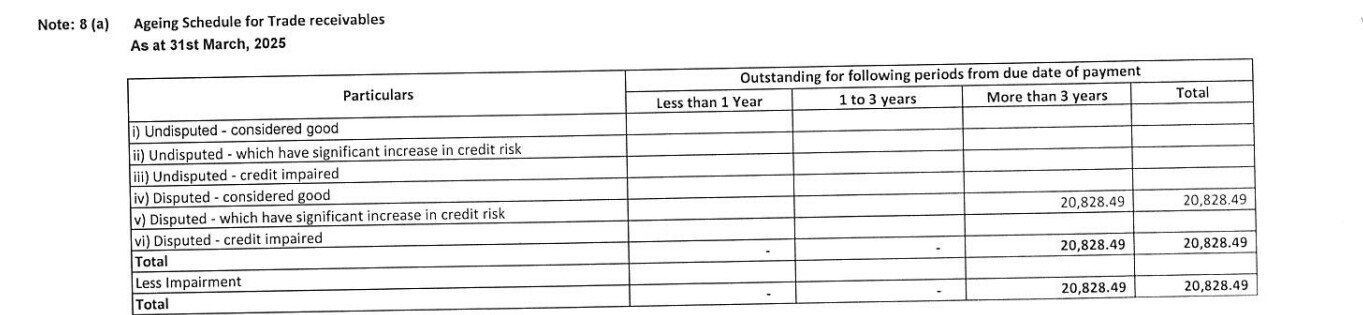
Full year FY25, was also an exception due to write-off of inventory and receivables in the acquired entities: Dolphin and Kandla.
The company promptly bounced back with a 41% EBITDA margin in Q1 FY26. Plus, recent commentary from management indicates two possible reasons for margin expansion due to Dolphin and Kandla.
Kandla:

Dolphin:

When analyzed on a segment basis, most of the businesses deliver 40%+ margins.

Company Sources
OK, so let’s put all this together and build a financial projection for FY26 assuming a 42% EBITDA margin:

Valuations
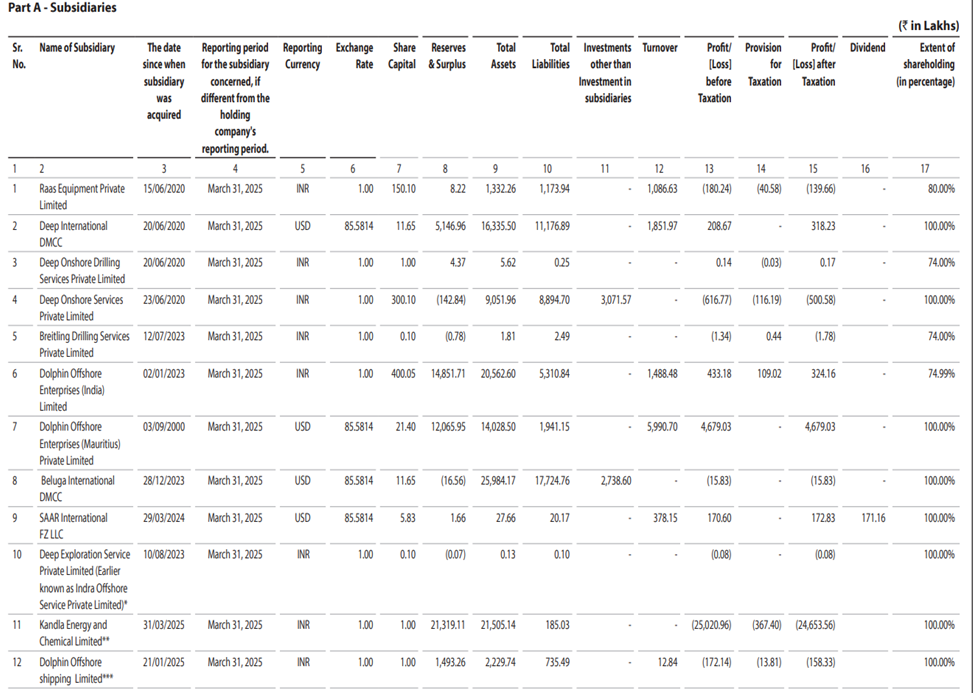
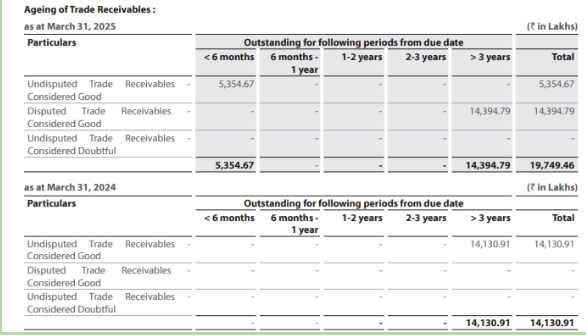
At a market cap of ₹3400 crore (a/o 28th July), the FY26 forward PE stands at ~21x which when combined with BV of 1.87 looks reasonable. However, the BV of 1.87x is inflated, if unadjusted for the high value of receivables owing to the Kandla and Dolphin acquisitions. Consolidated receivables owing to these entities total ₹363 crores and are suspect. Assuming a recovery rate of 30% amounts to ₹109 crores. Adjusting the same from the net worth leads to a price to book of 2.2x which is still reasonable. On the upside, ROCE will also improve when the bogus receivables are written off.
Risks
That said DIL is not without its own set of risks:
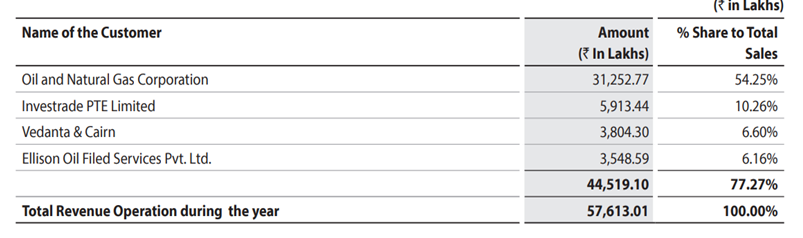
**  Client concentration from ONGC:** Although, DIL boasts clients such as Selan Oil & Exploration, Cairns & Vedanta, its primary client remains ONGC. This large exposure to a single client exposes it to extended payment cycles. Management commentary on exploration and upstream investments from ONGC’s con calls are a key monitorable. All that said, client concentration is a feature rather than a bug of this business.
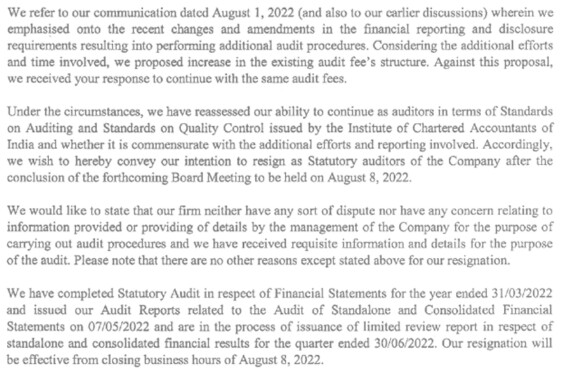
Furthermore, periodic disputes regarding contracts also demand periodic scrutiny such as the one below:

Excerpt from Congruence’s post on DIL
 Volatility in Crude and Natural Gas Prices: Even though DIL has repetitively stated that crude and natural gas prices have negligible impact on their revenues owing to fixed price nature of contracts; lower prices often affect upstream budgets, slows down project approvals and impacts rig utilisation. Recent examples include Saudi Aramco deciding to release 27 jackup rigs (6% of global jackup rigs supply) in H1 2024.
As such, this is a key monitorable. However, this risk is lower for Indian clients like ONGC, owing to Indian govts. push for exploration & production to curb high import reliance.
 Project Execution Risks: Oil & gas operations are inherently of low frequency-high-severity risk nature. These risks could include equipment failures, accidents, and environmental hazards, which often results in huge financial losses and damage to reputation.
 Uncertainty regarding the Russian-Ukraine war: Ukraine and Russia are among the biggest producers of natural gas and crude oil. An end to the war or a stop gap ceasefire will stop the artificial supply glut due to sanctions. This may lead to a fall in global crude and NG prices. Consequently, India will stop getting the discounts that are availed from Russia (although little) and will have to step up its exploration budgets and policies even more. All that said, any stop-gap negotiations in the Ukraine-Russia war is likely to lead to short term volatility in the stock prices.
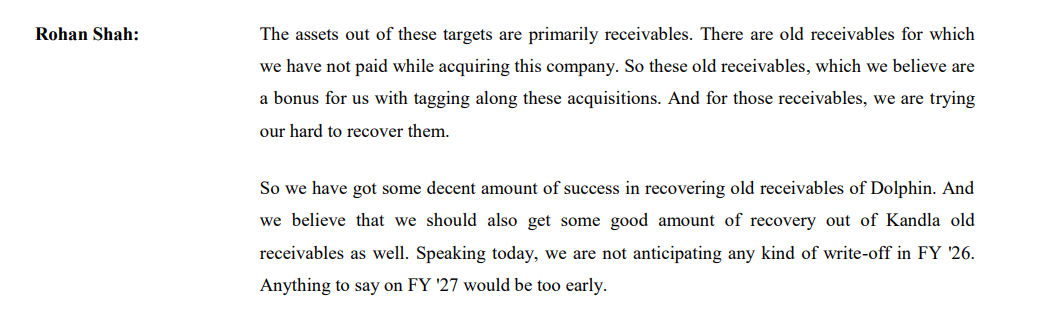
 Dolphin Offshore& Kandla receivables of ₹363 crs: This is more of an optionality than a risk. As of the FY25 AR, receivables attributed to the acquired entities was ~₹363 crs. Even a small part of the receivables if recovered, would lead to a huge cash influx for the company. Here’s what management had to say about the status and quality of the receivables:


Corporate Governance
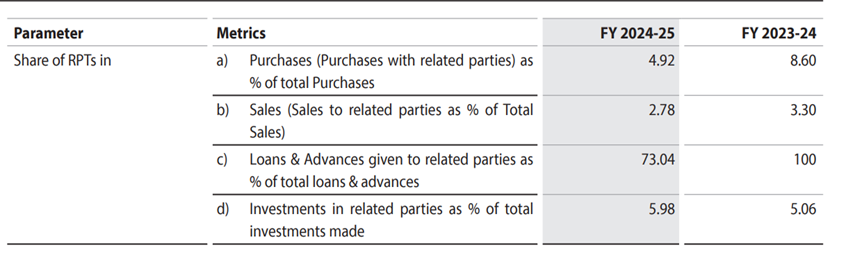
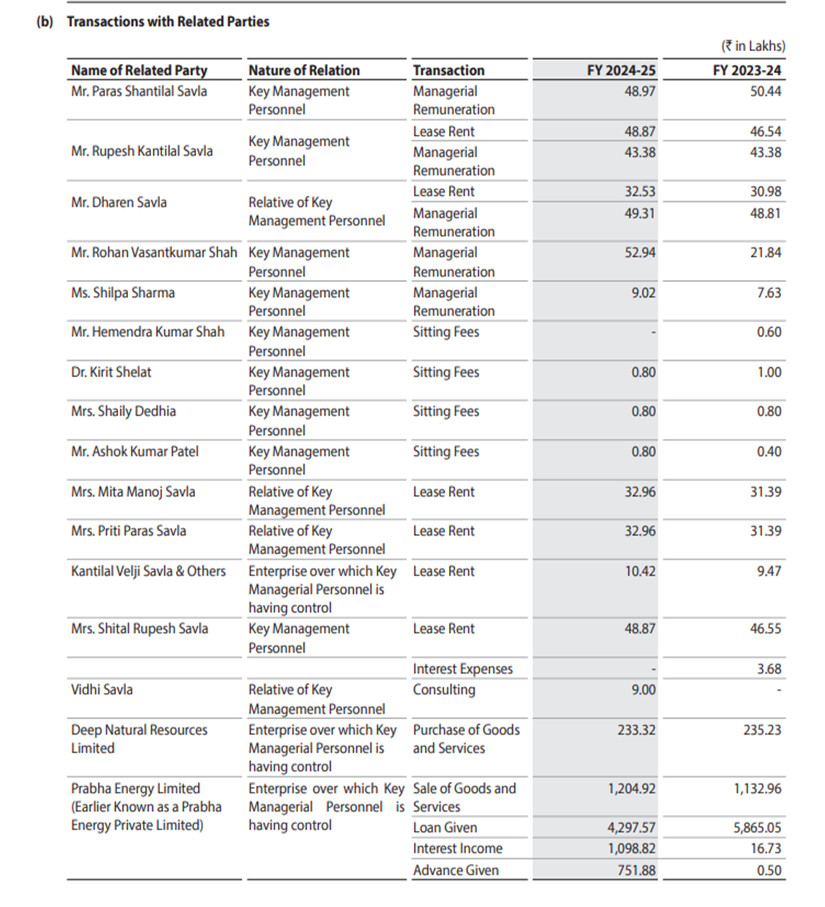
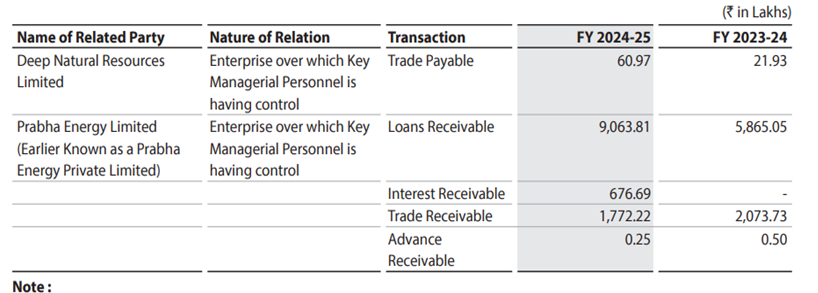
Related Party Transactions: The only material related party transaction worth flagging is a loan worth ₹91 crs given by DIL to Prabha Energy Pvt Ltd., which is a 53% subsidiary of Deep Energy Resources Ltd., where promoters privately hold a 68% stake. Also, the amount of loan has increased from ₹59 crs in FY24 to ₹91 crs in FY25 and carry’s a 12% interest rate.

Promoter Remuneration: The total remuneration drawn by promoters and their related parties (relatives and enterprises over which promoters exercise control) in the form of salaries and rent amounted to ~₹3.6 crs in FY25 vs. ~₹3.4 crs in FY24. This amounted to < 3% of the PAT of DIL for both the years. However, this is poised to increase in FY26 as the proposed remuneration has been effectively doubled as stated in the FY25 annual report:

This structure is proposed for both the promoters, Paras Salva and Rupesh Salva. Hence, promoter rem. from FY26 onwards might be a notable portion of the net profits, if PAT does not grow commensurately.
Board Composition: Deep Industries Ltd. board comprises 6 Directors, with 3 Independent Directors, meeting the requirement of at least 50% Directors being independent. However, the quality of these personnel may not be the best.

Few things which stand out include:
- All the independent directors seem to be Gujrati. Nothing wrong with that. But the fact that there is a high chance of collusion due to the community being close knit. A high likelihood of having personal associations rather than strictly professional one isn’t something that can be ruled out.
- As detailed in FY25 AR, page no. 22, Dr. Kirit Shelat is a 79-year-old retired IAS. Although, we stand to be grossly wrong his energy commensurate with his age may not allow him to be involved/scrutinize business affairs sufficiently. In FY25, he was proposed to be reappointed as an independent director for a second term of 5 years.
- Ms. Shaily Dedhia, 41 years of age, is a qualified company secretary with 11+ years of experience in legal and secretarial matters. She is also a director in Deep Natural Resources, Prabha Energy Ltd. and Dolphin Offshore Enterprises. Having directorships of related Cos has an off-chance for conflict of interests.
- We could not find a description of Mr. Ashokkumar Patel but discovered that he is also a director of Dolphin Offshore Enterprises (India) Ltd.
- All the directors attended each meeting pertaining to the respective committee which they were nominated to.
Contingent Liabilities: The total contingent liabilities for DIL on account of pending litigations or commitments amounted to ₹24 crs, which is < 2% of the net worth of the company and hence not material.

Insider trading allegations against promoters: Deep Industries promoter - Ratnesh Savla - was accused of insider trading by SEBI - making unlawful gains by trading in his company’s stock based on unpublished price sensitive information (UPSI) between July-Oct 2015. You can find more details of the same here. In another instance, the CBI had registered a criminal case against the promoters and ONGC officials on the charge of causing ₹80-crore loss to ONGC in awarding tenders to a private company.