Q4FY26:
•
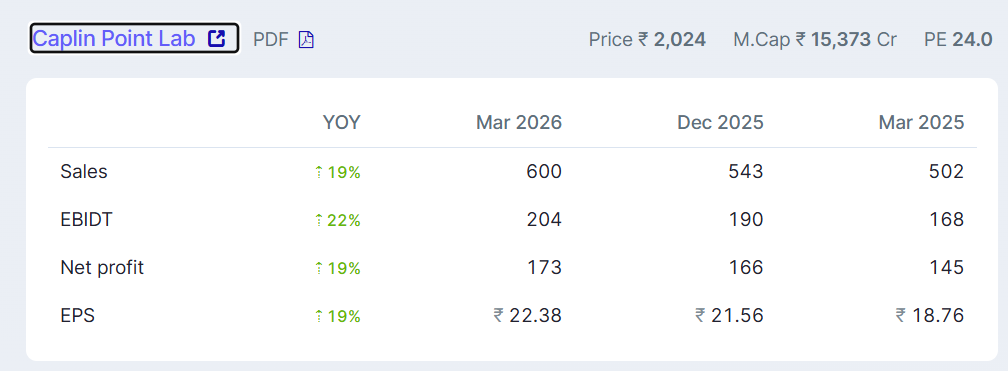
• Gross Margin remains strong, standing at 60.4% for 12M FY26 compared to 60.2% in 12M FY25. • EBITDA Margin for 12M FY26 increased to 38.1% vs 36.5% in 12M FY25.
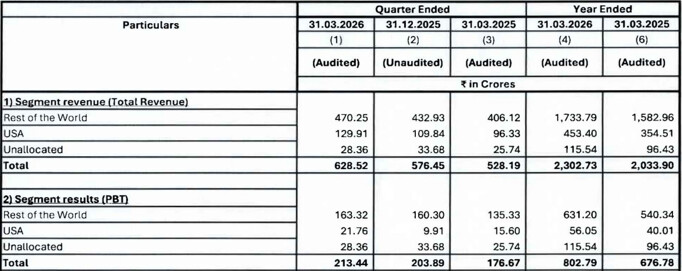
• Geographical revenue composition between Emerging Markets (Latin America & Africa) and US for 12M FY26 is in the range of 79% and 21% respectively. (82-18% in FY25)
Business Highlights for Q4 FY26:
Emerging Markets:
• Mexico Update – Company has received approvals for 25 products (PQ same) with a pipeline of 120+ products (100+ in PQ) to be filed within the next 18 months, from CPL, COL and CSL’s internal pipeline.
Company has won 11 General and Oncology products for Tenders supply in Mexico over the next 24 months, with a total value of $4 million.
Company working on building plans and approvals for constructing its own facility in Mexico for Dermatology and Oral Liquids products. This facility will cater to both North and South Americas.
• Chile Update – Company continues robust progress with tender and private market sales in Chile. Caplin already holds 135+ product licenses (125+ PQ) in Chile, with several more under review/pipeline.
Company has won 15 products for Tenders supplies over the next 24 months, with a total value of around $10 million.
Caplin will setup its own Quality Release Lab in Chile in the next 12-18 months, a move to increase profitability and speed to market for new launches.
• Company enters Brand Marketing in CNS segment in 3 markets of LatAm. Aims to extend to 2 more markets in 2027. Company has also launched a lineup of Branded Pre-Filled Syringe products in LatAm, a unique value addition to its growing portfolio.
• Caplin’s “China 2.0” strategy of partnering with Companies that have ANDAs/MAs approved in US and EU shows good progress. Through this partnership, multiple products have been filed across Mexico, Colombia and Chile, in addition to its first Biosimilar product filing in Central America. Company has signed partnerships with multiple Chinese companies, granting access to 110+ approved ANDAs/MAs (80+ PQ) in the US and EU. These products will be extended to all Latin American countries, under Caplin’s name.
• Oncology Unit update – Company’s new Oncology facility completes first Regulatory inspection successfully. Company has acquired several ANDAs in Oncology segment from 3rd parties. These products, along with internally developed pipeline products in both OSD and Injectable segments, will be submitted for approval across multiple markets in 2026/27.
• Vizag API Unit update – Caplin’s General Category API unit, to be used predominantly for backward integration, has received manufacturing license and has completed validations for 4 APIs already. Plans on track to complete validations for 12 more APIs before end of the year. First few DMF filings from this site will be done in 2026/27. Company aims to have its own API for around 60% of its Regulated markets pipeline in 4-5 years.
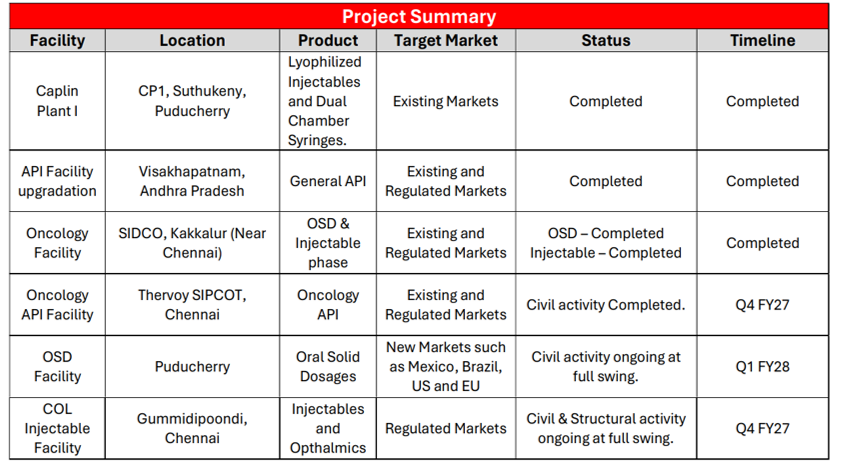
• Thervoy Oncology API unit update – Facility will be completed for validations by Q3-FY27. First DMF filings from this site planned in FY28.
• Company awaits approvals from several Central American countries for its own internally developed GLP1 products. Company plans to expand GLP-1 range of products to other South American markets in (post patents expiry) FY28.
• Amaris Clinicals update – Progress ongoing to increase the clinical trials to 3 studies per month from the existing 2 studies per month. All the products are from Company’s own internal pipeline.
US & Regulated Markets:
• Current split between B2B and B2C segments is 75% & 25% (Same as PQ)
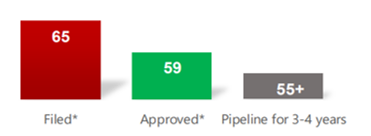
• ANDAs – 59 (54 PQ)
• Company’s development pipeline remains strong, with around 15 products likely to be filed in US within FY27, predominantly in Pre-Filled Syringes and Ophthalmic segments.
• CSL has filed 54 products (of which 32 are approved) in multiple non-US markets, such as Canada, EU, Australia, Mexico, Brazil, South Africa, Saudi, UAE etc. Plans in place to file 50+ products in these regions in the next 18 months. Meaningful revenue is expected out of these markets in FY27.
• Company expands capacity of IV Bag lines to 3X the current size, since multiple products have been approved in this niche segment.
• Company enters highly niche and complex Blow Fill Seal technology segment, with the first product development nearing completion. This segment will cater to Unit Dose Ophthalmics and Sterile Inhalation products, of which the company has a development pipeline of over 14 products. (Same as PQ)
• Company’s unique patent pending “Project Visual Integration” takes shape with a vision to Go Live within 3 months at CSL’s entire site. This project will ensure complete integration and monitoring of all critical processes making significant progress in Caplin’s continuous push towards Automation and Compliance. This project will eventually be rolled out across all Caplin group’s plants in the future.
• To cater the growing capacity needs at CSL, company’s COL-II facility construction will be completed by Dec ’26 to house 5 Injectable, Ophthalmic and BFS lines. Provision to add 3 more lines also included in the construction.
Update on Caplin Steriles USA Inc (CSU) - company’s own label in the US:
• CSU completes first full year of operations with around $11 million in revenue and 26.2% in EBIDTA, a sizeable feat for a “startup” entity. Company achieves profitability and self-sustaining cashflow within first year of operations.
(This was done without a de-growth in our B2B business, which shows our discipline in capacity utilization and ensuring consistent supply across segments.)
• CSU has launched 30 products till date (29 PQ) and plans to launch 15 (16 PQ) more products in the current year, a mix of injectable suspensions, Injectables in PP Vials and multiple IV Bags.
•
(Oncology API facility delayed by 1 Qtr. OSD facility by 2 qtrs)
•
(ANDA’s)
CONCALL NOTES:
• Mr. Ashok Partheeban is on the concall for the first time. Succession planning after C.C. Paarthipan well underway.
• In the next two-to-three years, we will have 17 injectable lines for USA and other regulated markets of the world.
• Our factories will be digitalized. Every machine that enters the factory, will have Video Master to make the qualifications easier and also for operational efficiency.
• The present world affects the following APIs, solvents, freight, and lead time to destination, currency swings, energy unpredictability. However, our model of keeping the goods next to the customer in the last 20-years has produced these compounding effects. Hence, we always keep the goods in our subsidiary warehouses for a minimum of six-months stock in the form of stock in the warehouse, stock-in transit, and work-in progress. This anti-fragile model has really helped us for the best fundamentals even in ROW markets of lead time in the last five years.
• In the next three years, we will have maximum products registered in the highly regulated markets such as USA, Mexico, South Africa, Brazil, Chile, and Colombia.
• We have been trying to buy a distribution company either in Chile, Mexico, or Brazil. That way, it will help take us to the nook-and-corner of the private markets of these countries. This one is not the mainstay for big companies; hence the focus of our business will be more on private markets in addition to the tender businesses.
• We will also focus more on R&D for hormone injection and inhaler areas, which are unique in the regulated markets.
• CHILE: Our private market is the most important in all the countries where we are. So, as Chairman mentioned, we have two candidates that we are looking to offer to buy. There are two solid distribution companies that reach nook and corners of the country in Chile. We have these two candidates because they actually have their own sales team, they have their own logistics team also.
So, we are currently doing bio-studies for more than 40-different products that are of very good margins and have a very few players in Chile.
• CENTRAL AMERICA: A peculiar thing about Central America and what happened during COVID was that a lot of independent pharmacies started growing a lot. And during COVID, what they basically did was they just started opening pharmacies wherever they could find a space because a lot of people were going out of jobs and they put their savings into the businesses. So, we made sure that all these individual pharmacies survived. And we did a recent enquiry into it, we found out that the shelf space for Caplin products is 41% in these individual pharmacies.
So, while we were talking about this with the board, we want to start a liquid manufacturing facility. And the reason for this is once we register all these liquids, our shelf space in these independent pharmacies will go from 41% to 57%.
We are also getting into Brand Marketing in Dominican Republic, Guatemala, and Nicaragua. We chose the central nervous system line where we already have bio-equivalence for more than 12- products, and we will be starting with that in September of this year.
So, in the whole of Central America, the business that we do, about 18% to 20% is institutional, which is government, the rest is completely private market. So, what we do have to do in Central America, in these countries, is you have to have two co-distributors at least so that they reach to those pharmacies that cannot fill in the everyday ticket sale, which is, let us say, we only do around about 300-products, a pharmacy that does, let us say, a sale of $150 per day cannot buy all the 300-products, though they have to buy through our co-distributors. So, in each of these countries, we have two or three strong co-distributors, they sell around about 10% to 12% of our sales, and the rest of it all is us going directly to the pharmacies, includes the chain pharmacies also.
• MEXICO: Mexico, our biggest market in Latin America so far, we have received 25- registrations so far. We participated in eight different products for a two-year tender, which we won all of them. We also participated in an Oncology tender with a partner of ours from China who gave us four different products and we won those products too. We plan to do a sale of around $4 million in the coming two quarters in Mexico.
We have already purchased the land in Mexico to build our first-factory in Mexico also, because we get a 16% advantage over price when you participate in the tenders in Mexico.
• USA: From a few years ago, we were a cash-burn EBITDA negative company. Today, we completed around INR 470 crores with EBITDA that sort of mirrors or comes very close to the parent company’s numbers, which have been benchmarked amongst the companies of our size.
We are getting into uncharted territory for Caplin Point as we get into some of these complex products and technologies.
In addition to the US, we will start seeing some meaningful revenue out of non-US markets in the coming few years as well because we have already filed 54-products globally in non-US markets such as Canada, Europe, Australia, South Africa, etc., we will start to see some progress there.
A lot of people were very sceptical about Caplin launching our own label because our B2B business was doing so well, people were a little bit sceptical saying that this might distract our partners and this might probably show some degrowth. But very happy to say that in our first full year of operations, we have nearly touched INR 100 crores in revenue. We were about 11 million plus in revenue with our own label, and we have done this with no degrowth whatsoever in the B2B business as well.
Our US business is transitioning from a phase of foundation building to one that is scaling and growing in depth. So, with a very strong pipeline, expansion of capacities, entry into complex technologies, etc., we are very well positioned for sustained and profitable growth in the years ahead.
We can see another 25% to 30% next year on the overall Caplin Steriles business. When it comes to our own label, we did close to INR 100 crores. So, the idea is to touch or go very close to INR 200 crores for the coming year.
We have an order book that is full for another six months almost. And to an extent where some of these lower margins, very high-volume products, we are not even taking them onboard. So, I think we are certainly on track to see a very strong next year for CSL, in fact, very strong next few years for CSL with all the capacity coming through.
Around 90% of all the growth that you have seen is from the products that were already launched in the market. This is actually a good statistic as well, because when most other companies, I think are somewhere in the region of their average earnings per ANDA, I believe, if I am not wrong, is somewhere around 800K to a million, whereas ours is more than 50% higher itself. And of all the products that we have approvals for, we were just discussing about this yesterday, literally just one product is the one that we have technically taken off the market, because there were no sales. Every other product continues to show good sales, and we continue to receive repeat orders.
The EBITDA of CSL for the financial year 2025-26 is INR 142 crores, which is 30%, as compared to INR 102 crores last year, which is 27.9%.
• For any inorganic opportunity, in fact, we are waiting in the wing.
And see, going for the sake of acquisition, I would not advise us to go for actually acquisition without going for a meaningful acquisition. That will be a vanity. I do not think it is advisable.
• There are hardly three or four companies who would have 16 or 17-lines of injectable actually in India.
When we complete all these injectable lines, we are aiming to go for US and the other major markets. That means that is a great opportunity, which will open up in the form of not only for our own products to be sold in US, but also in the form of CMO.
• The next three to five years is going to be the best period for Caplin Point.
• Generic business is based on supply and demand. We know we have an advantage of keeping the goods actually in the warehouse. If the profitability is not there in our sales, we will not sell. Selling for the sake of selling does not make any difference to the company.
• The Latin American growth will start flourishing actually after we complete the registrations, mainly in the markets like Mexico.
• Reason for Latin America big sales growth this quarter: So, we did supply a lot of material close to about INR 50-55 crores in the quarter to the Salvador. The tender was valued at about 16 million, and most of the parts have gone from India. That is the reason this growth in Latin America is showing a better than normal growth.
• We are happy to be anywhere between the 100, 110, 120-days, and that is a sweet spot for us in terms of receivables.
You can imagine that even if we do see another five days or 10-days increase in the future, we are going to be okay with it, because when that money comes in, more often than not, it comes in at a higher exchange rate compared to what it was previously, right?
So, we are not worried about that. Anywhere between, like I said, 100 to 130-days even is probably still okay for us going forward.
• Our history of writing-off debts has been virtually negligible and close to zero.
• CURRENCY STATUS OF MAJOR MARKETS: Guatemala is very stable. There is nothing in the form of fluctuation in the currency. And coming to Nicaragua and Honduras, maybe slight fluctuation in the form of 3% to 4%. The rest of the markets are like El Salvador and then Panama, Ecuador, the currency is dollar. So, it is not going to create any issue. Costa Rican currency also stable. Chile also for the last four, five years, the currency is stable.
• We need to be patient for the next 12-to-18 months, actually, because there is a period of stabilization in pharmaceuticals.
• The moment we understand that the price of a material which we bought is higher, we also actually design the price at which we have to sell the product in the market. That is why we do not face any major issues, to be honest with you.
THINGS TO TRACK
• CAPLIN STERILES PROGRESS: NEW PRODUCT LAUNCHES; LICENSING DEALS; MARGINS GOING AHEAD.
• MEXICO, BRAZIL AND CHILE MARKET PROGRESS
• NEWER CHINA GROWTH INITIATIVES PROGRESS (BIOLOGICS/INSULIN, CHINA PARTNERSHIP, SPECIALITY CHEMICAL)
• ONCOLOGY DIVISION PROGRESS
• EXISTING LATAM MARKET GROWTH PROGRESS
• GLP-I PRODUCT PROGRESS
• ANDA ACQUISITIONS
• CURRENCY STATUS OF MAIN CENTRAL AMERICAN MARKETS