
Malabar has invested in SBFC. Also Amansa. This is a segment where I trust the judgement of such big names. Suggest you to hear what Mr Nagar from Malabar has to say about SBFC. Also the jockey (Aseem Dhru) comes across as someone who will create shareholder value. The stock has given 0 returns since listing but sales and profit growth is upwards of 30%
1 Like
The stock price has limited history, hence return on stock price is yet inconclusive.
I agree with your views and will be helpful if you have any link of that interview by Mr. Sumeet Nagar.
My conclusions are slightly longer term oriented.
In the words of Dollars Bill I can say that “I am not uncertain”
Navigating the Emotional Roller Coaster of Bear Markets
Bear markets are a roller coaster of emotions. At times, it’s hard to even recognize whether you’re in one or not. This uncertainty arises because bear markets don’t always follow a single pattern—they come in various forms. Consider the sharp one-month decline during the 2020 COVID-19 outbreak, marked by sudden rebounds. Amid the panic, some market participants were calling for markets to be shut down(link), only to later dismiss it as a temporary event. Or think back to the slow and grinding decline of 2017-2019, where the market slipped quietly and relentlessly.
Bear markets or corrections are often selective in nature. Not all stocks fall equally—some segments are hit harder, especially the ones that led the previous bull run. Experiencing a bear market is a unique journey, depending on when you entered. Those who invested recently may see their portfolio value drop like pins in a bowling alley. Long-term investors, on the other hand, experience a different kind of pain: their wealth erodes, and they realize they haven’t fully capitalized on the prior bull market either.
Investing during a bear market brings its own set of complications. If you invest as prices fall, it’s nearly impossible to time the bottom. You might witness prices drop even further after you buy, leaving you disheartened. And if you did time it right, there’s often regret for not having purchased more. After making an investment, it’s easy to second-guess yourself when you see the stock drop the very next day, making you feel foolish for not holding out longer.
During these times, you may find yourself doubting everything—your analysis, business models, the compelling growth stories, and the next hot sector that’s suddenly out of favor. It’s disheartening to see the market’s brutal price action slicing through the narratives you once believed in, leaving you feeling disillusioned and questioning your decisions.
But as seasoned investors often say, “this too shall pass.” If you can endure the pain and stay committed to your investment strategy, you’ll emerge stronger. It’s in these challenging times that your resolve is truly tested, and your ability to maintain discipline can set the foundation for future success.
4 Likes
We keep asking for more trains and tracks. Perhaps we should first ask how much capacity we are already wasting.
Ever wondered why a railway platform is always chaotic?
People run helter-skelter just before a train arrives. Passengers who have just got off are still standing around, calling relatives and trying to figure out where to meet them.
The reasons are simple — and surprisingly similar.
We know where we are going, but the system doesn’t always tell us how to get there efficiently.
And that small problem points to a much bigger question:
«How much more capacity can Indian Railways extract from the network it already has?»
We usually think of railway capacity in terms of tracks, trains and platforms.
But capacity is also lost through thousands of small inefficiencies.
Start With the Passenger
IRCTC gives you your train, coach and berth.
Suppose your ticket says S5, berth 42.
Where is S5 going to stop?
Which entrance is closest to it?
Which staircase or foot-over bridge should you use?
Indian Railways has coach-guidance systems to provide this information. The problem is that the information isn’t always available early or clearly enough for the passenger to act on it.
So the train approaches, the coach-position boards appear, and suddenly everyone starts running.
Why not simply send the passenger a route?
Train 127XX — Platform 4
Coach S5 — Marker 18
Recommended entrance — Gate 2
The railway already knows much of this information.
The improvement is to turn it into a passenger-specific instruction.
The Same Problem Exists After Arrival
A passenger gets down.
A relative is waiting outside.
Where do they meet?
Near the escalator? The main entrance? Which exit?
The usual solution is a phone call.
“Where are you?”
“Outside.”
“Outside where?”
Instead, major stations could have clearly marked arrival meeting zones.
The passenger simply says:
«”I’m at Meeting Zone B.”»
This separates two types of movement that currently interfere with each other: people trying to leave the station and people waiting for someone to leave the station.
Escalators are infrastructure. Meeting zones are flow management.
Small Delays Become Big Delays
Now consider the train itself.
A train rarely loses an hour in one dramatic event.
It loses small amounts of time repeatedly — at stations, junctions, platforms and congested sections.
A few minutes here and there can accumulate significantly over a long-distance journey.
So railway efficiency isn’t only about making trains faster.
It is about reducing unnecessary waiting and improving the movement of trains through the network.
This is where signalling matters.
Automatic Signalling: The Simple Idea
Automatic Block Signalling divides a railway into multiple signalling sections and allows trains to follow each other more closely while maintaining the required safety margins.
The important question isn’t whether a block should be exactly 5 km or 15 km.
It is:
«On congested routes, can we safely reduce the spacing between trains and extract more capacity from the same track?»
Signalling alone cannot solve everything.
Junctions, platforms, terminals, rolling stock and timetables can still become bottlenecks.
But capacity isn’t determined by track length alone.
It is determined by how efficiently the entire system uses that track.
The Revenue Opportunity
Indian Railways operates with a very thin financial margin.
In FY2024–25, its operating ratio was about 98.22% — roughly ₹98.22 of working expenditure for every ₹100 of traffic earnings.
So incremental efficiency matters.
Now look at the waiting list.
If a major route consistently has passengers waiting for confirmed seats, the railway already has a very clear demand signal.
Instead of immediately thinking only about permanent additional infrastructure, could additional services be introduced when demand is high and capacity permits?
Not necessarily as permanent trains.
Think of them as a flexible supply response to known demand.
If passengers are already willing to travel but cannot get a confirmed ticket, additional available capacity can convert some of that unmet demand into actual journeys — and additional revenue.
Of course, another train requires rolling stock, crew, maintenance, energy, terminal capacity and, most importantly, an available train path.
So this isn’t about simply adding trains everywhere.
It is about finding where demand exists and recoverable capacity exists at the same time.
The Bigger Idea
Put these seemingly small improvements together:
Better passenger information
→ less scrambling and smoother boarding
Better arrival meeting areas
→ less congestion around exits
Better signalling and operations
→ more efficient use of existing track
Flexible additional services
→ more passengers served when demand exceeds available capacity
None of these requires a completely new railway network.
And that is the counter-intuitive part.
When we talk about expanding Indian Railways, we naturally think about more tracks, more trains and more platforms.
We should.
But we should also ask:
«How much railway capacity do we already have but fail to use efficiently?»
The cheapest additional capacity may not always be the next kilometre of track.
Sometimes, it is the capacity hidden inside the network we already have.
2 Likes
What doesn’t kill you makes you stronger: a quick view on the Nifty correction
If you had been a Rip Van Winkle and slept through the last 2 years, you would find the Nifty at approximately the same level as in Jan’24.
Corrections are part of the market, just like life with its ups and downs. In fact, the quantum of correction in the market currently is the same as the lows we witnessed in Mar’25.
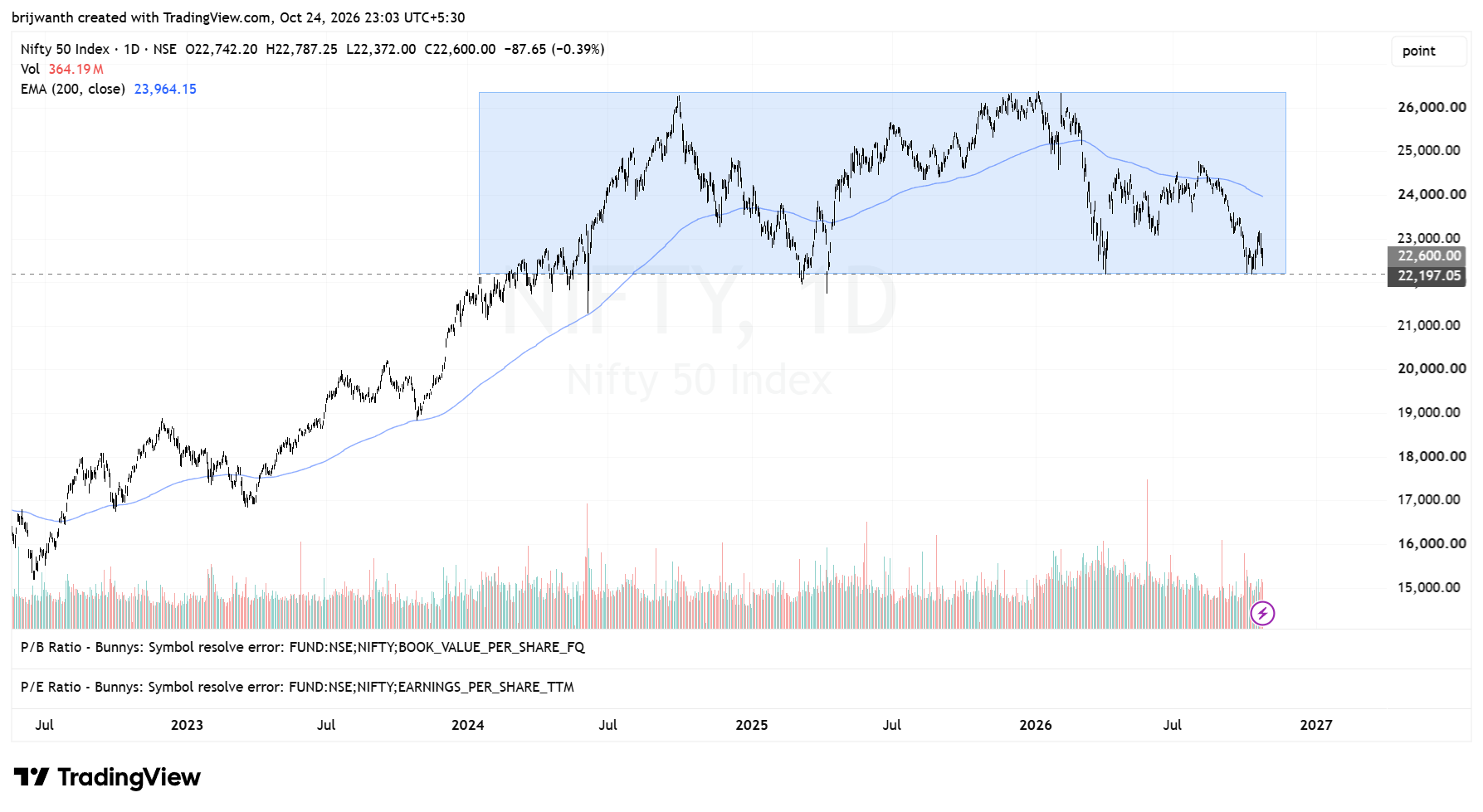
Nifty 50 over the last ~2 years: the index is back near Jan’24 levels, so two years of earnings growth have gone into the price without any return.
However, this correction doesn’t have any recent parallels, but if you try to find a good rhyming pattern, it does have some parallels with the grinding markets of 2010–13, after the post-2008 recession recovery.
It also matches well with June 2015 to May 2016 (the post-NDA-I fall), but I believe it has more in common with 2010. My reasons:
- Limited fiscal decision-making, leaving an overburdened monetary policy to carry most of the load.
- Policy bandwidth diverted by domestic controversies (NEET, etc.) rather than developmental priorities.
- A strong El Niño with weak inflationary controls (a temporary issue, but it still has an effect). It happened in 2009 and is happening in 2026 as well.
- An unstable world scenario then, with the PIGS and the Eurozone debt crisis. Today, it is clouded by unpredictable US trade policy and 2 active conflict zones.
- This time we also have the AI boom drawing investments from around the globe into itself, just like the Dotcom boom.
How I see it moving
Predicting is fickle, but if there are any indications, we should read them. The uncertainty around US policy and the 2 conflicts is likely to persist till 2028, though the mid-term elections may surprise everyone. markets will react to every policy signal, with no country exempt. India remains exposed to US trade actions aimed at a domestic voter base.
On the 2 conflicts, a near-term resolution looks difficult, as there is no credible mediator to bring both parties to the table. US policy remains unpredictable, and in West Asia, Iran’s fragmented leadership, with the IRGC and the political establishment running parallel power centres, complicates negotiations further. I do have some hope for Ukraine and Russia, as I see some funding lapse from both the EU and the US, along with Russia’s weakening resolve. Having said that, the Ukrainians have been able to turn the tide despite being largely underfunded for the last 2 years. In the worst case, both conflicts move from Page 1 to Page 4.
History doesn’t repeat, but it does rhyme. Two pictures to compare: September 1999 and June 2026.

No tide can run forever, so predicting the bust is a no-brainer; the question is its timing and nature. My guess is that it happens only after the public listing of 1 or 2 AI giants, if they fail to monetize; otherwise, the game can go on for a long time in private hands. The key takeaway, as with the Internet companies, is that a few AI giants may emerge after the shake-out and create decadal wealth. Amazon, Google (post-bubble listing) and Meta are the historical examples.
Coming to our own markets, I hope policymakers act early on the threats we face, both domestic and international, and address them before they become too big to manage.
So sit back and relax. Happy to hear differing views.
Disclosure: Personal views only. This is not investment advice or a recommendation to buy or sell any security. Companies mentioned are historical examples.
1 Like
Note to myself : post Dt. 06/11/2026 - 12:00 PM - delayed reflection due to moderators approval pending
A fall of 6% in NASDAQ overnight is a shook-up at best and a collapse at worst. But I have 2 points I would like to remember.
-
Markets seldom behave linearly, the returns collapse and then come back equally ferociously. It’s our job to allocate prudently in good stocks and pray that the thesis plays out or returns come (even if we are wrong).
-
Decoupling is a theory well past prime. Just because a earthquake didn’t occur near our shore doesn’t mean a tsunami won’t hit us. Those who have watched CNBC of 2007-08 era know very well that decoupling hasn’t played and we were hit too despite assurances of nothing to do with subprime mortgages.
Video link of Mr. Sameer Arora reminiscing https://www.facebook.com/reel/1166465068477825
corollary - even if we have nothing to do with AI boom, we will be still be effected albeit little lesser because we didn’t participate in it. Markets have proven the Finance Minister’s remarks from four years ago wrong. Decoupling doesn’t work, whether we like it or not.
- sayonara
2 Likes