There has been some speculation on traders shifting away from NSE, etc. I was wondering the accuracy of these reports, and did a mid month check on BSE volumes over the weekend. Since BSE had 1 expiry more than NSE last weekend, decided to wait till Tue EOD to complete the check. As of Tue night, 13 trading days have completed with 3 expiries on each exchange.
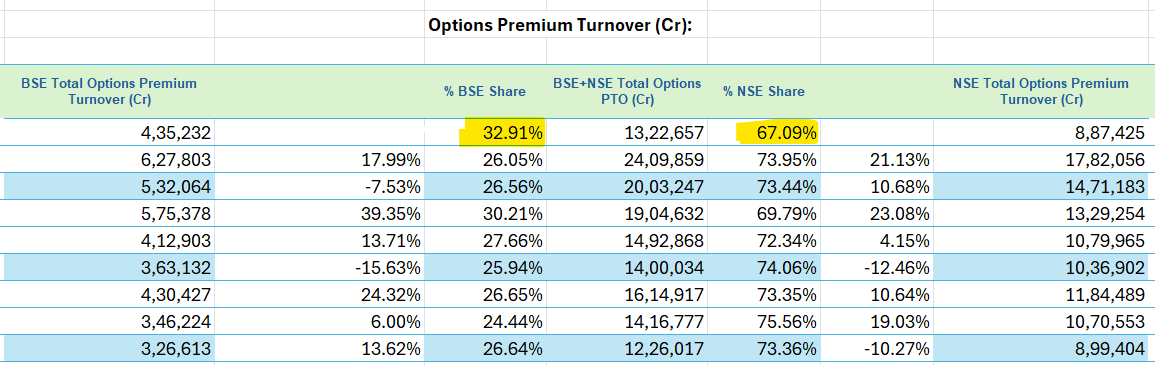
PTO market Share:
BSE market share seems to have crossed 30% to ~33%.
This share will go higher this month, since BSE has 2 expiries upcoming, and NSE just 1.
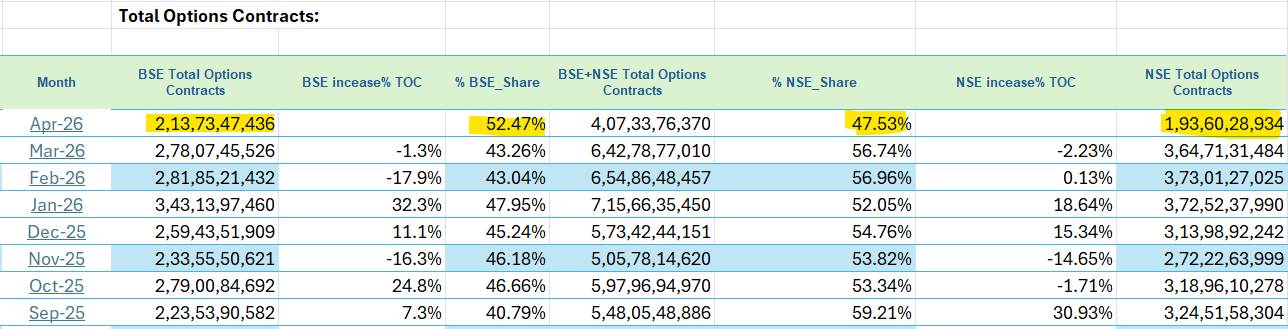
Is the drop in volume due to external factors like STT hike? Or reorientation by some traders for the new FY.
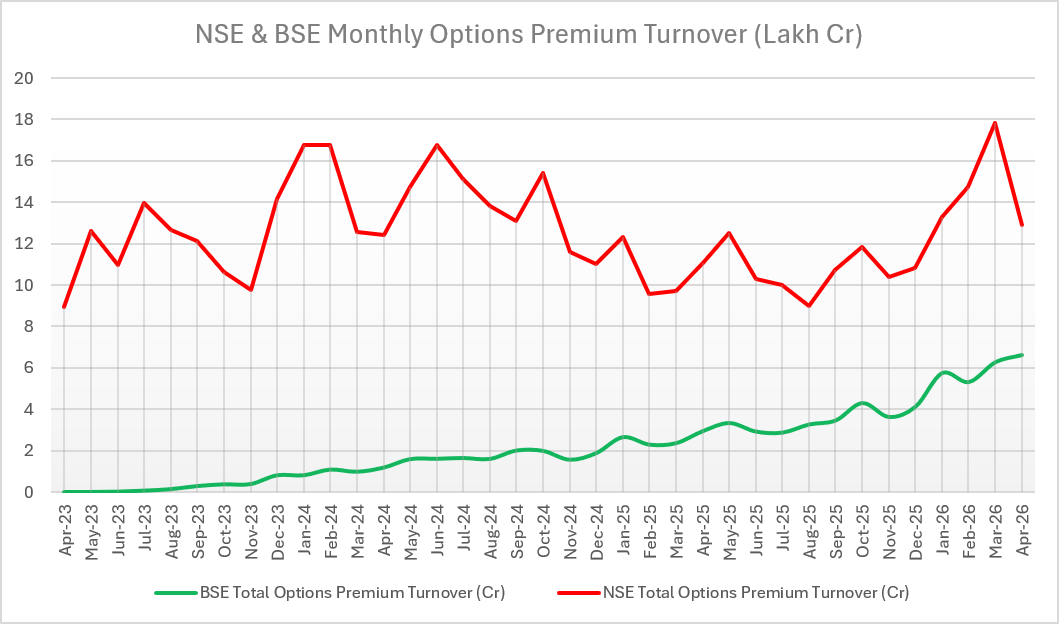
Again like previous writings, the options data needs to be seen over a 2-3 month time period to establish a proper trend. But Q1 seems to be signaling some shift away from NSE. Will BSE benefit is a different question?
And on Future Volumes - That spike in March end/April 1st week of daily volumes to ~1K Cr did not sustain and is now back to the 200-400 Cr levels. Also revenue wise this is not adding anything to top/bottom line.
Edit: Seems the trend has held till end of the month. BSE PTO market share is ~34% (6.6L Cr), whereas NSE has dropped to ~66%, but major change is BSE Total Volumes share is ~55.3% up from 43.2% previous month. BSE had an additional expiry this month, this did impact. BSE revenue from FnO segment this month will be ~Rs.431Cr.
On futures contracts, NSE charges 0.00183% (₹1.83 per ₹1 lakh), while BSE levies no fee. In options, NSE charges 0.0355% (₹ 36 per ₹ 1 lakh )compared with BSE’s 0.005% (₹ 5 per ₹ 1 lakh) on stock options.
BSE has lot of scope for revenue increase. Can easily double without dent on volume.
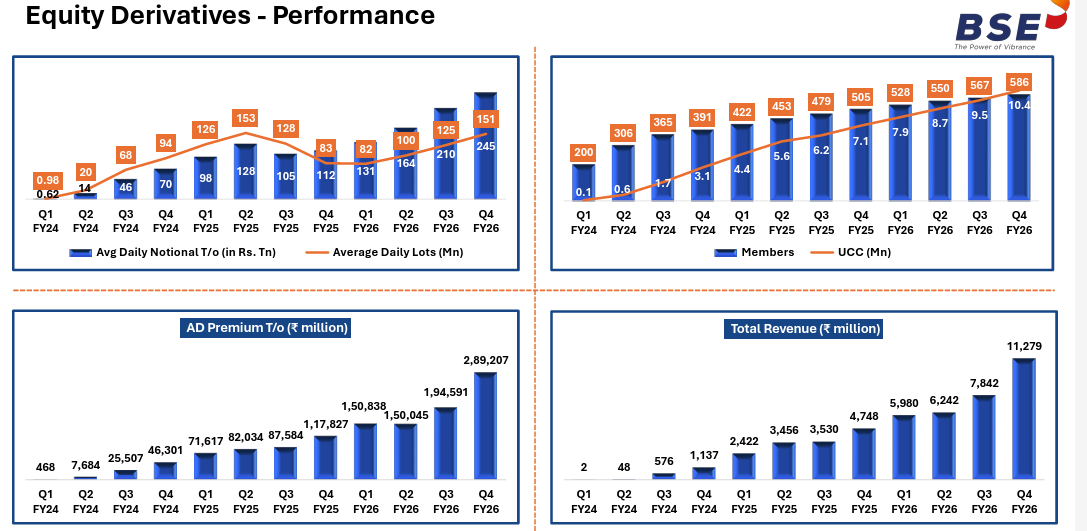
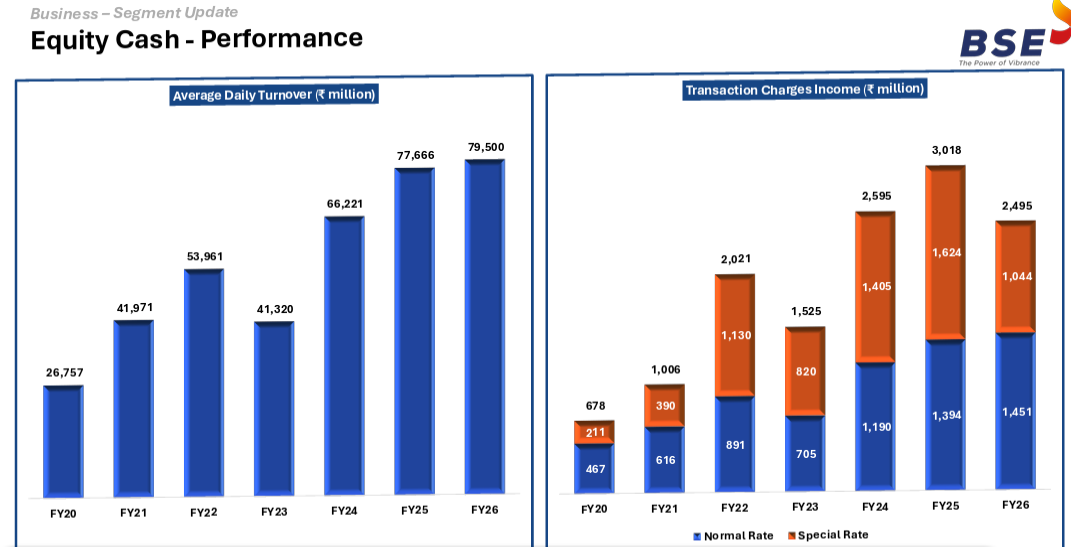
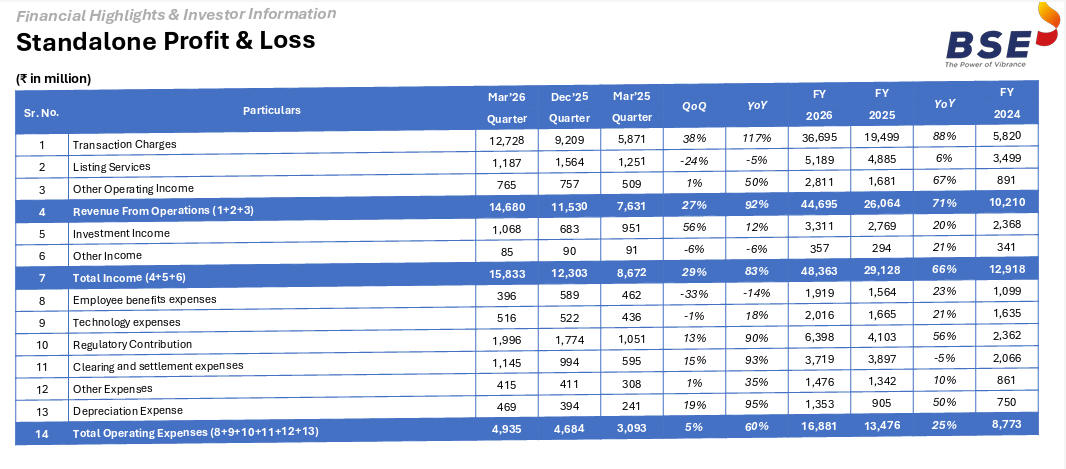
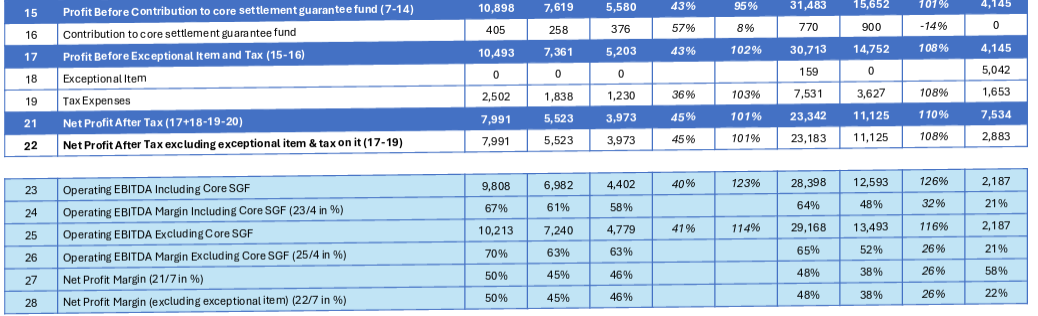
Numbers are very much in line with the expectations with standalone revenue at about 1500 Crore and profit after tax at about 800 Crore for the quarter.
The revenue from equity derivatives segment has exceeded 1100 Crore. See the details below:
Now that 2026 is behind us, we have a new benchmark of about 1500 Crore quarterly revenue and about 750 Crore quarterly profits. At the current market cap of 161K Cr, BSE trades at a normalized forward PE of about 53, which is very much reasonable for a business that is growing at this pace - I see further scope for valuation growth as the BSE has plenty of room to grow pricing in its derivatives business and hopefully penetrate into the stock derivatives and then into the currency and commodity segments.
I’m not sure why the dividends are only Rs. 10 per share as the business doesn’t need significant amount of money that they need to reinvest for growth - it would be a good question to ask management.
On the balance sheet side - the growth in fixed assets is understood to be on account of investment in its office building upkeep , co-location racks and technology upgrade - which are all in the right direction.
Looking forward to another good year with BSE and i would expect them to post a minimum of 6K Crore revenue and 3K Crore profits during 2027.
Options growth is on single digits, so FY27-Q1 will be close to OR a little higher than FY26-Q4 results. We will not see 25-30% growth in the options segment this quarter. The other revenue streams will need to perform much better for any +ve surprises. Options market seems to be stabilizing now, with a minor leaning towards BSE.
Q2 conf call will need to be tracked closely to see progress on other fronts, since mgmt has said they are deploying the profits to other groom other potential revenue streams.
Per me the market focus is shifting to very much on NSE IPO to value BSE. when does NSE file its DRHP? And the entire DRHP approval process to possible listing by Diwali timeframe (Nov 1st/2nd week).
Thank you for sharing the insights and tracking the business. Do you think BSE has now reached a self-sustaining liquidity threshold in derivatives, or is the current market share still vulnerable to reversing back to NSE?
In my understanding the key question is:
Would BSE continue to gain market share from NSE?
Even if industry growth is only single digits, BSE can still grow faster if market share keeps shifting.
Ofcourse, this is a open business, so nothing is guaranteed. BSE and NSE can take share from each other. BSE advantage is lower pricing, NSE advantage is early mover network effect. With NSE listing on BSE, the network effect might get diluted to some degree, i think (could be wrong).
I was not tagged, so did not see the message earlier.
Q1 is OKish. Q1FY27 FnO revenue just cross the Q4FY26 revenue, and is at 1,155Cr per my model. Its just 2.4% up compared to Q4FY26. YOY it is ~93% higher than Q1FY26, but that base was low.
Overall Options PTO BSE has ~30% market share in Q1. After April month, when record PTO was noted, the PTO has dipped each month after that. NSE has retained the PTO. Seems growth in PTO will moderate or even stabilize.
looks like new rule started from 1st July is hurting options volume. New rule is about prop firms financing by banks/nbfc. & Effect of it will be seen gradually over next 1 year. However, PTO of 2nd July was lower compared to previous month data. So, need to watch for upcoming expiry data whether same trend contines or that was 1 off.
As per reports - Prop trading makes 50% volume in options segment. So this new rule can dent on voulme.
Yes, the RBI notification on funding related to securities markets, would have an affect. Extent of Direct impact will only be known later, maybe in next few months.
There are two ways to look at similar regulatory actions:
Short Term - Immediate Impact on volumes, and in turn the revenue for the exchange. In many cases this is -ve and has a immediate -ve impact on revenue earnings. Market maybe refelcting this scenario for the BSE stock price + the NSE listing impact
Longer Term - Such regulatory humps (unless fatal) are a good way to remove excess unwanted slop in the system. In a way these actions, can make companies (hoping for BSE also) Anti-Fragile, i.e. ability to survive an event beyond their control and emerge stronger.
BSE’s diversification into mutual funds, SME listings, depository investments, and index derivatives ensures its business model is insulated and fiercely competitive well beyond NSE’s public debut.